
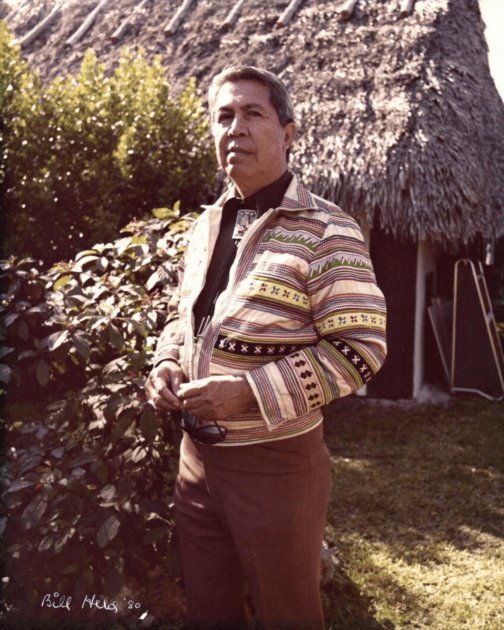
William Buffalo Tiger, Chief of the Miccosukees, 1920-2015.
The State Department’s recent report alleging Cuba’s support for left-wing “terrorism” in the United States signals a chilling escalation, as the Trump administration draws up enemy lists for a revived Red Scare. Ultimately, the document reads as an unwitting confession of U.S. foreign policy failure. While the State Department celebrates how mid-century McCarthyism crushed the “old” communist left, it inadvertently exposes Washington’s inability to contain the “new left” and modern movements condemning U.S. aggression toward Cuba. Even after decades of suffocating sanctions and a relentless blockade, Cuba endures as the primary driver and “spiritual hub of the Third World revolution,” according to the report. Crucially, as Charisse Burden-Stelley points out, the report exposes how the U.S. ruling class racializes domestic dissidents—framing internal struggles for liberation as foreign-directed subversion by an external communist menace. The report frames Black freedom movements in particular—from the Civil Rights Movement and Black Power to the George Floyd uprising—as especially susceptible to Cuban influence, as if racial terror were conjured by outside agitators rather than the white power establishment itself.
This racialized paternalism extends beyond Black liberation to Indigenous resistance as well. While the focus is primarily on Black and explicitly communist and socialist organizations, Indigenous peoples are mentioned twice in passing as part of the supposed Cuban plot to overthrow the United States. The first comes from a speech by William Kunstler, an attorney for the Wounded Knee Legal Defense/Offense Committee and National Lawyers Guild (NLG), who mentions AIM among the “revolutionaries” he defends to keep them “functioning” on the streets. The second involves NLG lawyers traveling to Standing Rock during the Indigenous-led movement to stop the Dakota Access Pipeline in 2016. Both instances mention Indigenous movements only through their representation by non-Native and mostly white allies. The implication, as was the case with the lawsuit against Greenpeace’s role in the Standing Rock movement, is that Indigenous peoples cannot lead their own movements or form their own strategies but are merely passive vehicles or unwitting dupes of outside agitators.
Yet this dismissive narrative erases a long history of Indigenous nations strategically turning Cold War anxieties against Washington to assert their own sovereignty. In 1961, as Cold War anxieties gripped the continent two years after Fidel Castro took power, a small tribal nation deep in the heat of the Florida Everglades saw an unexpected pathway opening. For William Buffalo Tiger, leader of the Miccosukees, the crisis was existential: federal bureaucrats refused to acknowledge his people as a distinct nation, lumping them under the umbrella of the larger Seminole tribe and leaving them without a scrap of legally recognized land or the authority to rule themselves. Every appeal to Washington met a wall of indifference. So he pursued a daring action.
A legal advisor pitched a bold strategy: force Washington’s hand by securing recognition from a foreign power. Partnering with his friend Wallace “Mad Bear” Anderson—a fierce Tuscarora nationalist—Buffalo Tiger assembled ten Miccosukee delegates. Together, they drove to the tip of Key West and boarded a commuter plane bound for Havana on what Buffalo Tiger publicly framed as “a goodwill delegation.”
In Cuba, officials chauffeured the group through capital streets, flanked by guards cradling submachine guns. On their second day, they joined a sprawling crowd in a public square, listening as Fidel Castro thundered through a six-hour speech translated by an interpreter. Afterwards, Castro met the delegates face-to-face, leaning in to absorb the story of their struggle. “Remember, when you have no place to live, come here,” Castro said. He offered them tracts of Cuban land and officially recognized the Miccosukee as a sovereign nation.
When the delegation returned home, Buffalo Tiger’s phone rang endlessly. Castro’s handshake had panicked Washington. FBI agents grilled the delegates about the revolutionary government. Yet the gamble paid off. Terrified of the diplomatic embarrassment of a small tribe allying with Havana under their noses, federal officials fast-tracked the tribe’s petition. The Miccosukee gained official federal recognition the following year.
The victory was nearly unthinkable against the backdrop of the era. Under the banner of Indian termination policy, Congress had spent nearly a decade stripping 109 tribes of their legal status, tearing up historic treaties, and throwing millions of acres of tribal land onto the auction block. In the grip of Red Scare mania, McCarthyite politicians vilified reservations as dangerous, “un-American” communes. They argued that dismantling communal tribal lands was the only way to assimilate Indigenous people into the capitalist market—a strategy designed to pass those lands directly into white hands. They attacked collective tribal structures as inherently socialist threats, weaponizing anti-communist hysteria to mask blatant land grabs.
Buffalo Tiger’s trip to Cuba initiated a long-standing relationship between Red Power activists and the Cuban revolution in subsequent decades. Consequently, the state’s persistent red-baiting of Indigenous activists as communist dupes sought to delegitimize a burgeoning radical sovereignty movement. The lesson, however, is that Indigenous diplomacy and radical internationalism have been effective mechanisms to leverage Indigenous treaty rights and sovereignty internally within the U.S. empire. It has also exposed the very thing that the authors of the recent Cuba report fear most: a budding consciousness wherein Indigenous peoples within the imperial core increasingly recognize their strength and power not by aligning with their masters, but by building active solidarity with the poor, working classes of the global majority who are fighting to build alternatives to the ravages of global capitalism and U.S. imperialism.
Ultimately, whether in 1961 or the present day, the ruling class’s playbook remains unchanged: treat imperialism and colonialism as non-issues and frame domestic resistance as foreign subversion. By pathologizing Indigenous sovereignty and Black liberation as products of external puppet masters, the ruling class attempts to deny the legitimacy of internal struggle—and, more importantly, conceal their unwillingness and inability to offer a viable alternative beyond the exploitative machinery of racial capitalism and imperial control. Yet history demonstrates the exact opposite. Far from being passive victims of foreign manipulation, Black and Indigenous revolutionaries have repeatedly exercised sophisticated political agency—wielding global anti-imperialist ties not out of indoctrination, but as strategic self-defense against state terror.
This piece first appeared on Red Scare.
