
[ad_1]

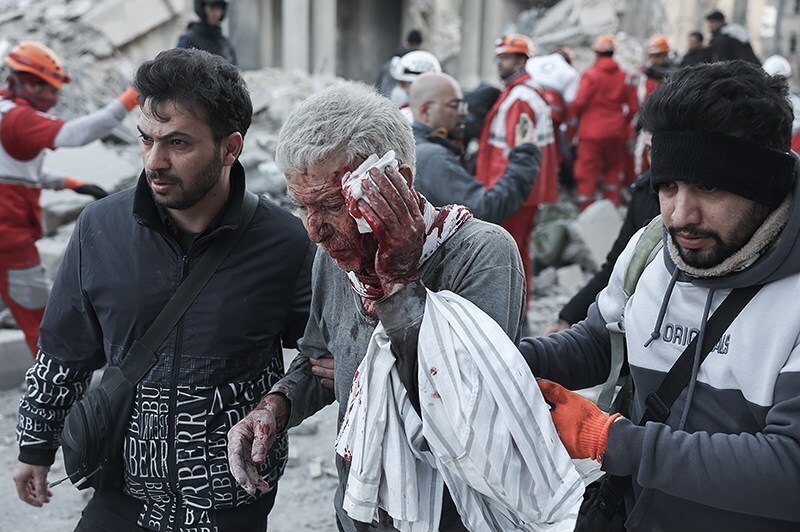
Photograph Source: Tasnim News Agency – CC BY 4.0
Ask what ordinary Iranians think about the recent escalation and you’ll find little reliable information. Even a young Iranian in London may lower their voice and glance around.
The difficulty is that many Iranians appear to hold several truths at once: they oppose the Islamic Republic, fear foreign military intervention, resent sanctions, and long for ordinary lives. These positions are not contradictory. Outside Iran, they are often treated as though they are.
Whether Tehran closes not just one but two of the world’s most important maritime choke points is, for many ordinary Iranians, beside the point. Their own world has been narrowing for years.
Whether Iran really is working on a plan to assassinate Donald Trump, as Israel has alleged, is also of no immediate concern to most ordinary Iranians.
Whether a Chinese spy ship tails the USS Abraham Lincoln near Iran or not will mean little to most ordinary Iranians.
Researchers and journalists warn that even restricted social media has now become a battlefield, with coordinated propaganda, automated accounts, AI-generated images, fabricated videos, verbal lies, and impersonation campaigns making it impossible to know what is really going on there.
Yet beneath the fog, one refrain remains.
“It’s the people who are paying the price—whether our people or theirs.”
Reuters has recorded versions of this refrain again and again whenever it has been able to report from the country.
As one mother, returning to her home despite the danger, told the news organisation, “Even if there’s another attack, I’d rather die in my own home.”
Years of sanctions may have fostered a sense of resignation reminiscent of Iranian poet and filmmaker Forough Farrokhzad’s quiet lament: “I feel sad for the little garden.”
Imagine endless years of sanctions, soaring inflation, economic uncertainty, and recurring military crises.
Imagine the accompanying tyrannies of silence, torture, and the enduring presence of the bully as your adversary. Now imagine another bully on the block with overwhelming firepower, even if deploying that firepower risks all-out war and major retaliation.
For countless Iranian families, questions of ideology give way to more immediate concerns: unreachable relatives, or forever lost loved ones.
Those expressing support for the latest attacks on Iran often overlook an important distinction. While Washington attributes the initial latest three tanker attacks to the Iranian regime, many ordinary Iranians are deeply critical of the Islamic Republic anyway. Yet opposing one’s own government is one thing. Welcoming foreign military intervention is quite another.
One recurring argument is that authoritarian rule must be opposed because bombs rarely deliver democracy. They leave shattered infrastructure, displaced civilians, and grievances that endure for generations.
Do Iranian civilians receive the same instinctive sympathy in the West as civilians elsewhere? While President Trump calls Iran’s leadership “scum”—a clear reference to the regime rather than ordinary Iranians—such language offers little comfort to civilians, especially when one unofficial US nickname for the latest attacks is “Operation Bitch Slap.”
Amnesty International puts the dilemma more bluntly, warning that the Iranian people are “trapped between unlawful US and Israeli attacks and deadly domestic repression.”
UN experts make much the same point, saying Iranian civilians are caught between armed hostilities and repression. “Iran made a poor choice. Now they pay,” posted Pete Hegseth on X.
Once again, Iranians can be victims of their own government and victims of foreign bombs at the same time. Watching the footage of the crowds at Ayatollah Ali Khamenei’s funeral procession, I was reminded of this paradox. Patriotism and opposition to the regime are often treated abroad as opposites. Inside Iran, they can coexist in the same person.
A quieter plea would be for diplomacy, but at present neither side appears willing to pursue it. Academics and civil society leaders repeatedly argue that conflict serves only to bolster governments and armed groups—certainly more than it serves ordinary Iranians trying to build ordinary lives.
This recalls Saadi’s famous observation, which I may have mentioned before: “Human beings are members of one body, created of one essence”—a reminder that civilian suffering is never neatly contained by borders.
Meanwhile, another struggle continues almost invisibly.
Digital rights researchers continue documenting extensive internet restrictions. Even in 2025, Freedom House stated, “The government continued its efforts to make access to the global internet more cumbersome and expensive, and pressured users to confine themselves to a domestic version of the internet where authorities could more effectively control content and monitor activity.”
Each shutdown narrows the window through which journalists, researchers, and families can glimpse events inside the country. Every interruption makes separating fact from fiction more difficult than the last.
This is especially true among opponents of the government, for whom unity remains elusive.
People organise around specific causes while avoiding the more rigid hierarchies that make repression easier. It is one reason they struggle to speak with a single voice.
Beyond Iran’s borders, exiled opposition figures and groups continue to argue over competing visions for the country’s future. Among the best known is Reza Pahlavi, who—despite criticism and derision from rivals and sceptics—continues to present himself as a pro-democracy transitional figure and has repeatedly urged members of Iran’s security forces to side with the public.
But any real support for Pahlavi inside Iran is difficult to gauge, given that he is portrayed as aligned with foreign interests.
That said, over the weekend I noticed a modest increase on social media in anti-regime messaging warning of moves towards a coup. Other narratives concern Kurdish, Baluchi, and some Arab armed groups pursuing their own regional objectives, while the long-established People’s Mojahedin Organisation of Iran remains politically active in exile. This is despite the organisation remaining controversial among many Iranians because of its history, including its alliance with Iraq during the Iran–Iraq War.
The organisation is also reported to retain supporters in London, but it is only one part of a much broader and often divided Iranian exile community.
Taken together, these movements do not constitute a unified resistance. Rather, they reveal a diverse and divided opposition, bickering over leadership, ideology, and methods. The Iranian authorities will no doubt welcome the fragmentation. Despite repeated protests, the authorities continue to exercise formidable and often brutal methods of repression, both at home and abroad. But anyone claiming to know what “the Iranian people” think should be treated with scepticism.
That is because many Iranians seem capable of holding several truths at once. They oppose authoritarian rule. They fear devastating war. They worry about inflation and economic decline. Many people flatten these realities into simplified narratives that are easier to defend than the complexities of reality—mistaking criticism of foreign intervention for support for the regime, or opposition to authoritarian rule for enthusiasm for outside military action.
For some Iranians, scepticism towards foreign intervention is rooted, in part, in the 1953 CIA- and MI6-backed overthrow of the democratically elected Prime Minister Mohammad Mossadegh.
The temptation is always to ask what the Iranian people think, as though more than eighty million lives can be reduced to a single opinion.
This is not possible.
Perhaps the most honest answer is that many Iranians hold several truths at once. The burden is not choosing between them. It is carrying them all.
[ad_2]
Source link
