
[ad_1]
Somewhere in the thousand-plus pages of America’s annual National Defense Authorization Act sits a provision that started out as Section 224 and later became Section 219 in the House version. On paper it looks straightforward: expand technological and defense cooperation between the United States and Israel. In practice it has turned into one of the more revealing fights in current U.S. politics. The reactions on both sides make clear that this is not really about joint research projects or sharing a few more technical papers. It has become a proxy for bigger arguments about how far American security commitments should go, what role Israel should play in Washington’s strategy, and where the Republican Party is headed on foreign policy.
The House kept the language when it passed its version of the bill. Representative Thomas Massie, a consistent America First voice, tried to strip it out. His effort never even made it to a full floor vote. That alone told you something: for now, the coalition that wants deeper strategic ties with Israel still has the numbers in the House.
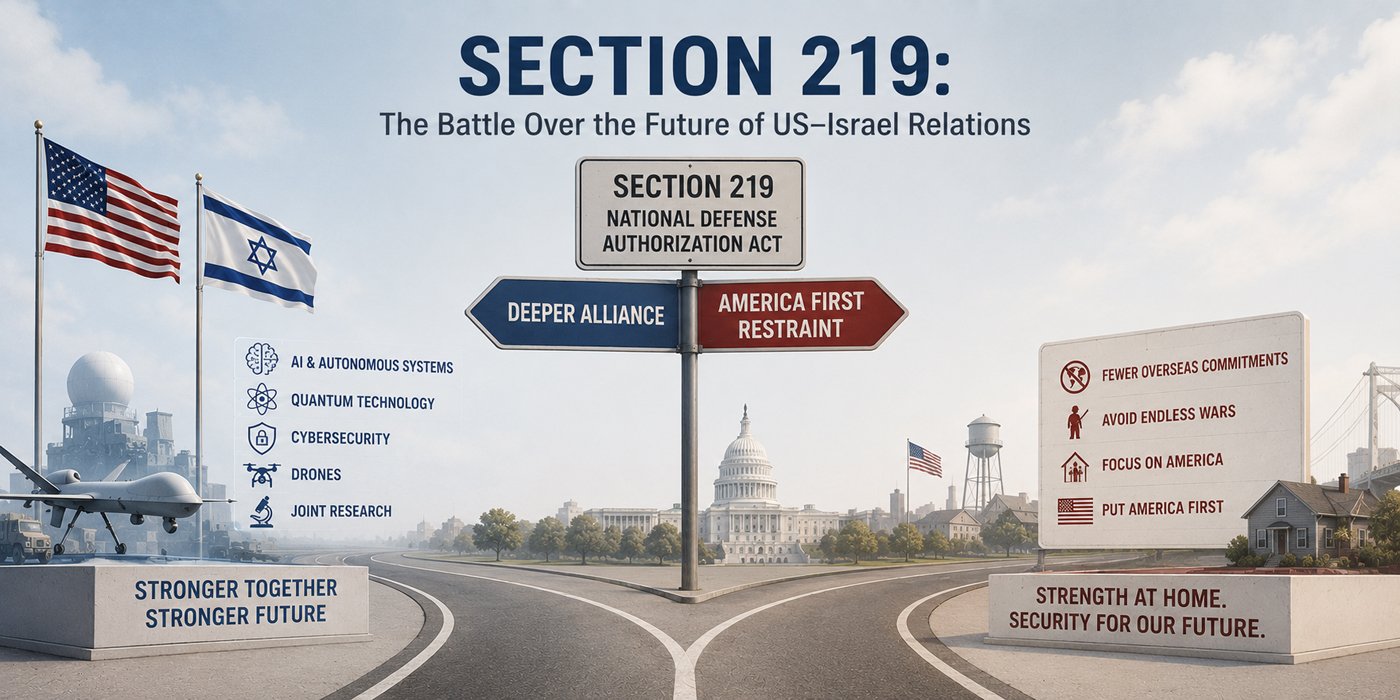
What the section actually does is instruct the Defense Department to expand work with Israel in areas like artificial intelligence, autonomous systems, quantum technology, cybersecurity, electronic warfare, drones, and joint research programs. Supporters say this is common sense. Facing serious competition from China and Russia, they argue, the United States cannot afford to go it alone on the technologies that will shape the next generation of military power. Israel has real strengths in these fields. Formalizing and deepening cooperation, they insist, does not create new combat commitments. It simply builds on relationships that have existed for years.
Opponents see a different trajectory. They worry the language is less about discrete projects and more about gradually knitting the two countries’ defense industries and military structures closer together. Once those ties become denser, they argue, American decision-makers may find their options more constrained when the next Middle East crisis arrives. Massie’s objection sits squarely in this camp. He believes the United States should stop creating new mechanisms that pull it deeper into security obligations connected to Israel
The fight is not really about one paragraph in a defense bill. It reflects deeper shifts already underway. The war in Gaza, the scale of civilian deaths, and the protests that spread across American campuses have made traditional support for Israel less automatic, especially among younger people. Inside the Republican Party a visible split has opened. Traditional conservatives still treat a wide network of allies as essential to American leadership. The America First wing wants fewer overseas commitments, fewer expensive wars, and more focus on problems at home.
So Section 219 is not just about Israel. It is about how America defines its own interests. Should Washington keep deepening alliances as the price of remaining the dominant global power, or should it start redirecting more energy and money toward rebuilding at home and competing economically with China?
The fact that opponents could not remove the section shows the old consensus still has real weight in Congress. But the intensity of the pushback shows that consensus is no longer automatic. What used to be a quiet assumption has become one of the sharper dividing lines in American foreign-policy debates.
Nothing is final yet. The bill still has to move through the Senate. If the two chambers produce different texts, a conference committee will have to work out the differences. House passage was a clear win for the provision’s backers, but the ultimate language depends on what happens next.
What is already obvious is that Section 219 has stopped being just another clause in a giant spending bill. It has become a rough test of the direction American foreign policy is likely to take. Will the United States continue leaning on ever-closer strategic partnerships, or will it gradually pull back toward a more limited, domestically focused approach?
For decades the relationship rested on a familiar mix of shared values, intelligence cooperation, technological overlap, and common adversaries. That foundation has not vanished. Israel remains a capable partner in missile defense, cyber operations, and advanced research. Supporters of the section keep returning to these practical advantages and argue that tighter cooperation is a logical response to a more competitive world.
Critics focus on the longer-term costs. They ask whether denser institutional links could reduce American flexibility later, or whether the political signal sent by this kind of language is wise at a moment when public attitudes, especially among the young, are shifting. Within the Republican Party the debate has taken on a sharper edge. Traditional national-security conservatives still see alliances as multipliers of American power. The restraint-oriented faction sees many of the same alliances as potential traps that can drag the country into conflicts that do not serve core interests. Section 219 has become one of the places where those two visions collide in public.
Whatever language finally emerges from the full legislative process, the argument around this provision is unlikely to disappear. The deeper questions it raises – about the proper scope of American commitments, the balance between alliances and domestic priorities, and the changing politics of the U.S.-Israel relationship – will keep returning. A single section of the defense bill has managed to capture a larger tension that has been building for years. How lawmakers settle it will offer one more clue about the kind of global role the United States is prepared to play in the years ahead.
Peter Rodgers is an international relations graduate of Penn State University. His area of interest is the United States’ relations with Eurasia. His writings have appeared on news analysis websites like responsiblestatecraft.org and middleeastmonitor.com.
Join the Discussion!
We welcome thoughtful and respectful comments. Hateful language, illegal content, or attacks against Antiwar.com will be removed.
For more details, please see our Comment Policy.
[ad_2]
Source link
