
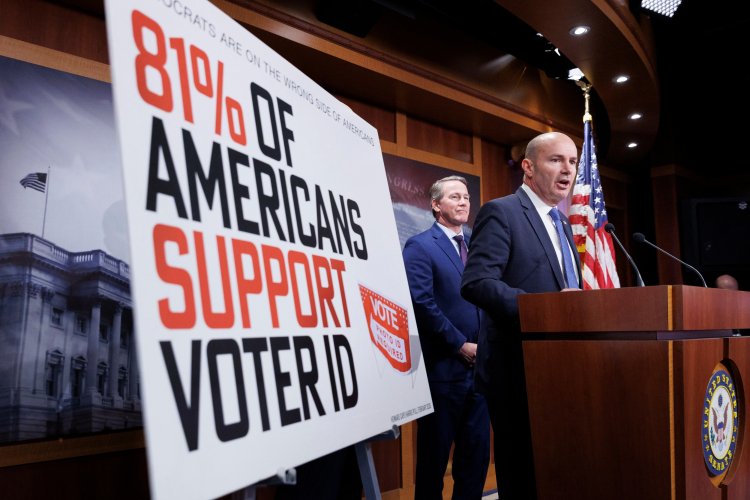
Amid the conflict with Iran and the partial shutdown of the Department of Homeland Security, leaders in Washington haven’t set aside their fight over the Safeguard American Voter Eligibility Act (SAVE America Act).
Democratic Party leaders have resorted to demagogy and falsehoods to try to stop the bill, most of whose provisions are widely popular with the American public. While doing so, they have largely failed to advance the most legitimate constitutional argument against it, which centers on the primacy of state administration of elections.
The act would, among other things, require “individuals to provide documentary proof of U.S. citizenship when registering to vote in federal elections.” It also lists many documents that would be acceptable as proof of citizenship, including REAL IDs, military IDs indicating citizenship, tribal IDs, passports, and birth certificates.
Despite that range of acceptable IDs, Democrats claim the SAVE America Act is the latest version of “Jim Crow 2.0,” with a goal of “disenfranchising American citizens and making it harder for eligible people to vote.” They have vowed to oppose it.
They have also resorted to the false claim that the bill would “make voting significantly harder for as many as 69 million married women” who have changed their name after getting married. A report by the bipartisan National Conference of State Legislatures, however, states that the bill “would allow individuals who have changed their names to provide an affidavit attesting to the name change to prove citizenship.”
The bill would also require those voting by mail to submit a photocopy of their voter ID with their ballots, and would require states to regularly check the Systematic Alien Verification for Entitlements system to identify potential noncitizens on their voter rolls. Most states already check that system, but on a more limited basis than the SAVE America Act would require.
President Donald Trump has raised the stakes in the fight over the act as well, posting on Truth Social, “I, as President, will not sign other Bills until this is passed.” With everything else going on right now, this is the political hill he appears willing to die on.
While there are policy arguments to be had about the SAVE America Act, one that has not been sufficiently explored is whether it is appropriate for the federal government to be this involved in election administration.
The Elections Clause of the Constitution states:
“The Times, Places and Manner of holding Elections for Senators and Representatives, shall be prescribed in each State by the Legislature thereof; but the Congress may at any time by Law make or alter such Regulations, except as to the Places of chusing [sic] Senators.”
The clause makes clear that state legislatures have the primary duty for creating election regulations (“shall be prescribed in each State”), while Congress has a backup role (“may … make or alter such Regulations”).
Since America’s founding, states have led the regulation and administration of elections. Federal election regulations, such as the National Voter Registration Act of 1993 (Motor Voter) and the Help America Vote Act of 2002, are relatively rare, reflecting Congress’ role as a backstop in election regulation. Both bills also had at least some bipartisan support (though Republican support for Motor Voter was relatively limited). Most of the proposals in the SAVE America Act would make our elections more secure, but at the cost of further eroding the constitutional preeminence of state control over election policy and administration.
In short, there is a legitimate question about whether federal legislation is appropriate for the changes being sought with the SAVE America Act. But that is not the Democrats’ complaint.
It hardly could be.
Democrats had only recently pushed for the For the People Act of 2021, which would have forced more election administration changes on the states than the SAVE America Act does. Among other things, that bill would have altered states’ voting rules for when they conduct voting, mandated “opt out” automatic voter registration, and required states to accept no-excuse absentee ballots.
What is clear is that politicians on both sides of the aisle want greater federal control over elections – as long as it is their side that exercises that control.
