
[ad_1]
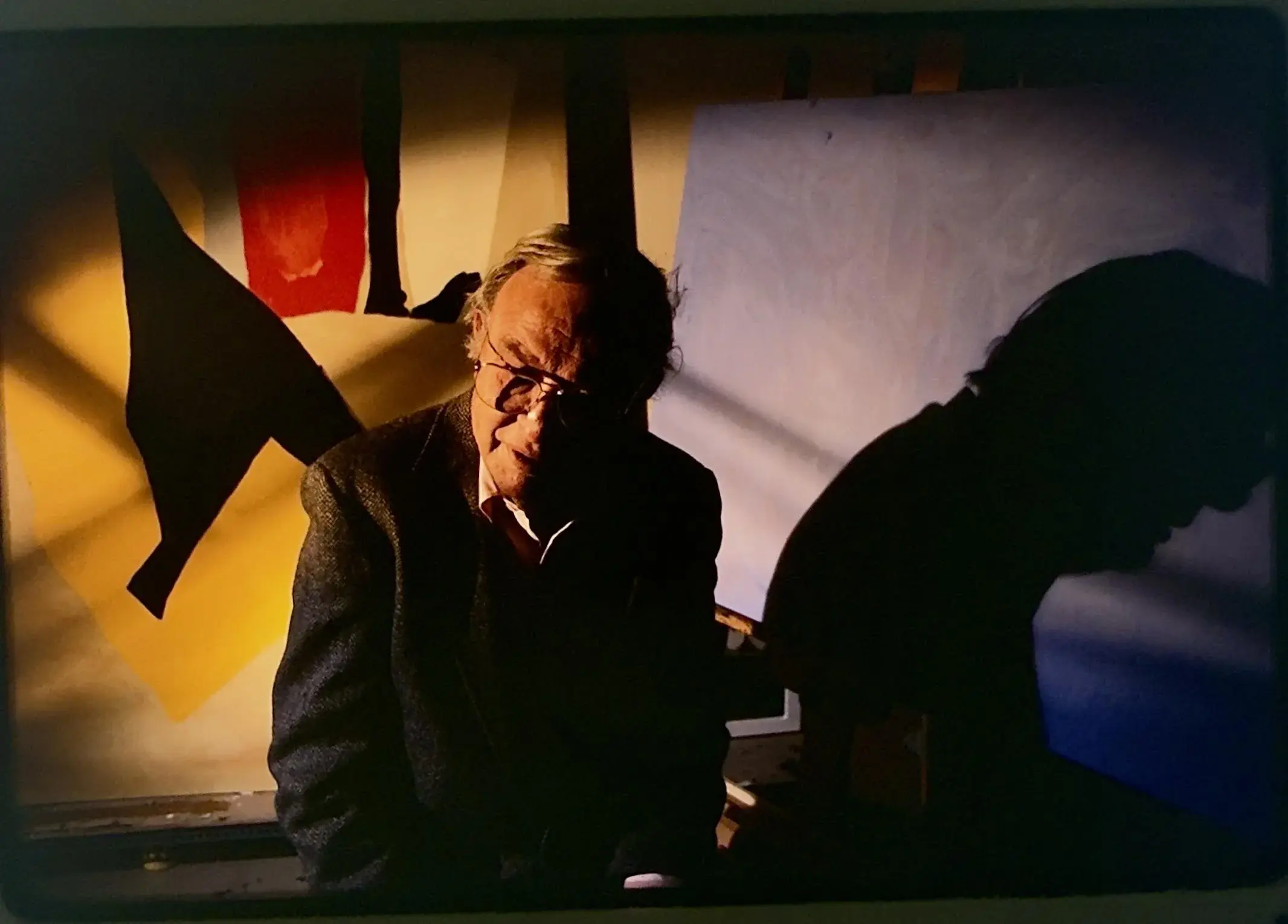
Robert Motherwell was older than I imagined. Through my cameras’ captures, a living embodiment of twentieth-century art history greeted me. In one of two guises: ”Let’s get this over with, or, let’s talk and enjoy the meeting of our decidedly divided ages ”. Fortunately for me, three or so hours flew by.
Just about every artist I met started the conversations with, “I hear you photographed Bill de Kooning”. I knew then that it was a generous calling card. From there, no question whether inane or curious was inappropriate. So after the de Kooning briefing and a few niceties, the great artist took me by the shoulder and escorted me around the studio without a word spoken. I felt as though i was navigating a parallax view. The world and my eyes shifted with different curious pronouncements happening as one.
I spotted a reproduction of his Elegies series. I saw a black painting that reminded me of Sargent’s Spanish Flamenco series. I asked about the influences. He said, “Maybe we should sit for a while.” He started by saying, “I thought you came here to shoot my portrait.” The Motherwell monologue after that was a great series of run-on sentences.
He spoke about familiar stories-the damnation of being forced to emulate Cezanne in art school. He whispered with eyes looking in many directions, that he might have at times had Sargent in his mind. Then we shifted the conversation to his friendships and my art world captures. We had Kenneth Noland, Helen Frankenthaler, Matta, Clement Greenberg in common. Though as we danced in periods of commonality, we touched on Ernst, Dali, de Kooning and ten more. The hours were a classroom symposium on thrills and more.
He looked at his watch and I knew a good time, a great education was nearing the finish line…so I began to shoot.
Some artists live their lives in three stages: small and intimate spaces; large spaces to create a larger identity; and a less imposing space that tethers the future and the past. Motherwell in this immense carriage house was in the “tethering” phase-a tremendous home, and an intimate serenade to the past and what may be the future. Connecticut was not Paris or New York. As I caressed his paintings, I felt a dance come over me. Maybe a Maypole, yet a jig nonetheless. Round and round we go, dancing on the moments of space and time. My time will never have a fixed place in history; from near and far it appears like a tiny ball of yarn, unraveling pieces of my history. The passionate sharing between two generations seems quite sumptuous in hindsight.
[ad_2]
Source link
