
[ad_1]
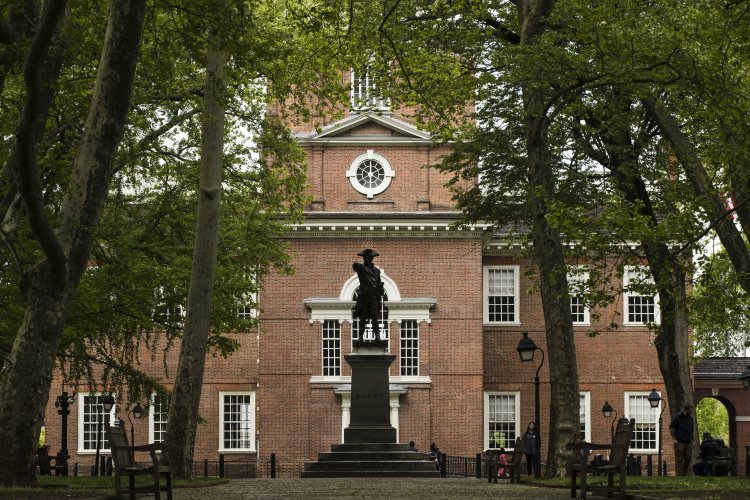
When the National Park Service recently removed signs that had made George Washington the most heavily criticized individual at Independence Park, critics accused the Trump administration of “censorship.” Now that the Park Service has unveiled replacement signs, the administration stands accused of “whitewashing” and “sanitizing” history. In truth, the Trump administration is rescuing a prominent historical site from radical activists and presenting American history in a much more accurate, nuanced, and informative way – just in time for the Quarter-Millennial anniversary of American independence.
A block north of Independence Hall, the President’s House Site features ruins of the house where Presidents Washington and John Adams lived from 1790 to 1800. After the Park Service took down panels there in January, the City of Philadelphia sued, claiming the Park Service violated a previous agreement. District Court Judge Christina Rufe likened the signs’ removal to something out of “1984” and ordered them rehung. Some were reinstalled before Third Circuit Court Judge Thomas Hardiman stayed Rufe’s order, ruling that no further signs could be hung until that court hears the case on expedited appeal.
The displays at the President’s House Site focused myopically on slavery, with the link being that Washington had brought several slaves north with him to Philadelphia. When the site opened in 2010 during the Obama administration, then-New York Times and current Wall Street Journal Critic at Large Edward Rothstein wrote that it “overturns the idea of history, making it subservient to the claims of contemporary identity politics.” He noted that “Washington and Adams were shaping the new country” at that house, yet it was presented “almost as if it were the Slave Market of Charleston.”
Indeed, 25 of the site’s 30 signs focused on slavery or race relations, as I found during an August 2025 visit in advance of an essay that I wrote for the Claremont Review of Books. Washington and other founders stood accused of “injustice” and “immorality.” Sign headings read, “Washington’s Deceit” and “Washington’s Death and a New Hope for Freedom.” The biggest hero of the American Revolution was portrayed as the chief villain at Independence Park.
The new signs, which await only judicial approval to be hung, mark a vast improvement. But you’d never know if from press accounts. The mainstream press’s go-to source for reviewing the new signs is ATAC (short for Avenging The Ancestors Coalition, and pronounced “attack”) and its founder, Michael Coard. ATAC has sponsored “Anti-July Fourth Day” events, and Coard says that “July Fourth is a celebration of…rapes, castrations, lynchings, and enslavement,” and those who celebrate it are “traitors” who “embrace whiteness” and “the 1776 birth of the racist American nation.” ATAC played a leading role in the original design of the President’s House Site, with Coard being on the site’s oversight committee. Essentially every news article that criticizes the new signs quotes Coard or ATAC.
Americans should judge these new signs for themselves. Far from neglecting slavery, they present it with the complexity and nuance that those seeking to disparage America’s history and heroes champion in speech but eschew in practice. The new signs refer to slavery as “an odious and pernicious affront to the glorious rule of liberty proclaimed in the Declaration of Independence and established in the United States Constitution,” which is how most of the founders, including Washington, viewed it.
The previous signs didn’t even mention the Civil War on their “Slavery Timeline.” The new ones observe that it “took Lincoln and a bloody Civil War to finish the work that the Founders had begun and end slavery in the United States once and for all.” These signs highlight Harriet Tubman and the Underground Railroad, Frederick Douglass and his belief in the “saving principles” of the Declaration of Independence, and the 13th Amendment’s abolition of slavery.
The old signs criticized the Constitution for “allowing each enslaved person to be counted as 3/5 of an individual for population purposes” – the clear implication being that slaves should have counted fully. The new ones note, “Slave-holding delegates wanted enslaved people counted as whole persons to increase their political power.” In other words, the injustice wasn’t that slaves didn’t count fully but rather that they counted at all, thereby padding Southern representation.
The new signs explain, “At the insistence of the Carolinas and Georgia, and over the objections of Virginia, the Constitution prevented Congress from banning the importation of slaves until 1808.” The previous signage had simply claimed that “slaveholders” pushed for this provision, ignoring that Virginia – whose extraordinary delegation included Washington and James Madison – voted against it.
Whereas the old signs described Washington’s actions as “deplorable,” “profoundly disturbing,” and as having “mocked the nation’s pretense to be a beacon of liberty,” the new signs offer balance and insights on Washington and slavery. They observe that he “often expressed discomfort with the institution and a desire to see it abolished,” yet “as a Virginia plantation owner, his wealth and livelihood were deeply tied to it.” They note that he “helped draft the Fairfax Resolves at Mount Vernon,” which called for putting (in the Resolves’ words) “an entire Stop” to the “wicked” slave trade. They highlight that he “signed legislation that both upheld and limited slavery,” including banning it in the Northwest Territory (the current Midwest). They note, “Among all of the Founders, Washington carried out the largest manumission of enslaved people,” through his will.
These new signs also observe, “Slaves living in the President’s House experienced a greater modicum of autonomy” than one might presume, as they were at times “able to explore the city and sometimes even attend the theater, with Washington buying the tickets.” In “Washington: A Life” (2010), biographer Ron Chernow notes this fact as well (substituting “freedom” for “autonomy”), citing Washington’s financial records: “Household accounts for June 1792 disclose expense money doled out for ‘Austin, Hercules & Oney to go to the play.’” While Coard objects to this sign, without being able to dispute its accuracy, it adds welcome nuance and complexity. It makes clear that while slavery was egregiously at odds with the right to liberty, the lives and living conditions of slaves varied greatly.
The new signs also provide information on the nine slaves who lived in the house and whose names remain carved into the site’s walls.
In addition, the replacement panels note that British General William Howe made the house his headquarters while Washington and his army suffered at Valley Forge; that Washington was owner Robert Morris’s guest there throughout the Constitutional Convention; and that Benedict Arnold lived there in 1778 as the military commandant of Philadelphia, courting Loyalist Peggy Shippen during that time. Such history wasn’t previously presented.
Oral arguments at the Third Circuit Court over the signs are scheduled to be heard by a three-judge panel on June 2, just one month before visitors flock to Independence Park for the 250th anniversary of the Declaration of Independence on July 4.
It matters how America’s story is told. If the Trump administration gets the green light from the courts to hang these exemplary new signs, its reclaiming of the President’s House Site at Independence Park for the American people will rank among the greatest happenings during the Quarter-Millennial celebration of American independence.
Jeffrey H. Anderson is president of the American Main Street Initiative. He served as director of the Bureau of Justice Statistics from 2017 to 2021.
[ad_2]
Source link
