
[ad_1]
This side of the border, French Canadians don’t tend to make political waves. Despite a sizable population in northern New England, they have collectively only once played a significant role in American politics. This was in February 1972, when the so-called “Canuck Letter” helped scuttle Ed Muskie’s shot at the Democratic nomination for president. (The letter, now widely believed to be the work of Nixon staffers, alleged that Muskie had drawn a derisive parallel between New Englanders of French-Canadian extraction and southern blacks.)
But last weekend, the heirs of Champlain and Frontenac found themselves involved in matters of state below the 49th parallel. In a speech explaining the breakdown of U.S.–Canada trade talks, Canada’s Prime Minister Mark Carney claimed that American negotiators had issued last-minute demands that threatened “the French language and Québécois culture.” Although Carney didn’t provide much detail, subsequent reporting suggested the U.S. was pushing for changes to laws requiring streaming platforms like Netflix to promote francophone Canadian content, as well as requirements for bilingual labelling on goods sold in Canada.
Washington disputes this narrative. U.S. Trade Representative Jamieson Greer called it a “funny and fake story.” President Donald Trump has even gotten involved. “I would never interfere with Canadians speaking French!” he wrote in a Tuesday TruthSocial post, adding “I love French Canadians!”
As of writing, this little bit of the trade fracas, at least, seems to have been resolved. Dominic LeBlanc, the Canadian trade minister, said Thursday that the U.S. was “withdrawing its positions on discoverability and labelling”—a statement, incidentally, that makes me think the White House’s version might be the more accurate account (a quiet walkback seems dramatically out of keeping with Trump’s otherwise maximalist approach here).
But whatever actually happened around the negotiating table, it’s worth considering why this particular issue touched such a nerve.
It should be clear to all by now that the transmission of civilization across generations cannot be taken for granted, and that those who care about preserving their culture have every right to get prickly in the face of threats (real or imagined). This is true even when the cultural group in question possesses its own nation-state, as we are seeing across Western Europe today. And it is doubly true when—as is the case with French Canadians—that cultural group is a minority within a broader political system it does not control.
For it is indeed remarkable that, more than two and a half centuries after perfidious Albion gobbled up France’s North American empire, the 8 million or so francophones of Canada retain their unique linguistic and cultural identity amidst a continental sea of 389 million anglophones.
How did this happen? Partly it is due to luck, but mostly it comes down to deliberate choices made by French Canadians themselves.
Shortly after the British took possession of the Great White North, the conquerors tried to shore up social stability by providing space for their new subjects’ peculiar cultural habits. Students of our own revolution will recall that the 1774 Quebec Act gave the imprimatur to Catholicism and certain of the province’s French institutions—for which it was reviled in the 13 Colonies, where patriots saw it as the prelude to popery and arbitrary rule further south. (And it is true that Canada’s early British administrators, who were mainly military men of aristocratic backgrounds, preferred the docile, tradition-minded habitants to the troublesome anglophone merchants dominant in the colony’s few towns).
For the next century and a half, the major factor in the preservation of French Canadian culture would be the Church. Quebec’s ultraconservative clergy saw French as a safeguard against the secularism (or worse, Protestantism) that threatened to leach in from the rest of the country, and kept the language as the medium of instruction and exchange in the religious, social, and educational institutions they oversaw. During the 19th and early 20th centuries—the period of la survivance, or the survival—francophone Canada ranked with Ireland as one of the most devout and traditional societies in the Catholic world.
As the 20th century progressed, something that looked more like conventional nationalism began to emerge. Steered by figures like Henri Bourassa and Maurice Duplessis, French Canadians began to demand cultural and political concessions, ever more stridently opposing their English-speaking compatriots’ efforts to run the country as a more unitary state—not to mention the latter’s insistence on sending Canadian boys overseas every time Brittania found herself embroiled in a European war. Intense Catholicism remained part and parcel of this incipient nationalism, with the Church exercising firm control over the most important aspects of provincial life.
And then came the Quiet Revolution. Beginning in the early 1960s, the faith underwent a collapse in Quebec whose suddenness and completeness still astonishes. From one of the most religious places on earth, it turned into the most secular province of a pretty secular country. (Why this happened when and as it did is a question for another column, although I suspect it tells us something about the fundamental unworkability of integralism—the explicit fusion of religious and political power—under modern conditions.)
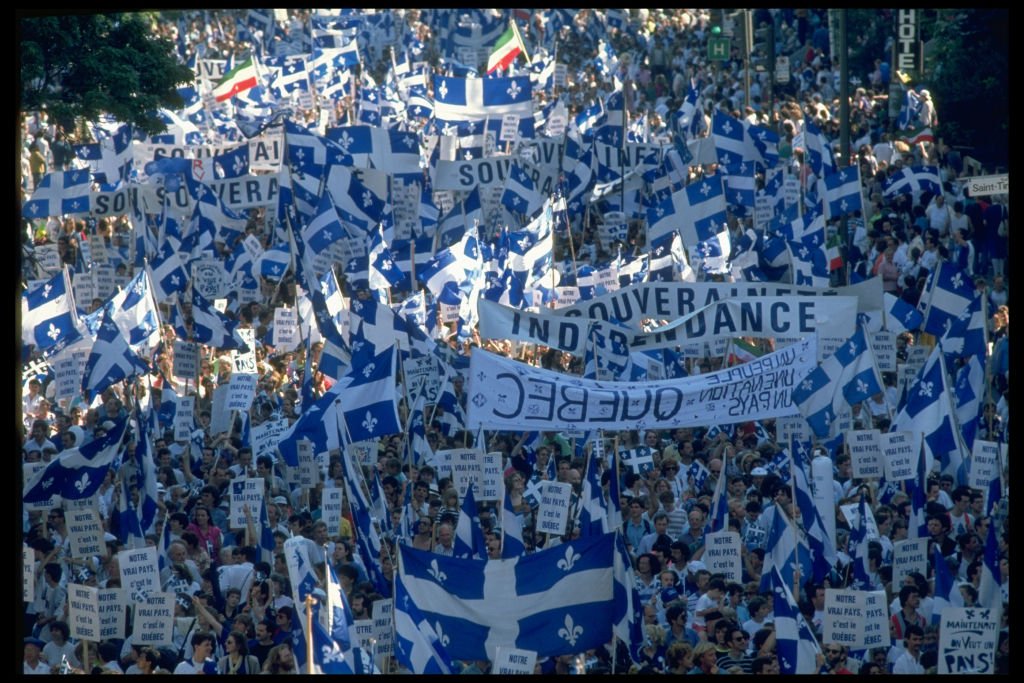
Yet this did not spell the end of French-Canadian civilization. Fervent, secular nationalism rushed in to fill the void. Maîtres chez nous was the new rallying cry: masters in our own home. Quebec’s voters and politicians demanded new provincial powers from Ottawa and used these to enact increasingly strong protections for the French language. Some sovereigntists even eschewed the political process altogether, opting instead for bombings and kidnappings.
In two successive independence referendums, la belle province came close to leaving the country outright; the second of these, held in 1995, was a real nail-biter (Canadian union was saved by about 54,000 votes). Quebec nationalism became the sine qua non for success in provincial politics, and the regional scene is now dominated by nationalist parties of vaguely right-wing (the Coalition Avenir Québec) and left-wing (the Parti Québécois) flavors.
For those interested, there are a couple lessons to draw from the efforts of our francophone neighbors to preserve their way of life.
The first is to care: to care enough to be annoying about it, to care enough to prioritize it over ease and convenience and even—gasp!—maximizing economic growth.
The second is to get comfortable seizing and using power. Had Quebec not fought tooth and nail for every concession from the national government, not rewarded politicians who prioritized culture and punished those who didn’t, and not planted a thicket of laws and regulations to make it as difficult as humanly possible to speak a language other than French, its unique civilization would likely have perished. Contemporary Louisiana, where the French language teeters on the edge of extinction and Cajun culture is basically a tourist attraction, provides a vivid illustration of what might have happened.
Subscribe Today
Get daily emails in your inbox
But with these lessons comes a warning: politics and culture can easily become a substitute for religion. Today’s Quebec is no one’s idea of a trad paradise; as few as 2 percent of its (nominal) Catholics attend church weekly. (On a recent trip up to the province’s Gaspé peninsula—once called “Canada’s Brittany,” both for its physical resemblance to the French region and its strong cultural conservatism—my brother and I struggled mightily one Sunday to find a church at which mass was actually being celebrated.)
A final thought, as the Great U.S.-Canadian Trade Spat continues apace: For all the talk out of this White House of “civilizationism” and saving the great cultural traditions of the West, often the greatest threat to these comes from the gravitational field created by America’s own gargantuan heft. Even were our president not openly talking about annexing Canada and renaming its natural features, our sheer cultural, economic, and technological power would be cause enough for concern.
It was for this reason that the Canadian conservative George Grant argued, in the 1965 classic Lament for a Nation, that the disappearance of his country was an inevitability. But Quebec, he thought, might hold out the longest. “French Canadian nationalism is a last ditch stand,” he observed, but “the French on this continent will at least disappear from history with more than the smirks and whimpers of their English-speaking compatriots.” They would go out, he predicted, “with their flags flying and, indeed, with some guns blazing.”
[ad_2]
Source link
