
[ad_1]
Alan Macleod reports on Lockheed Martin, Raytheon & BAE Systems using the classroom to launder their images and enlist the next generation as cogs in the military-industrial complex.
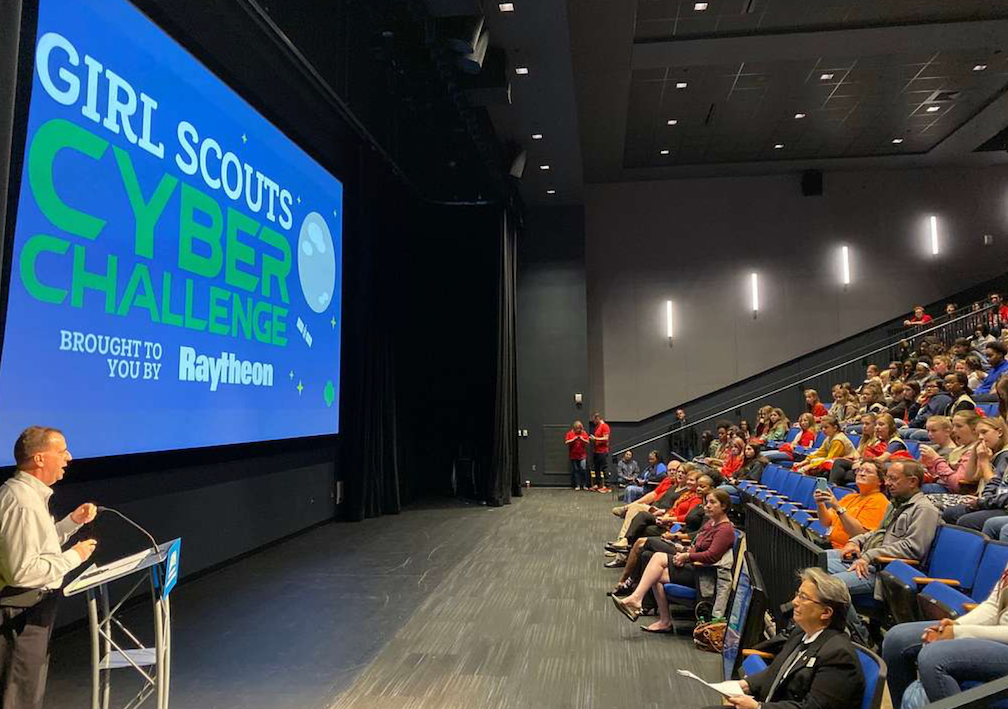
The U.S. Army’s James Kirsch delivers opening remarks for the Raytheon-sponsored Girl Scouts Cyber Challenge at the University of Alabama in Huntsville on Oct. 19, 2019. (Defense Visual Information Distribution Service / Public Domain)
By Alan MacLeod
MintPress News
 Raytheon sponsors the Girl Scouts of America. BAE Systems is reading your toddlers their favorite fairytale stories. And Lockheed Martin funds children’s math and STEM festivals.
This is done with great fanfare, supposedly to empower and inspire children to pursue their passion for science. In reality, though, these companies are attempting to launder their images and enlist the next generation to become cogs in the military-industrial complex.
All the while, these organizations’ products are being used across the world by the United States and Israel to commit war crimes – in Iran, Yemen, Palestine, and beyond – to target children.
MintPress explores the murky world of the arms companies training kids to bomb kids.
Normalizing War to Kids
When many Americans think of Raytheon (now officially rebranded as RTX Corporation), they don’t envisage rockets and cruise missiles; they think of math. For decades, the second-largest arms manufacturer on the planet has bankrolled a wide range of organizations aimed at getting children excited about STEM subjects.
Since 2009, Raytheon has been the title sponsor of MATHCOUNTS, a non-profit organization that provides engaging math programs for middle school students in every U.S. state, as well as organizing math competitions to find the brightest children in America.
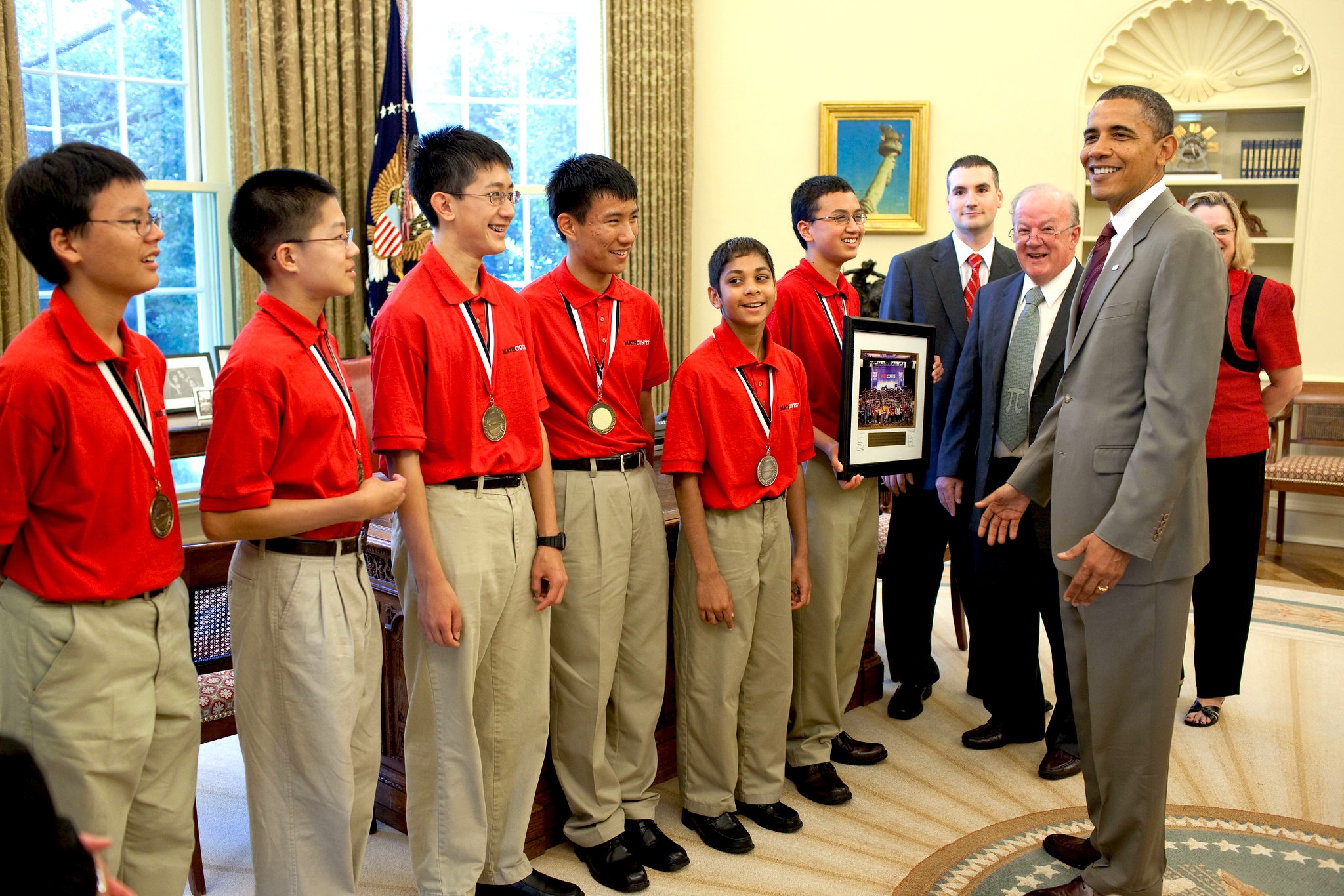
President Barack Obama greets MATHCOUNTS winners and their coaches in the Oval Office, June 28, 2010. (White House /Pete Souza)
In 2005, Raytheon launched its MathMovesU program, aimed, in its own words, “to inspire middle school students to get excited about math and science.” In addition to the materials provided, it has also spent millions on scholarships, grants and study awards to thousands of students, teachers, and volunteers.
And its MathAlive! traveling exhibit promises, in rather outdated branding, to take math “2theXtreme”. MathAlive! Has also traveled to several countries in West Asia, including Qatar, Kuwait, the United Arab Emirates, and Saudi Arabia – all of them among the biggest purchasers of Raytheon weapons technology.
The company also enjoys a longtime partnership with the Girl Scouts of the United States of America (GSUSA). In 2017, for example, it launched the GSUSA’s first national computer science program and cyber challenge for middle and high school girls.
“The progress to diversify the STEM workforce needs to be accelerated… At a time when technology is transforming the way we live and work, we can – and should – show young women a clear path to taking an active role in this transformation,” said Thomas A. Kennedy, then-Raytheon CEO; “Working together, Raytheon and Girl Scouts will help girls build confidence to see themselves as the robotics engineers, data scientists and cybersecurity professionals who will create a better tomorrow.”
Raytheon also spearheaded the GSUSA’s “Think Like a Programmer” project, which encourages girls to explore the world of artificial intelligence and cybersecurity, and developed many of the programming badges available to the scouts.
GSUSA appears proud of this relationship. Its website profiles one former scout who now works at Raytheon as a success story and a model to follow. The article includes a step-by-step guide and a list of tips for those wishing to follow in her footsteps.
Unsurprisingly, Raytheon also works closely with the U.S. military on these matters, establishing four new STEM “centers of innovation” with the Boys & Girls Clubs of America in Michigan, Oklahoma, Colorado and Washington, D.C., all near military bases.
While some might be surprised by the closeness of the relationship between a children’s organization and an arms manufacturer, it is worth remembering that the scouting movement was originally established by Lieutenant-General Robert Baden-Powell, as a stepping stone towards boys joining the military. Baden-Powell was deeply concerned that English boys would not be physically fit enough to fight for their country in any upcoming wars, and designed an organization that would train them both physically and mentally to do so.
Kirsten Bayes from the Campaign Against the Arms Trade was unimpressed by Raytheon’s attempts to improve their image and to train the next generation of weapons manufacturers. “Our view is that arms companies have no place in schools or colleges, and should certainly not be working with children’s educational charities,” she told MintPress, adding:
“Schools and other places of education should be places where children learn, grow and develop their full potential. They should not be a recruiting ground where arms companies whitewash their activities.”
Lockheed Martin U
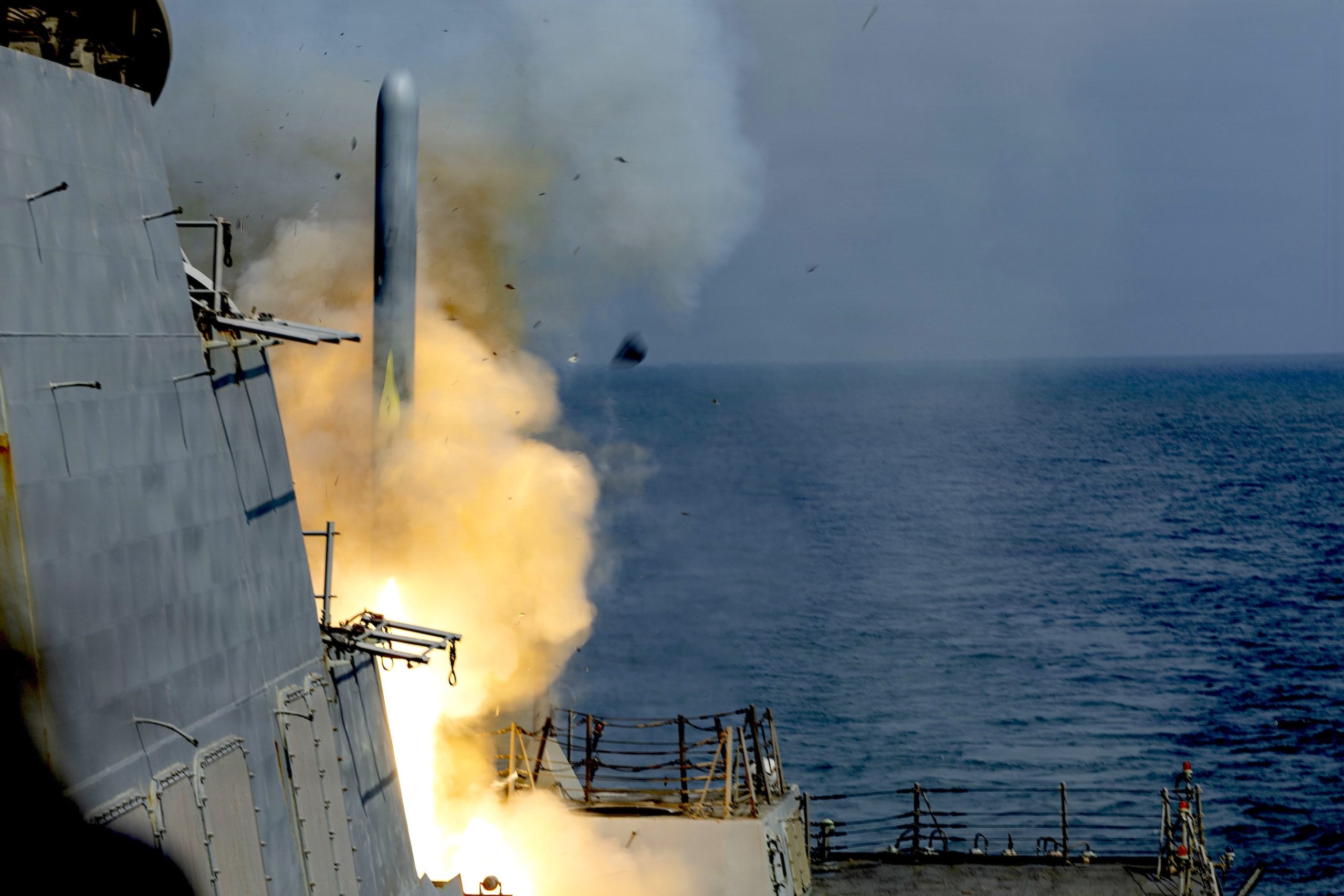
A U.S. destroyer firing a Tomahawk missile as part of the Trump administration’s start of unauthorized war on Iran on Feb. 28. (DoD/Wikimedia Commons/Public Domain)
Raytheon is far from the only weapons giant directly targeting America’s children. Lockheed Martin hosts CYBERQUEST, an annual high school competition that encourages children to pursue careers in intelligence and cybersecurity.
The 2026 event was held in 11 locations across the country, as well as virtually around the world. The arms giant offers high school internship programs designed to fast-track America’s brightest young minds into careers in defense. Every year, Lockheed Martin hires thousands of young interns, and claims that 60% of these candidates go on to paid work at the company.
It also sponsors “young minds at work” days, setting up hands-on experiments for children to play with, including bottle rocket experiments and more.
Universities are a key recruitment ground. The corporation spends huge sums attracting top talent, including hosting “Lockheed Martin Day” at more than a dozen colleges nationwide, where company recruiters are allowed on campus to dazzle students with virtual reality exhibitions, flight simulators, and even landing helicopters directly on college greens.
Lockheed Martin has entered into partnerships with several top colleges. A $1.5 million donation to the University of Texas at Arlington, for instance, resulted in the renaming of one of their buildings as the Lockheed Martin Career Development Center.
The company touts its reputation as a safe space for women and LGBT employees, and is regularly listed as one of the best employers for inclusivity.
One woman the company itself profiles is Haley, who, as a girl, dreamed of becoming an inventor. “As a child,” they write, “Haley clung to a notebook where she sketched her ideas and inventions. On the cover she scribbled, ‘Haley’s Way to Make Life Better.’ Her best idea? A self-folding Christmas tree cleverly called ‘Merry, Bright and Boxed’ to make cleaning up after the holidays more efficient.” Today, that child with dreams of making the world a better place is a missiles and fire control engineer with Lockheed Martin, developing weapons that efficiently kill people all across the planet.
Targeting Toddlers
Boeing, too, has developed a number of projects aimed at young children. Their “Engineering is Elementary” program is designed for pre-K, kindergarten, elementary and middle school students, and, like those from Raytheon and Lockheed Martin, is focussed on funnelling young minds into a career in weapons manufacturing. “Boeing has a strategic community focus to increase teacher effectiveness in math and science and to attract more students into STEM-related careers,” a company representative said, adding,
“Engineering is Elementary provides teachers and students a greater understanding of engineering, and it accomplishes that in a fun, interactive way. Our goal is to interest students in engineering at an early age and increase the number of scientists and engineers.”
Aerospace manufacturer BAE Systems goes even further. The London-based giant that produces jet aircraft, missiles, howitzers and warships published a series of bizarre videos featuring both its employees and members of the British Armed Forces reading classic fairytales to children. This included Rapunzel, Jack and the Beanstalk, Goldilocks and the Three Bears, Cinderella, and Hansel and Gretel. These came complete with worksheets to help extremely young children with their problem-solving skills.
Reading bedtime stories to babies is just part of a wider strategy BAE Systems is conducting in order to, in their own words, “improve our corporate reputation at both a local and national level.” Other initiatives include hosting school roadshows, robotics festivals, science camps, and local community outreach programs, all aimed at children. During the COVID-19 pandemic, it also stepped in to provide schools with branded learning materials for children as young as five.
Bayes appeared appalled at the company’s actions, stating:
“We are aware that BAE Systems claims to spend as much as £100m [U.S.$134m] per year on educational activities. It claims its motives are community based, but we would say that this is part of their recruiting strategy: seeking to influence young people without presenting the full facts of what an arms company is, and what the consequences of working for them would be.”
Fairytales & Nightmares
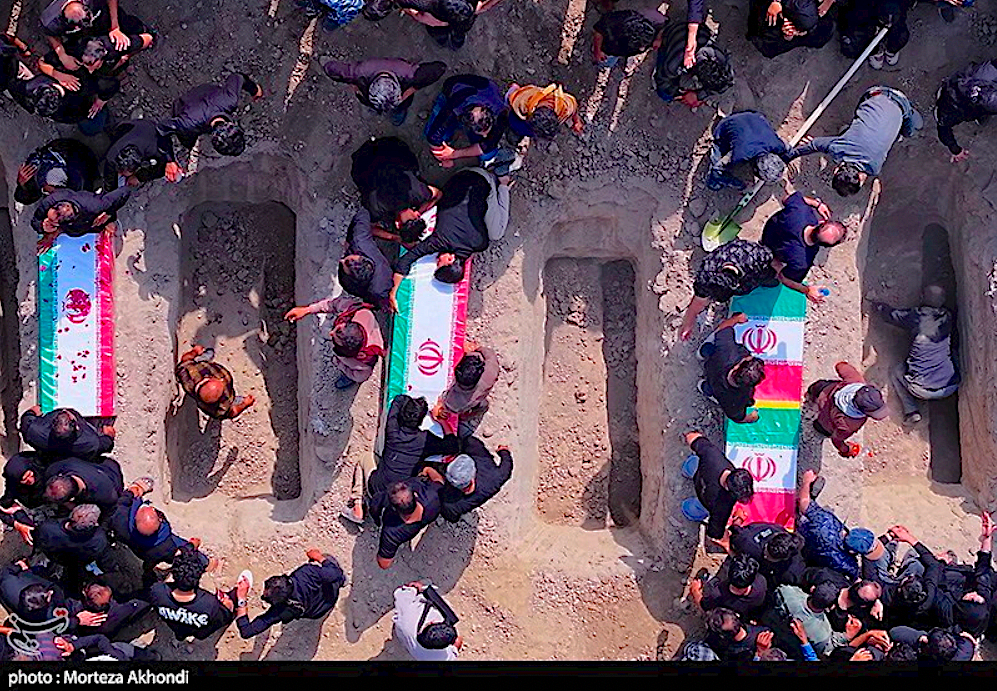
The funeral of victims of U.S. airstrikes on Shajareh Tayyebeh elementary school in Minab. (Tasnim News Agency / Morteza Akhondi / Wikimedia Commons / CC BY 4.0)
As much as these companies attempt to present themselves neutrally as scientific entities, the reality is that their primary businesses revolve around producing the hardware and weaponry that the United States uses to dominate the world.
In the past 12 months alone, the United States has bombed seven countries: Iran, Iraq, Nigeria, Somalia, Syria, Venezuela and Yemen. And it is companies like Raytheon and Lockheed Martin that make this kind of extraordinary planetary violence possible.
For example, on Feb. 28, the United States launched an attack on the Shajareh Tayyebeh Girls’ School in Minab, Iran. A Tomahawk cruise missile — one of the most precise guided weapons on the planet — was launched from a nearby warship and pummeled the building, causing the school to collapse in on itself. Soon after, a second missile hit the school’s courtyard, where desperate survivors were gathering.
The attack was timed precisely for maximum damage: 10:45am on a school day. At least 156 people were killed, most of them pupils at the school, which neither served any military purpose, nor was located near any military target. Over 100 more were injured.
The event was immediately denounced as a major war crime. But Secretary of War Pete Hegseth brushed it off, and later stated that, “The only ones that need to be worried right now are Iranians who think they’re going to live.”
The Tomahawk cruise missile is produced by Raytheon, and subsystems used in the operation were made by a subsidiary of BAE Systems.
Washington also uses its primacy in weapons to keep its allies in power. Saudi Arabia is by far the U.S.’ top arms customer, purchasing hundreds of billions of dollars worth of hi-tech weaponry, which it immediately uses against Yemen, and to suppress domestic dissent.
Riyadh has pursued a genocidal attack on civilian infrastructure in Yemen, including against farms, sewage and water facilities, causing the deaths of hundreds of thousands of civilians. In August 2018, it dropped a 227 kg (500lb) laser-guided bomb on a school bus in Dhahyan, northern Yemen. Fragments found at the scene identified the bomb as having been produced by Lockheed Martin. Forty children were killed in the attack — a far from uncommon occurrence during the Saudi-led campaign to topple Ansar Allah from power.
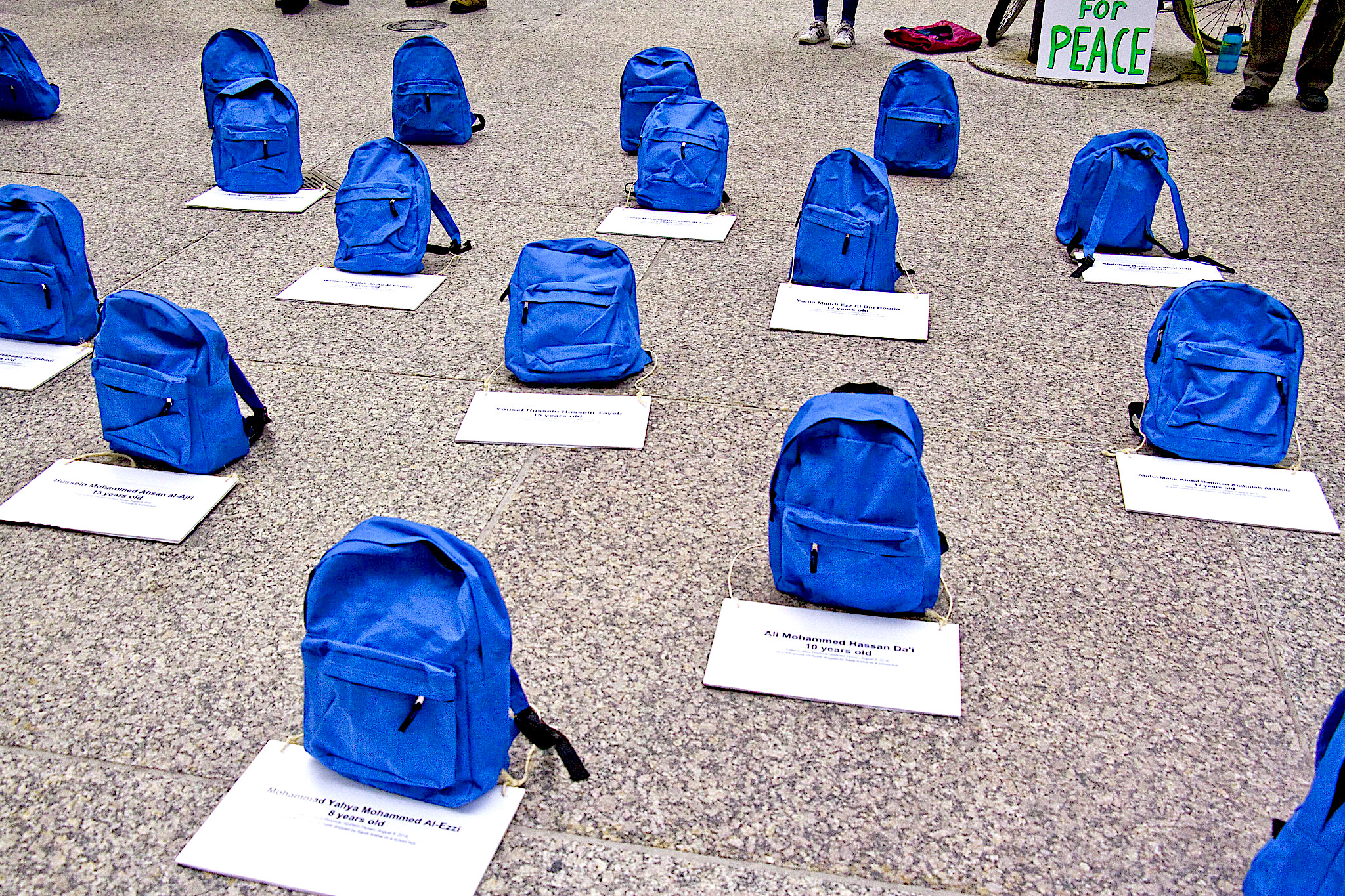
2018 Chicago protest against the Saudi war in Yemen. The blue backpacks stand for each one of the children killed in the Saudi attack on a school bus with a bomb manufactured by Lockheed-Martin. (Charles Edward Miller, Flickr, CC BY SA-2.0)
If Saudi Arabia is Washington’s biggest customer, then Israel is its prime recipient of welfare. A study from Brown University found that in the two years following the Oct. 7, 2023 attack, the United States spent $21.7 billion on military aid to Israel, including aircraft, missiles and all manner of small arms munitions.
Israel has used these weapons to systematically target children in Gaza and beyond. At least 97 percent of schools in the densely-populated strip have been hit. One of the more notable examples was the Khadija Girls’ School in Deir al-Balah, which was targeted on July 27, 2024. A Human Rights Watch investigation found that Israel dropped at least two GBU-39 bombs on the school – munitions manufactured in the United States by Boeing.
An Israeli air strike on Khadija Girls’ school on Saturday in Deir al-Balah killed at least 30 Palestinians, including 15 children, and injured more than 100. Family members of two of the victims of the attack search for their missing loved ones. pic.twitter.com/PViIzkxIzJ
— Palestine Info Center (@palinfoen) July 28, 2024
Thus, while arms manufacturers read fairytales to Western kids, children across the world are forced to live out a very real nightmare, thanks in no small part to these companies.
Whether they live in the United States or one of the countries under its boot, however, children everywhere are being targeted by these weapons firms, though in different ways. In the United States, Raytheon, Lockheed Martin, Boeing, and others have stepped in to bolster cash-strapped education departments. While their rhetoric emphasizes empowering children — especially girls — to follow their science dreams, their true intent is to launder their reputations as merchants of death, and to train up the next generation of Americans to become willing members of the American war machine.
Children on the other side of the globe, however, are given no such illusions, and have to live with the constant terror that they will be these companies’ next victims. This image, is not the one the likes of Raytheon want us to think about when we picture their products, and so they spend millions attempting to distract us with stories of empowerment and discovery. What a world we live in, where weapons companies are training kids to bomb kids.
Alan MacLeod is senior staff writer for MintPress News. He completed his PhD in 2017 and has since authored two acclaimed books: Bad News From Venezuela: Twenty Years of Fake News and Misreporting and Propaganda in the Information Age: Still Manufacturing Consent, as well as a number of academic articles. He has also contributed to FAIR.org, The Guardian, Salon, The Grayzone, Jacobin Magazine, and Common Dreams. Follow Alan on Twitter for more of his work and commentary: @AlanRMacLeod.
This article is from MPN.news is an award winning investigative newsroom. Sign up for their newsletter.
The views expressed are solely those of the author and may or may not reflect those of Consortium News.
Please Donate to
CN’s Summer
Fund Drive!


[ad_2]
Source link
