
[ad_1]
Austin D. Sarat
Move over, Brad Raffensperger . He was the Georgia Secretary of State who, in January 2021, received a call from President Trump demanding that Raffensperger find more than 11, 000 votes for him in the aftermath of that year’s presidential election.
Referring to Joe Biden, the president said, “There was no way that they won. Ballots were dropped in massive numbers… (T)hey’re massive numbers and far greater than the 11,779. The other thing, dead people. So dead people voted. And I think the number is close to 5,000 people….We have all the votes we need. We won the state.”
Trump pressed Raffensperger. “So look. All I want to do is this. I just want to find 11,780 votes, which is one more than we…(need),” and assured him that “there’s nothing wrong with saying that you’ve recalculated.”
Later, Trump branded the call “perfect” and claimed that no one “had …problems with the call.’ They “didn’t voice any objections or complaints about anything that I said on the call, which could be construed as inappropriate.”
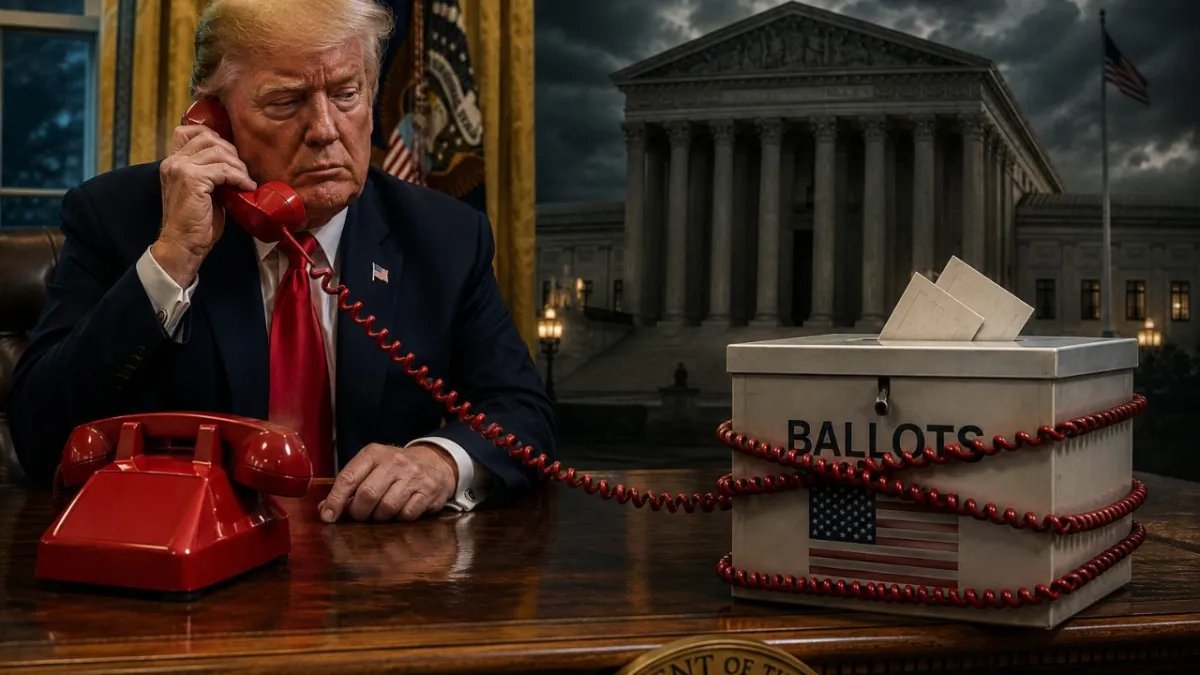
On June 5, this year, the president again picked up the phone to try to influence the results of another election, this one, California’s gubernatorial primary. He reached out to First Assistant U.S. Attorney Bill Essayli, the top official in the federal government’s Los Angeles office, and urged him to announce that he was launching an investigation into voter fraud.
Trump recounted what transpired this way: “Steve Hilton, who is running for governor. He was up in front, just about leading. No problem. Then all of a sudden, four, five days after the election is over, they said, ‘Steve Hilton is starting to lose votes.’”
“You look at what’s happening — it’s getting tighter and tighter and tighter,” he said. “And the people who were supposed to win, bad things are happening. It’s a crooked state.”
Soon after the call, Essayli complied with the president’s request.
Essayli posted on X that “California’s election system has serious structural vulnerabilities. Universal vote-by-mail with no voter ID requirements creates conditions where fraud can go undetected and unpunished, eroding public confidence… My office is also working closely with @AAGDhillon to conduct a comprehensive audit of California’s voter rolls.”
He went on to allege that “The state has stonewalled every effort to verify that only eligible U.S. citizens are registered to vote…My office will not look the other way. We will investigate and prosecute. Every legal vote deserves to be counted. Every illegal vote cancels one out.”
According to the Western Journal, members of Essayli’s office already “have visited ballot counting centers and cited structural vulnerabilities like universal mail-in voting without ID requirements.”
But remember the call that inspired those visits. Political influence.
That’s why Californians should be skeptical about whatever Essayli’s investigation yields.
This week, Trump came clean about the call. He told an audience at a rally in Pennsylvania that he “called up the very powerful, very good U.S. attorney in California. I said, ‘Do me a favor. Take a look.’”
Do me a favor? Is that now the basis for federal government investigations?
This was a rerun of the kind of appeal he made to Raffensperger five years ago: “Give me a break.”
As if such personalistic ways of doing business were not enough, the president took credit for doing in California this year what he failed to achieve in Georgia in 2021. He boasted to his followers on June 23: “About an hour after the call (to Essayli), ladies and gentleman, Mr. Hilton has won…“had I not made that call, Steve Hilton would be watching the election from home.”
California Governor Gavin Newsom took to social media to say: “Trump just admitted it. The President of the United States is personally directing federal prosecutors to start investigations into his political opponents when his preferred candidate may lose the election.”
That kind of election interference would ordinarily be a federal crime. Even for a person who was granted immunity from criminal prosecution by the United States Supreme Court, the president’s admissions were shocking.
For the first time in American history, the occupant of the Oval Office took credit for changing the result of an election.
But Trump’s assertion of voter fraud was baseless when he first made it, and it remains baseless now. Hilton himself said that “he has not seen evidence of fraud in the election.”
California Attorney General Rob Bonta called the president’s claims “truly embarrassing, unhinged, wild-eyed, dangerous, reckless, desperate. What’s your evidence for the bold claim you’ve made? He has none.”
There is not now, nor has there ever been, a serious voter fraud problem in California. If there were, the state attorney general and the secretary of state would be well equipped to deal with it without presidential interference.
The conservative Heritage Foundation has only identified 71 cases of voter fraud in the period 1982 to 2025.
It is true, however, that counting votes in California takes a lot of time. Hilton says that “the sluggish count has made California ‘a national and international laughingstock’”
But, ironically, the time allotted to counting the votes is a function of the care election officials take to ensure that every vote is legitimately cast. An article in the Fresno Bee quotes Eric McGhee, of the Public Policy Institute of California, and Mindy Romero, of the University of Southern California’s Center for Inclusive Democracy, who explained that given the state’s very large proportion of voting by mail, “’Signatures must be checked for each ballot to ensure the correct person submitted it. This is an election security measure meant to instill the confidence in elections that critics of the slow count say they want.’”
“Ironically then,” the article continues, “the state’s efforts to verify the legitimacy of ballots lengthen the count, which then leads to allegations that the count is being manipulated.”
The president ignores those efforts when he makes such allegations.
But whether they are or are not baseless, the president made clear when he phoned Essaayli that his campaign to weaponize the justice system has now come to California.
Californians, whatever their political affiliation, deserve better than that.
Austin D. Sarat is the William Nelson Cromwell Professor of Jurisprudence and Political Science at Amherst College. He is an internationally renowned scholar whose interdisciplinary work examines law in relation to culture, violence, and the liberal arts. His academic foundation includes a B.A. from Providence College (1969), an M.A. (1970) and Ph.D. (1973) from the University of Wisconsin, and a J.D. from Yale Law School (1988). He has also received honorary degrees, including an LL.D. from Providence College (2008) and an A.M. from Amherst College (1984). Sarat has also been awarded the Jeffrey B. Ferguson Memorial Teaching Prize at Amherst in 2022 and the Ronald Pipkin Service Award as well as many others
[ad_2]
Source link
