
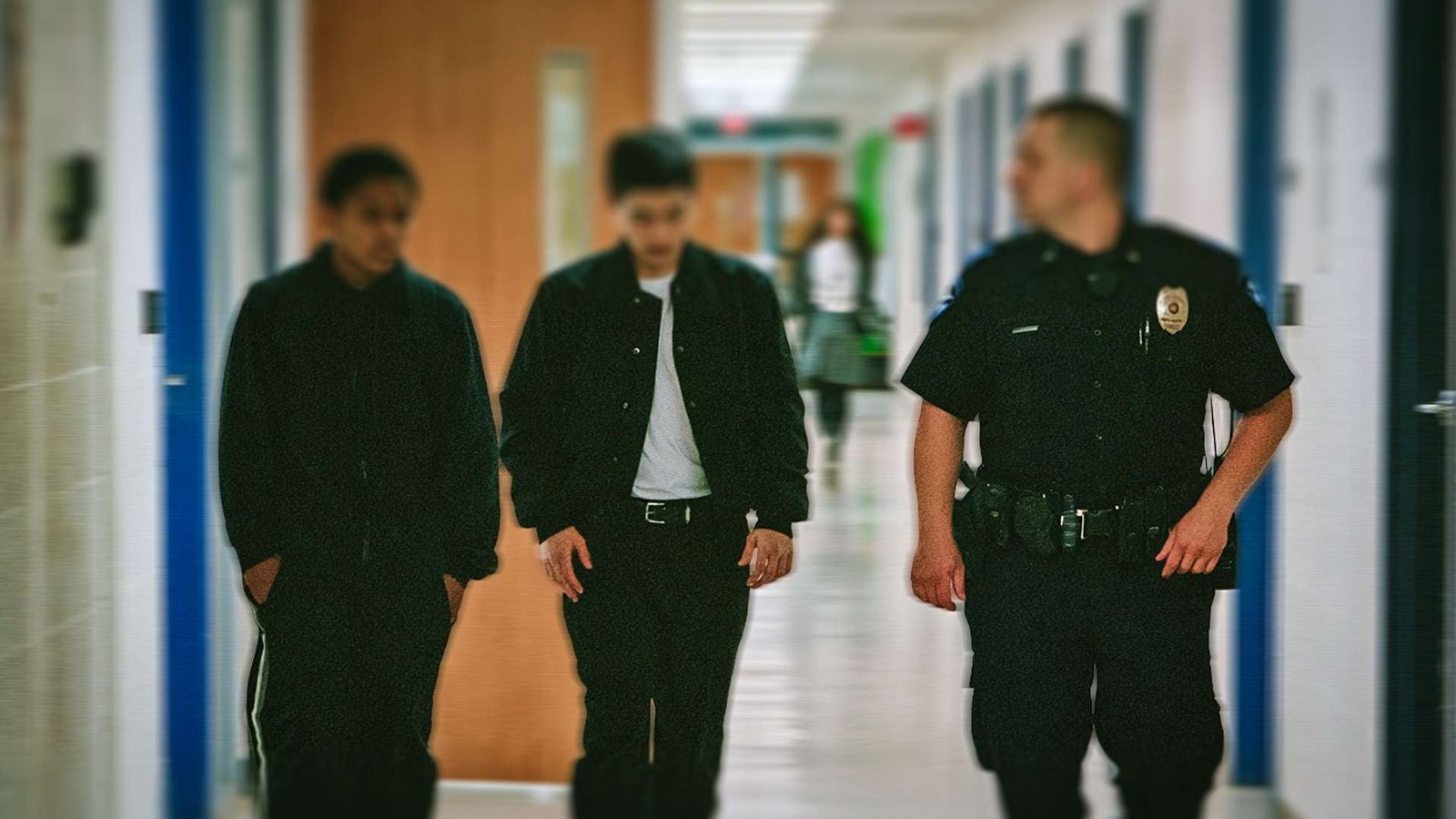
Police officers were placed in Iowa schools to keep students safe from violence, but the threat they most commonly deal with is illicit vaping, according to a report released today by the American Civil Liberties Union (ACLU) of Iowa.
The ACLU of Iowa used public records requests and federal data to study the impact of the increase in school resource officers (SROs) across school districts in the state. The report cited examples of what the civil liberties group says is the unnecessary use of SROs to handle classroom discipline issues: Besides fighting the proliferation of tobacco and THC vapes, SROs in the state were called in to deal with a 7-year-old boy running through the hall and a disruptive 6-year-old. They also investigated students for such behavior as being “disrespectful” in class and “drama with a group of girls.”
The number of police in schools nationally has dramatically increased in recent years, growing by 23 percent at high schools, middle schools, and elementary schools between 2018 and 2021, largely under the justification of stopping mass shootings and handling violent situations.
The ACLU of Iowa report didn’t find evidence that police made schools safer, but instead that black and disabled students were disproportionately subjected to police referrals and arrests, and that the presence of SROs generally tended to escalate minor infractions.
“Without question, nothing could be more important than keeping kids safe, but unfortunately there’s no evidence that SROs make schools safer,” Rita Bettis Austen, the legal director of the ACLU of Iowa, said in a press conference today. “In fact, research shows it creates harm for many students. It does this by taking incidents that have been traditionally treated less harshly and instead refers kids to police. This can funnel kids into the juvenile delinquency and adult court systems.”
Organizations like the National Association of School Resource Officers (NASRO) say that carefully selected, well-trained officers act as a filter and decrease arrests by building strong relationships within the school with staff and students.
Civil liberties groups and disability advocates have long argued that increases in school police and zero-tolerance policies for petty disturbances have fueled the “school-to-prison” pipeline and led to disproportionate enforcement against minorities and students with disabilities. Those groups have been aided by viral news stories of police arresting and assaulting school children.
Following the police killing of George Floyd in 2020 and national calls for police reform, several major school districts across the country ended their SRO programs, including in Des Moines and Ames, Iowa, in 2021.
However, a school shooting in Perry, Iowa, in 2024 prompted state lawmakers to pass a bill designed to increase armed guards or law enforcement in schools.
The ACLU of Iowa’s survey found that there were 130 SROs employed across 78 school districts in Iowa, and that roughly a quarter of school districts in the state employed at least one SRO.
The report’s authors said that the most concerning finding was the disparities in enforcement. The report found that although black students in Iowa make up 7 percent of the population, they accounted for 13 percent of referrals and 21 percent of arrests, “even though national studies indicate that black students do not actually misbehave or commit crimes in schools at a higher rate.”
Likewise, 13 percent of the students in Iowa have a disability, but they accounted for 27 percent of SRO referrals and 26 percent of arrests.
ACLU of Iowa legal fellow Jacob Sarasin said he was also “shocked that 80 percent of school districts have no meaningful policy” on training requirements for SROs.
The report concluded that many school districts and law enforcement agencies lacked adequate training requirements for SROs, failed to routinely evaluate SRO programs, and lacked policies for notifying parents when their children are detained or questioned by SROs, even though state law requires such notifications. Most districts also lacked mechanisms for parents and students to lodge complaints about SRO misconduct.
The study found that the most common reason for SRO interventions was students getting caught vaping THC or nicotine.
“Vaping does not require an armed police officer to address,” the report said.
Other studies have also reported similar findings. A study published in 2020 found that after Florida more than doubled the number of SROs in schools across the state in 2018, the number of school arrests—which had been declining for years—suddenly started to rise. There was also a sharp increase in the use of physical restraint against students.
A 2021 working paper by the Annenberg Institute at Brown University, which billed itself as the broadest and most rigorous examination at the school level of how SROs impact student outcomes, found that while SROs “do effectively reduce some forms of violence in schools,” they did not prevent school shootings or gun-related incidents.
Another study by researchers at the University of Maryland and the firm Westat, who studied several dozen middle and high schools in California, found that increasing the number of SROs led to both immediate and persistent increases in the number of drug and weapon offenses and the number of suspensions and expulsions of students.
