
[ad_1]
During a worship service at the Pentagon on Wednesday, Defense Secretary Pete Hegseth read a prayer to bless the government’s war efforts in Iran, which “was shared to him by the lead planner” of the Combat Search and Rescue operation (CSAR) that “rescued two Air Force crew members shot down over Iran,” reports USA Today.
“The path of the downed aviator is beset on all sides by the iniquities of the selfish and the tyranny of evil men,” Hegseth read. “Blessed is he who, in the name of camaraderie and duty, shepherd the lost through the valley of darkness, for he is truly his brother’s keeper and the finder of lost children. And I will strike down upon thee with great vengeance and furious anger those who attempt to capture and destroy my brother. And you will know my call sign is Sandy One when I lay my vengeance upon thee, and amen.”
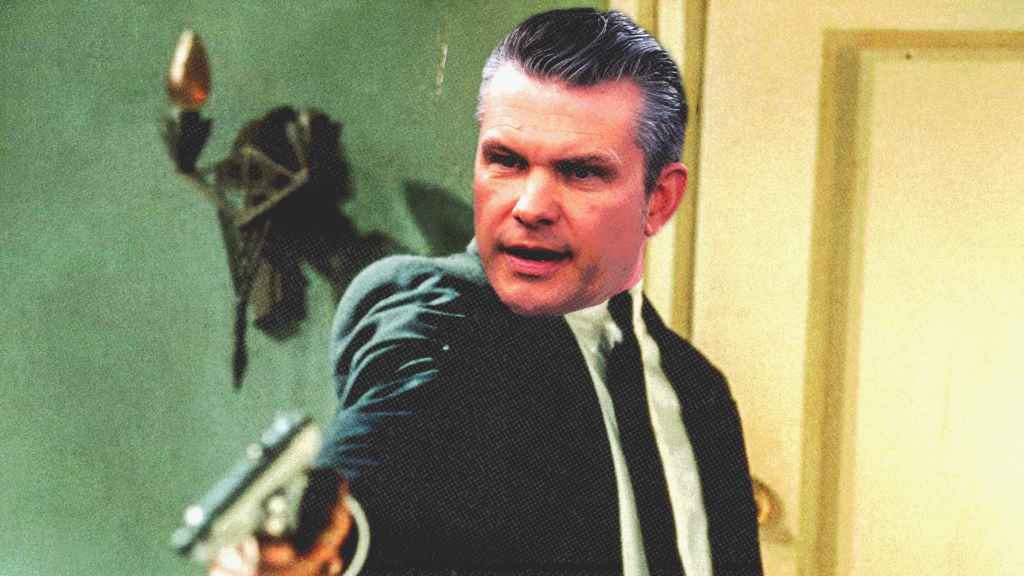
The prayer, known as CSAR 25:17, is “meant to reflect Ezekiel 25:17,” according to Hegseth. This passage foretells a “great vengeance” against ancient Israel’s enemies for taking “revenge with malice in their hearts” against the nation. While CSAR 25:17 is supposedly meant to “reflect” scripture, it reads closer to Samuel L. Jackson’s monologic prayer from Pulp Fiction. In it, Jackson’s hitman character declares that “the path of the righteous man is beset on all sides by the inequities of the selfish and the tyranny of evil men” and “you will know my name is the Lord when I lay my vengeance upon you,” before killing a guy who had been stealing from his boss.
Hegseth’s Wednesday prayer was not the first time he has used scripture or the Christian faith out of context to support the administration’s illegal war. Last month, in the first Pentagon worship service since the war started, Hegseth used a mix of Bible verses and metaphors to ask God to “break the teeth” of the Iranian oppressors and give the United States success in its efforts. President Donald Trump, meanwhile, has said that God supports the U.S.-Israeli campaign against Iran because “God wants to see people taken care of.” Comments like these led Pope Leo XIV on Thursday to condemn “a handful of tyrants” who “manipulate religion and the very name of God for their own military…and political gain.”
Indeed, the Trump world has time and again exploited the faith of the president’s supporters to further a political agenda that expands the state’s power and perpetuates civil liberties violations. In February 2025, the president signed an executive order that established a federal task force to “eradicate anti-Christian bias” in the U.S., which the Interfaith Alliance recently warned will “weaponize a narrow understanding of religious freedom to legitimize discrimination against marginalized groups,” including the LGBT community.
After the killings of Renee Good and Alex Pretti at the hands of federal agents earlier this year, Speaker of the House Mike Johnson (R–La.) defended the administration’s deportation campaign on Facebook by citing Romans 13, where apostle Paul directs Christians to submit to “governing authorities.” The post received backlash from the faith community, including from Benjamin Cremer, a pastor who writes about the intersection of politics and Christianity, who called Johnson’s interpretation of the scripture “to sanctify a vision of government authority that demands submission while refusing accountability….not a faithful reading of the text.”
In Oklahoma, Christian nationalist politicians have tried to force their beliefs by proposing strict penalties on pornography and mandating Bibles—notably, Trump-endorsed Bibles—in classrooms. Louisiana, meanwhile, recently saw its law requiring the Ten Commandments to be displayed in classrooms struck down in court and later allowed to temporarily proceed in some districts while the legal battle continues.
Hegseth may very well believe that the U.S. is fighting a holy war in Iran and that God is on his side. But as the Trump administration has repeatedly shown, when politicians use faith to justify expansions of the state and illiberal policies, Americans ought to be skeptical of their motivations and the movement that brought them into power.
[ad_2]
Source link
