

[ad_1]
Announcing a pause on more than $1 billion in Medicaid funding to Minnesota and California last month, Centers for Medicare & Medicaid Services Administrator Dr. Mehmet Oz accused state officials of being too lax about fraud, citing among other things the results of a provider verification process in Minnesota and the rapid growth of a California home care program. But he left out important context in both cases.
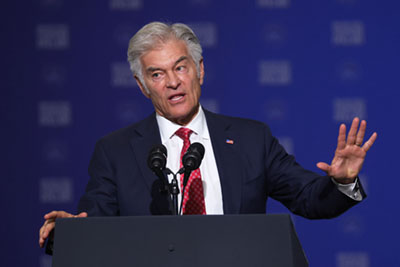
Oz said at the July 21 press conference that Minnesota disenrolled 3,000 healthcare providers “who historically could send bills willy-nilly,” calling into question whether their previous claims were legitimate. Many of those providers, however, have said they were disenrolled in error as the state rushed to meet a federally imposed deadline. Most providers have appealed, and hundreds have been reinstated. The agency that runs Minnesota’s Medicaid program has said the verification process “was not a fraud determination.”
Oz also claimed spending on a California Medicaid program that provides in-home care to seniors and people with disabilities is growing at a rate that “doesn’t make sense.” State officials and California policy experts say there are other reasons for that growth, including an aging population, minimum-wage increases and policies meant to keep more people out of nursing homes.
Last month’s announcement, at which Oz was joined by Health and Human Services Secretary Robert F. Kennedy Jr. and other federal officials, was the latest salvo in the Trump administration’s ongoing efforts to pressure states over what it says is widespread fraud in Medicaid. The public insurance program, jointly funded by the federal government and the states, provides health coverage to more than 66 million low-income people.
Minnesota and California, both of which are run by Democratic governors, have become a particular focus of that effort. Earlier this year, the Centers for Medicare & Medicaid Services paused $351 million in federal Medicaid reimbursements to Minnesota and $1.3 billion in reimbursements to California, which officials said was the largest deferral in CMS’ history. Those are in addition to the $1 billion in deferrals announced in July.
More broadly, the administration has sought to make fraud in federal programs a central issue, appointing Vice President JD Vance to lead a White House task force on fraud and framing cuts to healthcare programs in last year’s budget reconciliation bill in terms of “eliminating waste, fraud, and abuse.”
Fraud exists in Medicaid, as it does in Medicare and other federal health programs, though experts say it’s hard to put a precise number on it. The latest government estimates suggest that “improper payments” as a whole account for about 6% of Medicaid spending, though CMS itself has said much of that involves documentation issues or administrative errors unrelated to fraud.
During the press conference on July 21, Oz said CMS’ reviews of Medicaid spending in Minnesota and California had identified statistical “outliers” and “anomalies” that the states had not accounted for, but he did not present evidence of widespread fraud.
Those reviews “turned up the same, recurring theme again and again, every single quarter,” he said. “Claims in these same high-risk categories that the states have not yet been able to document fully and acceptably to the federal government, claims that are unresolved and claims that smell like fraud. And if it smells like fraud, we’re not paying for it anymore.”
A spokesperson for the Minnesota Department of Human Services disputed Oz’s characterization of the state’s revalidation process, noting that only a few hundred providers have actually been terminated to date because most others appealed, and said CMS has given the state few details about other spending it flagged as questionable.
“[W]e firmly believe that the actions we have taken — and will continue to take — are tangible measures that will help ensure program integrity while keeping Minnesotans who rely on these programs at the forefront,” the spokesperson told us in an email.
Anthony Cava, a spokesperson for the California Department of Health Care Services, said federal officials are “penalizing California for responsible, federally encouraged growth in home‑based care, which saves taxpayers approximately $100,000 per person annually by keeping people safely at home rather than in institutions.”
We asked CMS and HHS several questions about the evidence behind Oz’s claims, but have not received a response to our queries. Here’s a closer look at some of those claims, as well as what we know about fraud in Medicaid generally.
Provider Disenrollment Not the Whole Story in Minnesota
Oz, in the July 21 press conference, said the majority of the $199 million that CMS deferred from Minnesota last month was tied to claims by thousands of providers that were later disenrolled when the state sought to check their credentials.
“Minnesota, in particular, was asked to audit all the people providing services in these high [fraud] risk areas,” Oz said. “And Minnesota itself disenrolled roughly 3,000 providers — 3,000 providers who historically could send bills willy-nilly and be fine. They themselves have disenrolled them for failed background checks, failed site visits and other issues.
“This raises questions about the claims tied to these same providers in the quarter before they were removed. … We looked back to see how much they billed us last quarter, and unfortunately it was a lot.”
There have been valid concerns about fraud in certain Medicaid programs in Minnesota, and it’s true that the state recently informed thousands of businesses and nonprofits that they would be terminated from Medicaid because they failed to complete a revalidation process. But there’s a lot more to the story than Oz revealed at the press conference.
Earlier this year, Minnesota agreed to a series of anti-fraud measures after federal officials threatened to withhold an additional $2 billion in annual Medicaid funding. One of those steps was to revalidate more than 5,000 providers in more than a dozen service areas that a state auditor had deemed especially vulnerable to fraud, including certain autism, mental health and disability services.
State officials told the Minnesota Star Tribune that they faced immense pressure from the federal government to complete that process in a matter of months, ahead of a May 31 deadline, even though reviewing paperwork and conducting site visits for that many providers would normally take years. The state subsequently notified 3,411 providers that they would be terminated from Medicaid because they had not met the requirements in time.
The move caused an outcry among providers, many of whom described a rushed and error-prone process in interviews with local news outlets. Some said they submitted the necessary documents, but the state never got around to reviewing their paperwork or conducting a site visit before terminating them.
More than 2,700 of those providers have since appealed, and 748 of them had been revalidated as of July 23, according to a spokesperson for the Minnesota Department of Human Services. Those with pending appeals have been allowed to continue billing Medicaid.
That means just 550 providers had actually been disenrolled as of July 23. The spokesperson said that includes 426 providers that did not appeal and 124 that were terminated for other reasons, including changes in ownership, expired licenses or exiting the program voluntarily.
The Department of Human Services has also been clear that a provider being disenrolled, in itself, is not a determination they were involved in fraud. Almost three-quarters of the initial 3,411 disenrollments were due to incomplete or inaccurate paperwork, with most others due to “failed site visits.” Only two failed background checks.
The department says only 59 of the more than 5,000 entities reviewed were flagged for further investigation, due to issues like not disclosing people with an ownership stake or misrepresenting who worked at the business.
We asked CMS whether it has other reasons to doubt those 3,411 providers’ past claims, but did not get a response.
Oz said CMS also used “fraud detection analytics” to flag hundreds of providers that were “of a character that historically defrauded the government,” which accounts for another $42 million or so of the deferral. Around $3 million more, he said, is tied to “specific documentation gaps,” such as allegedly billing for services provided after a beneficiary’s death.
CMS did not respond to our questions about those statements, either. The Department of Human Services spokesperson said CMS has not explained to state officials how it came up with those figures.
“As of this writing, CMS has not shared analytics it uses to identify billing patterns or any specific concerns it has related to issues of fraud, waste, or abuse,” the spokesperson told us in an Aug. 4 email.
Analysts Say Policy, Demographic Changes Driving California’s Home Care Spending
As for California, Oz said about three-quarters of the $867 million being deferred is tied to the state’s In-Home Supportive Services program.
IHSS covers in-home assistance, including help with bathing, dressing and other personal care, for older adults and people with disabilities who might otherwise require care in a nursing home or other facility. Every state Medicaid program offers something similar, in order to allow more people to stay in their homes while reducing the need for more costly institutional care.
At the July press conference, Oz suggested California’s home care program is growing at a suspiciously fast rate. That alone accounted for $391 million of the deferred funds, he said.
“Over the past two federal fiscal years, California’s spending in this program — this is a critical statistic — comparing state to state, California’s spending in these in-home programs went up 24%,” he said. “The rest of the country’s average is about 12%. So California increased spending at twice the rate of the average of the rest of the entire nation. That doesn’t make sense.”
Oz said CMS deferred an additional $250 million after flagging certain IHSS providers as “high risk” based on billing patterns, and another $5 million or so tied to other red flags, mainly IHSS providers who allegedly billed for home-care services when their patients were in the hospital.
This isn’t the first time Oz has singled out the state’s IHSS program. Announcing a previous funding deferral during a press conference at the White House in May, Oz also brought up the growth of California’s program.
“People in New Mexico, which is a blue state, are paying extra taxes so that California can get away with something that they can’t defend,” he said.
There have been documented cases of fraud in the IHSS program, but they represent a small fraction of the program’s total budget.
In the 2023-2024 state fiscal year, for instance, counties referred a total of $3.1 million for administrative action or prosecution after investigating complaints of fraud, according to the California Department of Social Services’ most recent program integrity report. (Counties help administer the program in California.) Total spending on IHSS that year topped $22 billion.
Jason Montiel, a spokesperson for the department, told us that counties received about 7,000 complaints of potential fraud that year and referred a little over half of them for revenue recovery. “For context, statewide, there are currently over 850,000 IHSS service recipients and over 765,000 IHSS providers,” he told us in an email.
California’s Department of Health Care Services referred 15 credible allegations of fraud involving IHSS to state prosecutors in state fiscal year 2024-25 and 12 in 2025-26, California State Medicaid Director Tyler Sadwith wrote in a Feb. 17 letter to CMS officials.
Sadwith wrote that such cases can include caregivers billing for services at times their patients were in a hospital or other institution and “check splitting involving collusion between IHSS provider and beneficiary/member.” IHSS cases “generally involve lower dollar amounts” relative to other types of Medicaid fraud investigations, he added, “with typical suspected fraudulent amounts averaging around $30,000 per investigation.”
Some IHSS caregivers in California have indeed been prosecuted for allegedly claiming to have provided services to patients who were hospitalized, incarcerated or out of the country. The U.S. Department of Justice has included a handful of such cases, all brought by state prosecutors, in annual news releases touting healthcare fraud “takedowns” over the past three years.
But California state officials, as well as policy experts we spoke to, rejected the idea that fraud is widespread in IHSS or the reason for the program’s recent growth.
We asked CMS for the source of Oz’s statistic about home care spending growth in California relative to other states, and we haven’t received a response. Still, he’s generally correct that spending has increased. The program is expected to cost around $33 billion in the 2026-27 fiscal year, a 10% increase from the prior year, according to the California Legislative Analyst’s Office.
A recent analysis from that office — which is a nonpartisan body advising the state Legislature — identifies three main drivers of rising costs. First, more people qualify for the program due to the state’s aging population, an increase in the share of Californians that have a disability and policy changes that have expanded eligibility. Second, the average recipient is also receiving more hours of care. Finally, the cost per hour of care has also gone up, driven in part by increases in the state minimum wage.
California Medicaid officials have cited those factors in responding to questions about the program’s growth from CMS.
“Caseload increases reflect California’s Medicaid expansion and its aging population,” Sadwith, the state Medicaid director, wrote in the Feb. 17 letter to CMS. “Higher approved service hours correspond to increased acuity and functional need. Rising expenditures also reflect legislatively mandated minimum wage increases, which have helped to recruit and maintain the workforce necessary to meet CMS’s and California’s longstanding goals of transitioning toward home and community.”
Sadwith added that California has sought to broaden access to in-home care as part of a strategy to reduce the number of people in nursing homes — a longstanding goal of federal Medicaid policy, because it both saves money and allows more people to age at home, which most want. He cited data from the nonpartisan health policy research group KFF showing that 96% of California’s Medicaid spending on long-term care in federal fiscal year 2024 went to home and personal care rather than institutional care, compared to 69% nationally.
“CMS highlights the increase in IHSS expenditures … as a cause for concern, suggesting this figure signals excess or abuse,” he wrote. “In reality, it reflects the expansion of access to services that CMS itself has encouraged states to pursue for decades.”
Two outside policy experts who follow Medi-Cal, as it’s called in the state, similarly told us that state-level policy changes, demographics and other factors likely explain the growth.
“We’ve changed, for example, asset limits in terms of being eligible for these types of services,” said Shannon McConville, a senior fellow with the Public Policy Institute of California. “There’s also been some expansions in the program in terms of immigration status.”
(Federal Medicaid dollars can’t be spent on care for immigrants living in the country illegally, as well as some immigrants with legal status, other than emergency care; California has used its own funds to expand coverage to those groups.)
“I have not seen any evidence that indicates fraud as a driver of these spending trends,” Laurel Lucia, the deputy executive director of programs at the University of California Berkeley Labor Center, which has published research on IHSS, told us by email.
Rather, she said, “IHSS spending has grown rapidly in recent years due to the increased need for home care among seniors and individuals with disabilities, and increased home care worker wages.”
Lucia noted that the average hourly wage for IHSS providers rose more than 50% between 2018 and 2024. “This growth largely mirrored the growth in the statewide minimum wage, a unique factor given that California has one of the highest state minimum wages in the country,” she said.
California’s minimum wage rose from $10.50 or $11 per hour (depending on employer size) in 2018 to $16 per hour in 2024. A law mandating higher minimum wages for certain healthcare workers, including employees of licensed home healthcare agencies, took effect in late 2024.
Those higher wages reduce turnover among caregivers, “which is critical to continuity of care for the seniors and people with disabilities who rely on IHSS,” she added.
We asked CMS what evidence it has that fraud is driving increased spending on home care in California and why it rejected state officials’ explanation for that growth, but have not gotten a response.
Andy Schneider, a research professor of the practice at Georgetown University, told us it’s not unreasonable for an administration to say home care in general could pose some “unique program integrity risks” and work with states on better anti-fraud measures. For instance, it may be easier for dishonest providers to submit false timesheets for care that takes place outside a hospital or other institution; a number of such cases are prosecuted every year in states across the country.
But that doesn’t prove that fraud accounts for a major share of program spending.
“CMS asked in January for a lot of information, and I think they got it in this [Feb. 17] letter [from state officials], and they evidently don’t agree with the answer,” said Schneider, who served as a senior adviser to CMS under former President Barack Obama. “But it’s not clear to me what more California can tell them. And there’s no regulatory prohibition against spending more money, at a faster rate, than other states on a particular service, if you’ve made it a policy decision that you want to make it possible for as many people with disabilities and as many elderly people who want to stay out of institutions to do so.”
Estimates of Medicaid Fraud Are Murky
As for fraud in Medicaid overall, some degree of it clearly exists, as it does in other government programs. But there’s “no comprehensive or reliable measure” of its prevalence, as analysts with KFF put it last year.
“Measuring fraud is difficult, in part, because it can only be determined with certainty after the fact and if it is identified,” they wrote.
The federal government does estimate the rate of “improper payments” for certain programs, including Medicaid. The most recent estimate for Medicaid is 6.12%. But that’s not an estimate of fraud.
While improper payments can include fraud, they also include incorrect payments due to administrative errors and payments that weren’t properly documented. According to CMS, 77% of improper payments in fiscal year 2025 stemmed from insufficient documentation, “which is generally not indicative of fraud or abuse.”
The federal government also compiles reports on fraud prosecutions. In fiscal year 2025, state Medicaid Fraud Control Units reported recovering a total of $2 billion from civil and criminal cases involving either fraud or abuse and neglect. (For context, combined state and federal Medicaid spending is more than $900 billion per year.) Separately, federal agencies recovered $3.4 billion from fraud cases involving Medicaid, Medicare and other healthcare programs in fiscal year 2023, the most recent for which data are available.
Of course, that counts only cases that prosecutors know about and think they can prove in court, so it’s likely an underestimate.
“I can’t give you a quantitative answer” about the extent of fraud in Medicaid, Schneider told us. “I don’t think anybody can.”
One thing we can glean from those reports is that most documented Medicaid fraud is committed by providers — for instance, billing for nonexistent or unnecessary services — and not by beneficiaries, as Schneider wrote in an analysis for the Georgetown Center for Children and Families last year. Fraud by beneficiaries, he wrote, accounts for a “negligible” portion of both convictions and recovered funds reported by state fraud-control units.
States and the federal government share responsibility for policing fraud, and ensuring program integrity more broadly, with CMS and other federal agencies overseeing states’ administration of the program.
As part of its routine oversight, CMS reviews states’ expenditures and claims for federal reimbursement every quarter. In a program as large and complex as Medicaid, Schneider said it’s normal to have disputes over which claims are allowable or how much the federal government owes. In those cases, CMS will often defer payment until state and federal officials sort out the issue.
But Schneider said the Trump administration is using the deferral process in unprecedented ways.
“You don’t see the agency holding a press conference with the vice president in the White House to announce a large deferral — and in the case of the first California deferral, a historic deferral in size — against one or two particular states,” he said. “It’s just not the way CMS has interacted with states in the past. They’re trying to make the program work. It’s not a gotcha.”
Editor’s note: FactCheck.org does not accept advertising. We rely on grants and individual donations from people like you. Please consider a donation. Credit card donations may be made through our “Donate” page. If you prefer to give by check, send to: FactCheck.org, Annenberg Public Policy Center, P.O. Box 58100, Philadelphia, PA 19102.
[ad_2]
Source link
