
[ad_1]
HUNTINGTON BEACH — In a state that hasn’t elected a Republican governor in nearly two decades and where Democrats outnumber Republicans nearly two to one in registered voters, Tuesday night belonged to two conservative political outsiders who based their campaigns on a simple message: Californians deserve better.
Former Fox News host Steve Hilton and reality television veteran Spencer Pratt arrived at their respective races with thinner war chests than their establishment rivals, no prior experience in elected office, and campaigns built less on policy infrastructure than on raw charisma, populist messaging, and an uncomplicated argument: that California leaders had failed, and that change – dramatic, disruptive change – was long overdue.
By the time the first results came in Tuesday night, both men were outperforming what most political handicappers had predicted would be strong showings in California’s already tumultuous jungle primary where the top two vote-getters, regardless of party, advance to the general election.
The Jacket
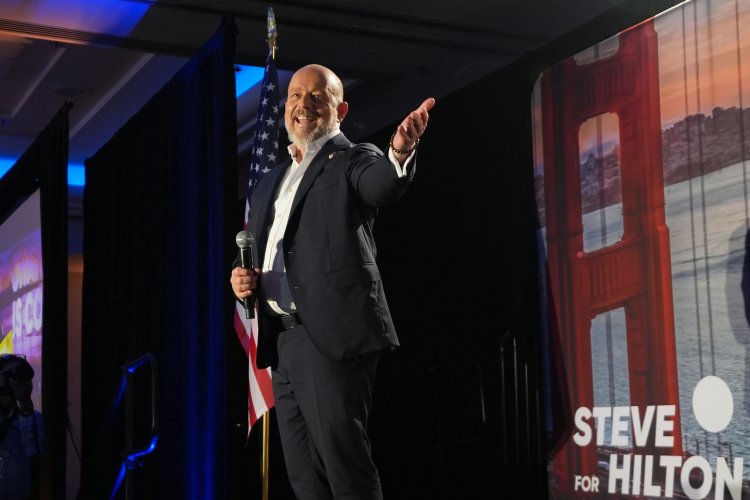
If there was a single image that captured the ebullient mood of the evening for California Republicans, it came from Steve Hilton’s election night gathering, where the British-born candidate shared a light-hearted conversation he had with the last Republican governor of the state.
Hilton told his supporters a story about Arnold Schwarzenegger. When he became an American citizen, Hilton said, Schwarzenegger sent him a congratulatory video.
“He said, ‘But Steve, you got the wrong jacket. You got the wrong jacket,’” Hilton recalled to laughter from the crowd.
“And I made a pledge that day that one day I would get the jacket that Arnold told me to get on my road to being governor of California.”
Hilton opened his jacket to the crowd to reveal that the internal lining was an American flag on one side and the California state flag on the other.
“And here it is. I am a proud American. And I am a very proud Californian tonight. Arnold, that was for you!” he said, beaming.
The room erupted into chants of “U-S-A! U-S-A!” In a race in which Hilton had been dismissed by many as a novelty that would wear off, it captured a jovial and patriotic side of the British-born candidate who has made restoring California’s once golden allure a passion project.
With roughly half the ballots counted, Hilton had edged into the lead in the governor’s race, sitting one point ahead of Democrat Xavier Becerra and seven points clear of progressive billionaire Tom Steyer, who had spent more than $200 million of his own money on the campaign – the largest self-funded outlay of any candidate in the country this primary season.
Even before the final votes were counted for the night, Hilton was recalibrating for a broader general-election audience. Hilton struck a tone befitting a candidate running statewide in a deeply blue state rather than one firing up a conservative base.
When pressed on his strategy for winning the general election, Hilton spoke less about defeating Becerra than about uniting Californians. He framed his outsider status not as an ideological cudgel but as a fresh set of eyes on problems that career politicians had proven unable to solve.
“I’m here to fight for you and to help you have the chance at following your dream, whatever it is,” Hilton said. “That’s the whole point of my campaign – it’s practical things that will help everyone. It’s not ideological – it’s not even particularly partisan. It’s not about Democrat or Republican. It’s about change.”
Meanwhile, in Los Angeles
Roughly 50 miles north, Spencer Pratt was writing his own chapter in what was shaping up to be a remarkable night for California’s anti-establishment right.
With nearly half the votes counted, the reality show star-turned-political-insurgent appeared poised for a second act in his unlikely political career – and a potential runoff battle for the soul of Los Angeles.
Pratt was clearly feeling confident after amassing a sizeable lead for second place.
“Obviously, God wanted to give more months of me exposing all the failures of our mayor,” he told reporters outside a private election-watch party.
“It’s going to be a fun ride. I hope she’s ready.”
When a reporter asked Pratt if he was ready for the inevitably sharper attacks of a general election, Pratt expressed complete confidence.
“I was born for this – clearly,” he remarked.
Late Tuesday night Pratt found himself in a strong second place in the mayoral primary, pulling 30% of the vote and sitting nine points ahead of progressive city council member Nithya Raman. Incumbent Mayor Karen Bass led the field at 37% but fell well short of the 51% threshold needed to avoid a runoff.
If the results hold, Los Angeles voters will face a general election matchup few political observers would have predicted at the start of the cycle.
What set Pratt apart from other political outsiders was his willingness to weaponize artificial intelligence as a campaign tool – and his instinct for where voter anger was running hottest. His team deployed a steady stream of AI-generated imagery and video that depicted Bass and Gov. Gavin Newsom as cartoonish villains – literally, in some cases, rendering them as the Joker – and framed the city’s Democratic establishment as a detached elite presiding over a corrupt, drug-zombie-riddled Los Angeles in freefall.
The imagery was provocative by design, but it landed because it tapped into something real. Years of rising crime, tent encampments stretching across neighborhoods from Hollywood to Venice, and the Palisades and Altadena wildfire response that drew widespread criticism had left many Angelenos feeling abandoned by the leaders they had repeatedly elected. Pratt’s AI-powered broadsides gave voice to that frustration in a way that felt visceral and immediate – more social media provocation than traditional political ad. The conservative social media echo-sphere couldn’t get enough but no one could predict whether it would translate to a strong showing at the ballot box.
The strategy drew criticism from Bass’ camp and media commentators who called it manipulative and beneath the dignity of serious political discourse. But in a city where voters had grown tired of polished talking points and incremental promises, Pratt’s unfiltered approach found a receptive audience. His social media following swelled, his rallies grew louder, and what had once seemed like a publicity stunt began to look like a legitimate political movement.
Pratt ran an unapologetically combative campaign, hammering Bass on her handling of the January wildfires, the city’s persistent homelessness crisis, and a housing shortage that has driven residents out of California for years. Bass, who initially declined to engage with her unconventional challenger, eventually pushed back, dismissing him as a “TV reality star villain” while AI video after video cast Pratt as a superhero fighting the dark forces of L.A.’s Gotham-esque crime scenes.
On election night, Pratt held his celebration at Don Antonio’s in Sawtelle, reportedly barring press from the event – a break from longstanding tradition, though consistent with his anti-establishment message throughout the campaign.
The race is far from settled. Mail ballots, which tend to skew Democratic, have yet to be fully counted, and Raman remains within theoretical striking distance. Should she fall short, progressives will likely scrutinize the role played by Rae Huang, a Democratic Socialists of America candidate whose continued presence in the race may have divided the left-leaning vote and handed Pratt his standing.
Becerra’s Triumph
Back in the governor’s race, the Democratic establishment found itself represented by Becerra, who initially was far behind a leading pack of candidates but whose path to contention was cleared in part by circumstance.
When Democratic Rep. Eric Swalwell withdrew from the race following sexual-assault allegations, it created an opening the former attorney general moved quickly to fill.
Leaning into his long political resume, Becerra ramped up fundraising and secured the backing of major labor groups and prominent Latino legislative leaders – coalitions that helped carry him from the back of the pack to the front of the Democratic field.
That rise, however, brought new scrutiny. Rivals trained their fire on his tenure as Health and Human Services Secretary under President Biden, particularly his department’s handling of unaccompanied migrant children at the U.S.-Mexico border in 2021. HHS was responsible for the shelters where those children were housed, and critics argued the conditions there and the administration’s failure to keep track of the children after they left the federal government’s care reflected poorly on his leadership – a line of attack that complicated his attempt to present himself as the steady, experienced hand in the race.
Yet, in deep-blue California, Becerra will be hard to beat in November. He enters a general election as the Democratic institutional favorite, and his highly scripted yet still personal and compelling remarks Tuesday night signaled his frontrunner status.
At his election night gathering, the former attorney general cast himself not as the establishment favorite painted by his rivals, but as something far more personal: the son of immigrants, the product of sacrifice, a candidate who had been counted out at nearly every turn and kept going anyway.
“L.A. is the starting line for millions of success stories across this state,” he told supporters, “and here in Hollywood’s hometown, we love a good underdog story.”
He then offered his own. His parents, he said, arrived in California as immigrants with little more than $12 and a green card, a construction worker and a clerical worker who faced long odds, hard obstacles, doubt, and discrimination.
“But they had grit, and game, and grace all wrapped up in one,” he said.
Decades later, their son – the first in his family to earn a university degree – had dared to run for governor of California, fueled by little more than grassroots support and sweat equity.
“Almost immediately, I was counted out – an afterthought, overlooked by many, outspent by a ton, even called along the way to drop out and save us all the trouble,” he said. “Guess what? I stayed in the fight. Like my parents, I never gave up, never stopped putting one foot in front of the other, never stopped believing in the beacon-like goodness of California. And thankfully – neither did you.”
Becerra then pivoted from biography to blueprint, outlining the kind of California he intended to build by stressing his plans to offer more public services and benefits to all Californians, including illegal immigrants. California Gov. Gavin Newsom had planned to reverse the expansion of health insurance to all undocumented migrants because of the state’s deep deficits. Becerra pledged to expand it to universal access across the state without mentioning the cost.
On climate, he vowed to expand California’s global leadership – safeguarding its air, water, and coastline – and drew one of his sharpest contrasts with Hilton in the process.
“We will never surrender the green growth jobs of the future to Washington politics or international competitors,” he said to sustained applause.
On education, he promised to invest in schools with genuine commitment, expanding early education, childcare, and paid family leave – pausing to add a pointed rhetorical flourish: “the real family values.”
And threading throughout was Becerra’s pledge to fight Trump. Where Hilton had argued that his relationship with the president was an asset – a bridge between Sacramento and Washington – Becerra framed it as precisely the disqualifying liability that California voters should fear most. A governor in the pocket of the White House, he suggested, was not a partner for California but a concession of everything the state had spent years defending.
Then Becerra reached for something bigger than policy – a sweeping, almost defiant vision of California’s place in the national story, and a direct challenge to the Trump era that drew the loudest response of the night.
“California is bigger than Trump,” he told the crowd, his voice rising. “Our values are undeniable and un-deportable.”
He painted a portrait of a political moment he argued was already turning against Trump’s populist movement, warning that when the pendulum swings back against what he called “the chaos, the cruelty, and the corruption,” little would remain of the MAGA movement but “broken promises, unpaid debts, and empty ballrooms.”
When that moment comes, he said, “the world will look once again for American renewal – and for the state of California to lead the way.”
It was a closing argument as much as a victory speech, and he delivered the final stretch in both English and Spanish, a deliberate signal to the coalition he was asking to carry him to November.
“This is your state,” he said. “Este es tu estado. We will not be bought. We will not be bullied. And we are never backing down.”
It was an obviously highly rehearsed and well-honed frontrunner message, playing to the state’s larger number of Democratic voters and Trump haters. Focusing a California campaign on fighting Trump is a tried-and-true tactic that had worked for several campaigns before – including last fall’s Prop 50 effort to gerrymander the state in Democrats’ favor and for Adam Schiff’s successful Senate run in 2024.
Yet Becerra’s remarks lacked any true embrace of the change California voters appear to be seeking.
Recent statewide polls indicate that a majority of Californians want a significant change in the state’s direction following outgoing Gov. Newsom’s tenure. Surveys show that 54% to 56% of voters desire a new approach to tackle key issues like crime, homelessness, and the high cost of living.
Abel Moldanado, who served as lieutenant governor during Schwarzenegger’s time in office, said during the primary that Becerra attracted Democratic base voters by hammering home anti-Trump themes and pointing out that he sued Trump 120 times as California attorney general.
“That’s not going to cut it for California voters, I don’t believe, in the next five months,” Moldanado told CNN Tuesday night. “They want to know what are you going to do to fix the state. This state is not in great shape – I think we all know that.”
“He’s got a tremendous voter registration advantage,” he acknowledged. “The question is, is he going to tell us what he’s going to do to fix it.”
CNN host Elex Michaelson then posed the clear question about whether it’s really necessary to outline a plan to save the state if the lopsided Democratic electorate will vote for Becerra regardless.
“Is it enough to say I’m the Democrat and I’m anti-Trump in deep-blue California?” Michaelson asked.
Whether California voters are truly ready for the change both Hilton and Pratt are promising – or whether late-counted ballots restore more familiar order – remains to be seen. But on Tuesday night, at least, the outsiders owned the room, edged out more progressive rivals, and shook up state politics more than anyone could have expected one year ago.
Susan Crabtree is RealClearPolitics’ national political correspondent.
[ad_2]
Source link
