
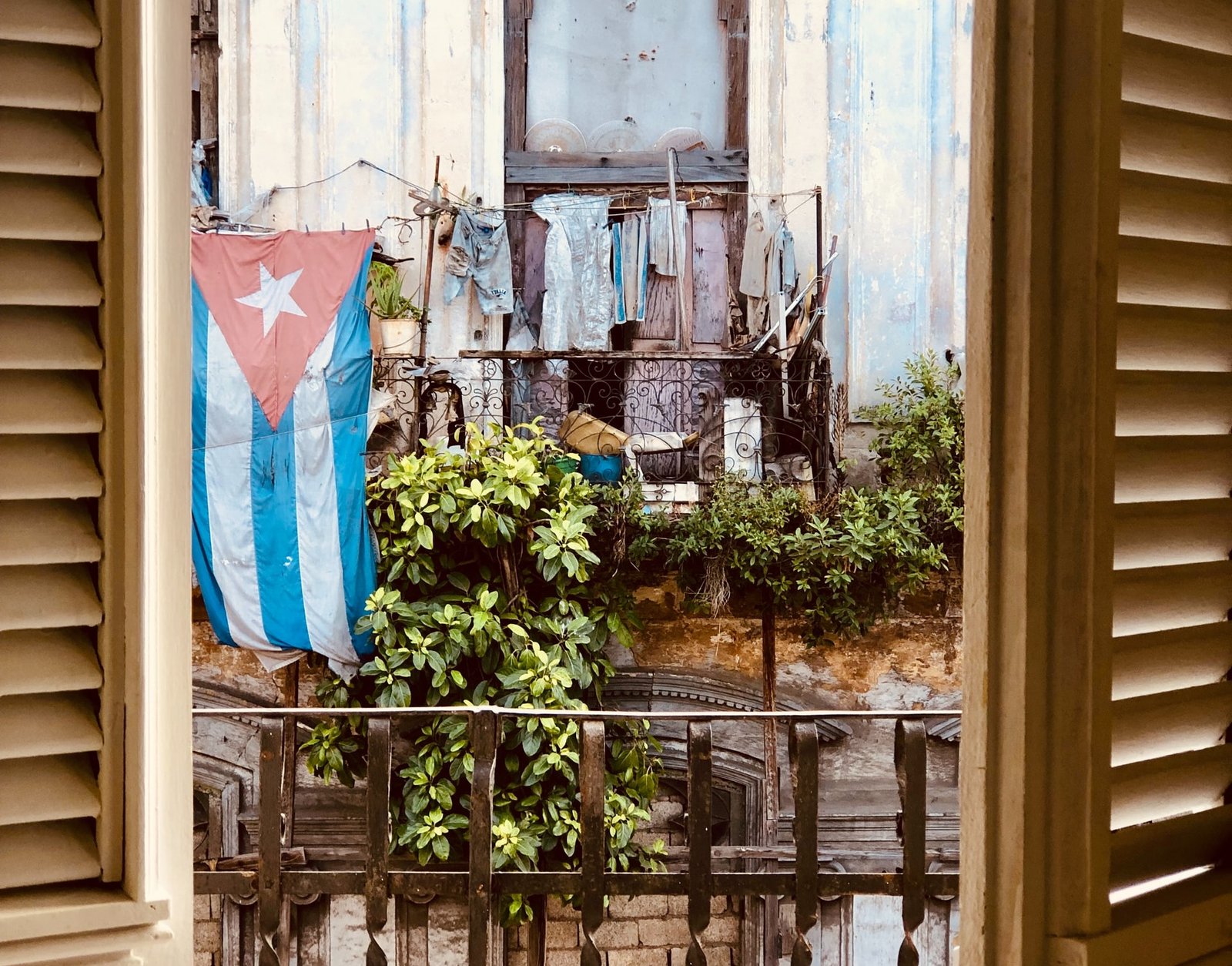
Photograph Source: Jason Gamble – Unsplash
The rooftop of Azotea de la India in Centro Habana offers respite. At this elevation, just peaking over the rival buildings, the sea breeze races across the island struggling to combat the heat that blankets the streets below. This place is a Cuban archive, an unmatched collection of vinyl records from a bygone era of cultural production, curated alongside a Cuban cocktail class. Dayle and Pancho are a Cuban-Italian couple skilled as artists, craftspeople and historians. When they are not hosting listening sessions, this space is a haven for artists and other creatives that resist succumbing to the despair of the country below. Instead, they have created a space for joy to exist and propagate, to cultivate community, to take care of their neighbors and to embody the resilience of the Cuban identity. A 1960’s Irakere jazz record ricochets off neighboring walls and spills down the unseen alleyways below. Everything in this space is recycled and re-purposed by hand. The bar, the DJ booth, the dining table and the generator articulate more than a gritty DIY event space – this is a passion project of preservation that simply could not be accomplished without care and love for Cuba.
In many ways, a short research-focused trip to Havana in mid-May of 2026 is wildly incapable of capturing Cuba in its entirety; certainly not the amplified precarity of our contemporary moment. My profession and political proximity to violence, however, lends itself well to discuss the unique cadence of war that Cuba is embattled in. In contrast to the pure carnage the world has witnessed in Gaza, in Sudan, in Ukraine, in Kashmir and in the DR, Americans are co-authoring a slow violence that violates the international human rights of the Cuban people (Nixon 2013). This slow violence is responsible for crimes against humanity and for violating multiple United Nations Charters for Human Rights. I will not make broad sweeping generalizations about the Cuban government here, though it should be of note that the Cuban citizens who held space for me will not excuse their government’s role in their decades-long suffering. This, however, is a key feature of this silent military strategy. In economic warfare, sanctions and embargoes are offensive volleys aimed at starving out international commerce, stagnating value, production, prosperity and daily life for citizens in the public sector.
These are not poorly calculated decisions but rather precise attacks on communist rule. Communism, or rather the goal thereof is, “the creation of a state where every person can contribute according to their ability, and in return receive what is necessary to live equally with everyone else, Furthermore, “the government of persons is replaced by the administration of things, and by the conduct of processes of production. The state is not ‘abolished’. It withers away,” (Engels 1932). Since communism is seen as a direct threat to the global dominance of US empire and capitalism, coercing a government into paralysis and shaming it publicly as a failed state requiring intervention are important components of a much larger campaign of manufactured ruin. US Secretary of State Marco Rubio has peddled this propaganda and seemingly awaits ascendance to the Republican party throne, gambling on the fall of Cuba’s regime as his crown achievement as a politician. His Cuban-American heritage serves as a credential to validate his approval of human suffering, all without acknowledging the critical role that American policy has served in crushing any attempts for the communist state to thrive, starting in 1960.
Rubio wants to usher in a new era for Cubans, one that is (allegedly) prosperous for all. But he noticeably ignores advice from revolutionary Ernesto “Che” Guevara who warned in 1960: “the first thing we will have to do is not to go to the people to offer them our wisdom. We must go, rather, to demonstrate that we are going to learn with the people, that together we are going to carry out that great and beautiful common experiment: the construction of a new Cuba,” (On Revolutionary Medicine 1960). Modern day American foreign policy blatantly ignores collaboration with Cuban citizens. Instead, it forges a path forward with its most central insight from land developers and expatriates of the Cuban regime, hawkish to re-make the island fit for their capitalist dreams.
Although Havana lacks the more traditional, physical features of war that we have consented to as Americans, the suffering is equally visceral, an unabashed display of collective punishment. In a socialized economy under duress, struggle is ubiquitous, and these woes are on the minds and tongues of everyone you may encounter. Strains of exhaustion haunt the faces of caregivers who fought for sleep during frequent blackouts during scorching night; bodies ghastly from inadequate food rations. Families sprawl onto the streets in the late afternoon to escape damning heat that suffocates an overcrowded electrical grid and makeshift housing arrangements. At local, state-run bodegas, bread stores and produce markets, supplies are sparse – if available at all – they are low quality and hardly answer the beckoning hunger in the bellies of the elderly and children. Pensions and salaries (sometimes less than the equivalent of $20 US dollars a month) are simply insufficient. During a thorough tour through Old Havana a brilliant sociologist named Yoly told me that these state allowances were not always so dismal. There was a time in the country when agricultural production was abundant and fuel was widely available to transport goods and services across the island. There was a time when guarantees of free education, health care, housing and food were more than empty ambitions for a young nation who dreamt of a future beyond the inherent exploitations of Western capitalism.
Cubans are not unfamiliar with the requirements of revolution: the sacrifice, the risk and the costs of freedom. Unfortunately, a country whose low birthrate and rapidly aging population is at a costly moment in history where these values and identity may very well be forgotten. There is a very stark, generational gap in understanding Cuba’s history. This too, is a direct outcome of decades long unilateral policy of sanctions, embargoes and blockades. After the Special Period of the 1990s, the collapse of the Soviet Union and their subsidies caused the contraction of the Cuban GDP by more than 30% between 1989 and 1993. It also caused a severance of memory within a class of citizens who lack both a historical analysis of material conditions and lived experience under another reality. The only Cuba that young people know is of a government that has been chronically shorthanded, struggling to provide in the public sector. While there was an era of considerable improvement in the private sector under President Obama, the windfalls of this moment were not concretized or advanced into lasting foreign policy. The present reveals a generation who has slowly gained access to other, more individualistic ways of life. Private investment, content filtered through (illegal) VPNs and increased access to public Wi-Fi have offered alternatives to a national identity rooted in communal survival. “The internal blockade” is a common phrase that was repeated to me in various conversations with locals discussing their current living conditions and refers to a lack of transparency, active suppression and censorship efforts perpetuated by the Cuban government. While this may very well be an effort to preserve revolutionary Cuban ideals, it has undoubtedly fomented anger and frustration.
This erosion of trust in governance simultaneously creates a loosening attachment to national pride and identity. An entire class of people now exist who don’t care if foreign invasion or takeover happens because perhaps tomorrow will bring change and hope for the future. Anything is better than the status quo. Slow violence via embargoes and sanctions create political apathy and sows the seeds of discontent without firing weapons or threatening military action. It intentionally destabilizes the government while promoting and enabling human suffering amongst the masses. It pits those with access to foreign investment in the private sector against those without, historically the most vulnerable. It creates new social divisions that feed on inequality and unrest. This is a man-made crisis, full stop. No better crystallization of policy-driven inequity exists than the words written in a memorandum from the Deputy Assistant Secretary of State for Inter-American Affairs in 1960,” …If the above are accepted or cannot be successfully countered, it follows that every possible means should be undertaken promptly to weaken the economic life of Cuba. If such a policy is adopted, it should be the result of a positive decision which would call forth a line of action which, while as adroit and inconspicuous as possible, makes the greatest inroads in denying money and supplies to Cuba, to decrease monetary and real wages, to bring about hunger, desperation and overthrow of government,” (Mallory Memorandum 1960).
Cuba is a country who has long provided the highest level of medical education and gifted this knowledge back to the world’s most underserved and is now without the capacity to save lives within its own borders. Cuban patients are suffering at an accelerated rate without power for ventilators, in intensive care units, without adequate medical interventions. This is further exacerbated by deferred procedures, sub-optimal antibiotic provisions and an inability to transport sick patients to facilities across the island. Human decisions have decided that this level of suffering is not only acceptable, but gainful for scavenging capitalists looking to prop up their ventures without the regulations and tax code of their homelands. Every day that the United States unilaterally allows these conditions to persist, every day that these sanctions force the termination of business relationships, including global, with punitive legal restrictions, Cuban people die. The US government is in an ideological war of ideas, using this to justify avoidable casualties without claiming them as victims of war.
“People speak sometimes about the ‘bestial’ cruelty of man, but that is terribly unjust and offensive to beasts. No animal could ever be so cruel as man, so artfully, artistically cruel.” – Fyodor Dostoevsky, Crime & Punishment 2006
On the night of May 13th, 2026 I descended the steps of Azotea de la India filled with a sense of hope of what resilience is, and reminders of what place joy has in liberation. On the street, I am met with a contradicting reality. Without the generator-powered luxuries of the rooftop, Havana is enduring yet another hours-long blackout. The urban density is all but invisible in the darkness and yet, life persists. The absence of power creates a kind of deafening silence only punctuated by battery powered radios, speakers, and flashlights. In the darkness, children stay up past conventional bedtimes, playing in the streets, laughing through disaster, at last avoiding the stagnant heat that builds mercilessly in the absence of airflow. I navigate the silence, about thirty minutes walking distance from my hostel, buoyed by their resilience. The stars are on full display, typically a view observed only from the countryside. Roads are nearly absent of vehicles, save for the few electric transports, bikes and horse drawn carriages. It’s hard to put into words how jarring this experience is. In some contexts, this kind of suffering might incite panic, interpersonal and community violence, or uprising. Instead, the Cuban people have not faltered.
Perhaps we can learn from this, if we are careful and intentional in our dreams of collective liberation. It is one thing to name injustice from my privileged position in the United States. It is another bear witness to the suffering our political institutions have caused. From a country that glorifies individual achievement, the rest of the world remains on fire around us, at our expense.
“Isolated individual endeavor, for all its purity of ideals, is of no use, and the desire to sacrifice an entire lifetime to the noblest of ideals serves no purpose if one works alone, solitarily, in some corner of America, fighting against adverse governments and social conditions which prevent progress.” Ernesto “Che” Guevara, On Revolutionary Medicine 1960.
Despite an onslaught of mandates aimed at destroying the political will of the people and creating opportunity to revolt and uproot the communist regime, Cubans wait in perpetuity. Wait for change that may yet come, wait for relief that is barred from its shores, wait for a dignified response to the slow violence that all but erases hope for the future. And still, Cuba has demonstrated that continued survival may be the most powerful iteration of defense and liberation on display. Long. Live. Cuba.
References:
Collective Punishment | The Practical Guide to Humanitarian Law. (2026, May 10). Guide-Humanitarian-Law.Org. https://guide-humanitarian-law.org/collective-punishment
Dostoyevsky, F. (2000). Crime and Punishment (R. Pevear & L. Volokhonsky, Trans.). David Campbell Publishers. (Original work published 1866)
Engels, F. (1932). Socialism : utopian and scientific. Allen & Unwin.
Foreign Relations of the United States, 1958–1960, Cuba, Volume VI – Office of the Historian. (n.d.). In history.state.gov. Retrieved July 31, 2026, from https://history.state.gov/historicaldocuments/frus1958-60v06/d499
Irakere. (1985). Bailando Asi. In Spotify. Arieto. https://open.spotify.com/album/24BqqFHNww0T4dwlx5aMYq
Nixon, R. (2011). Slow Violence and the Environmentalism of the Poor. Harvard University Press. https://doi.org/10.2307/j.ctt2jbsgw
On Revolutionary Medicine. (2026). Marxists.Org. https://www.marxists.org/archive/guevara/1960/08/19.htm
Slow violence (concept) | Research Starters | EBSCO Research. (2021). In EBSCO. https://www.ebsco.com/research-starters/environmental-sciences/slow-violence-concept
Studio ATAO | Understanding Socialism in the U.S. (2019). Studio ATAO. https://www.studioatao.org/socialism?gad_source=1&gad_campaignid=14173103193&gclid=Cj0KCQjwjb3SBhDgARIsAMKiWzjqLI-sTxnYgm6VcDZkw5g2YWstAhmHVtqhB05KN9-DzYy5asxIWtUaAploEALw_wcB
