
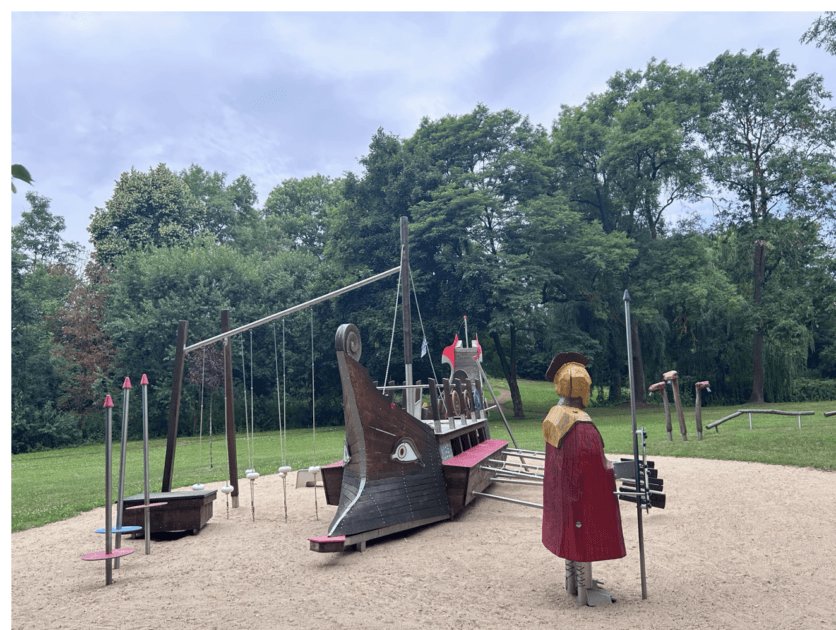
Playground at the Schliemann Museum, Ankershagen, Germany. Photo: David Yearsley.
On a Sunday morning in the middle of July we left Berlin on bicycles for Copenhagen—700 kilometers in seven days. The route is almost exclusively on bike paths, mostly paved but also with stretches of gravel, dirt and sand. We cycled through fields and forests, along rivers, canals, marshes, dunes and countless lakes; over bridges; through villages, and baroque towns. We made it out of the Müritz National Park in the German state of Mecklenburg-Vorpommern, just before a massive wildfire closed the route there. Beyond the forests, wheat and rapeseed fields stretched to the horizon. The collective farms of the German Democratic Republic are now the capitalistic farms of the Federal Republic of Germany. The land told its truths. Monoculture appears non-ideological.
On the edge of the park, a beekeeper offered organic honey and proclaimed her resistance to plans for wind farms: use less energy, not more, her sign counseled.
Past a dairy with an old wooden plough displayed amongst a trio of modern mechanized behemoths, we rounded into the village of Ankershagen built on a rise in the flat landscape. A sign advertised a point of cultural interest: “Heinrich-Schliemann Museum.” This attraction came as a complete surprise to us. None in our party had read the guidebook we had in one of our saddlebags.
We dismounted and drank and soon learned that Schliemann, the excavator of Ancient Troy, had been raised here, provided with a classical education thanks to his father, Lutheran pastor of the village. There were more people then; the region’s vast rural places are depopulating. Swatches of Brandenburg and Mecklenburg-Vorpommern appear emptier of people than North Dakota.
The first thing that caught our eye in Ankershagen was not the church or the vicarage. It was a large wooden horse bigger than a Winnebago. There was a too-long tail behind it. On the horse’s flanks was a banner advertising The Greek Festival beginning the next week.
Each in turn, we climbed up the ladder into the belly of the beast, crawled through its empty insides and then shot out the other side: more like flying excrement than fierce Agamemnon.
Another group of cyclists was having coffee at a table outside the vicarage’s barn, now converted into a café. Otherwise, the complex was empty. The other cyclists didn’t seem to notice us playing below, despite our age and size. No visitors entered the museum. We heard the roar and whirl of a motor. A giant tractor pulled through the village.
Nearby was a sandbox with faux ruins in it: a column capital here, the head of a hero there; a giant urn rose from the pit near the remains of a once impregnable fortress wall. Future Schliemanns of Mecklenburg-Vorpommern might just catch archaeological fever in this remote place as they scrabbled for fame and fragments.
At the far end of the grounds, across a large lawn presided over by a magnificent copper beech, was a playground made up of a trireme oaring across the land towards a couple of serpents rising from the sawdust waves, with a helmeted Greek warrior standing alongside with spear and shield. I looked back across the lawn to see if anyone was watching. They weren’t. I climbed into the hold and took my place: the Colossus of Rhodes, a two-eyed Cyclops wearing sunglasses, impressed the Achaean host.
I headed back to the horse. There were no kids in sight. Maybe the Greek Festival would attract them.

The museum was in the restored brick and timbered vicarage. The current exhibition is devoted to another of Schliemann’s archaeological exploits—his work at Mycenae on the Peloponnesian Peninsula. It was there that Agamemnon, commander of the Greek forces, was murdered after returning from the Trojan War by his wife, Clytemnestra.
We still had 70 kilometers to cover that day, so there was no time to visit the museum: on to Rostock for the ferry to that corner of the Baltic, then with the bikes across the Danish islands and on to Copenhagen three days later against a relentless headwind. Poseidon had taken against us, maybe because we didn’t do the Schliemann Museum.
As we rode on, I thought of the room in the New Museum back in Berlin where there are still a few bits of the Trojan gold that Schliemann brought back from his excavations. He called it Priam’s Treasure. In 1873 Schliemann was apprehended in Athens after having smuggled “Priam’s Treasure” out of present-day Turkey. He paid off the Ottoman authorities and made off with the booty.
In the New Museum in Berlin, there is a photo of Schliemann’s wife, Sophie, wearing a fabulous headpiece and necklace taken from Troy. A replica of this fabulous ensemble is displayed alongside in the glass case. The real treasure is now in Russia, having been re-plundered by the Soviets in 1945.
Four days after passing through Schliemann’s Ankershagen, we dropped the bikes at a railroad station café north of Copenhagen.
We flew through smoky European skies and then through smoky American skies to Chicago. Still jet-lagged, we went to Christopher Nolan’s Odyssey in the Music Box Theatre, opened in 1929, on the North Side. The show was sold out. The line began building an hour before the screening started. The staff had made a papier-mâché Trojan Horse and placed it in the neo-Gothic lobby.
Homer’s Odyssey is not full of laughs, but as the American actors with American accents and the British actors with American accents hacked and follied, avenged and ached, forgot and remembered, mourned and manned-up, killed and were killed, I thought of Ankershagen—of the joy a kid could have on those outsized ancient-modern toys for a lot less than the price of admission to the Music Box ($21) and a lot less than to make and market the movie, its budget pegged somewhere around $400 million.
The movie soundtrack’s creator is Ludwig Göransson, a Swede who landed on Hollywood’s shores. This likably modest fellow (at least if his Academy Awards speeches are an accurate barometer of his temperament) captured an Oscar (his second) for his previous collaboration with Nolan on Oppenheimer. At the director’s prompting, the composer’s Odyssey score rejects the epic, symphonic mode that is the default setting for sword-and-sandal blockbusters.
Instead, synthesized sounds that could be ancient glow and jangle, haunt and harry. A panpipe longs for home. A lyre plucks at deferred courage or wily derring-do. An android chorus hymns from the half-light a nearly forgotten and fully neglected wife, son and kingdom. Gongs try to wake the audience and the characters and to confuse them as soft sounds comfort them. Regret and forgetfulness meander through thickets and fight the wind, are lulled by waves and taunted by terror. Duty and ennui walk a faraway beach hand-in-hand, gray-bearded and buffed-up Odysseus dallying with a cover-girl nymph—a South African-born actor who also talks American.
Past the halfway point on the three-hour cinematic itinerary that dutifully checks off the points on the bucket list printed in the back of the Homeric guidebook, Odysseus and his few remaining men sail past the Sirens. Their lethal song is a founding myth of music’s irresistible sensual power: its craving strains enter from afar and invisibly penetrate the soul. The body cannot hold out against the song. Nolan’s script makes quick and clumsy work of Odysseus’s mad lust to hear it. The movie episode is more about the waxing of the ears (the hero’s chest has already been waxed in his off-screen trailer) and tying him to the mast than about any of the myth’s myriad meanings.
But it is the score’s set piece. The soundtrack comes to the foreground, the screams of the hero becoming the underscoring. It is time for music’s origin story to be told, a moment that a composer can either charge into or withdraw from.
Göransson begins with the shimmer of simulated women’s voices, sacral tones frayed by signal interference. The ghost of an organ (a Greek invention) seeps through the sonic ordeal. The mass tips downward as if into the watery depths and the unconscious. A melody emerges from the Valium haze: panpipes; perhaps a wet finger on one of Plato’s celestial orbs traces a melody. A rising minor sixth that is a centuries-old signifier of desire arches upward then falls back to a blunted dissonance, a half step above the drone, before rising again to form an open, unresolved fifth—that icon not just of antiquity but of eternity. Above Odysseus’s screams, the minimal music obsesses over its own abstractions. Is it a revelation or a retreat, a profound exploration of music and the psyche, or a loss of artistic nerve? Is it mythic music or merely mood music?
After a few more stops (Seattle) and fires (Spokane), it was time to head through the smoke, back home to Ithaca (New York).
The Finger Lakes were green. The next village up the lake is called Ulysses. The village due west on the Allegheny Plateau from Ithaca is Mecklenburg.
It’s time for a Trojan Horse and trireme to come to the shores of Cayuga Lake. Something new and old and fun—for the kids.
