
[ad_1]
Maria and Peter are students and meet up for a late dinner. Peter asks Maria whether Tom is at the party that they intend to go to after dinner. Maria answers that Tom is at the party. After all, Tom had told her that he would be at the party. When they arrive at the party, it turns out that Tom had changed his plans, and is not at the party.
This was the scenario posed to research participants in a new study by a team of European researchers. They were then asked: Was Maria’s answer true or false?
It’s pretty clear that Maria’s answer is false, at least from my point of view. In other words, I am fully embracing the correspondence theory of truth. However, the study, published in Cognition, shockingly found that only just over 50 percent of participants would agree with me. Apparently, many other people tend to identify truth with how well a statement fits within a person’s coherent set of beliefs or whether a person’s beliefs are authentic, that is, they are sincere and honest.
To probe how ordinary people think about what is true, the researchers first created conceptual maps of 200 participants asking how similar they think truth is to other related concepts. For example, correspondence related to “reality” and “fact”; coherence to “justification” and “reason”; and authenticity to “honesty” and “transparency.” While many participants endorsed notions relating to all three conceptions of truth, in a “winner-takes-all” summary of the judgements, 55 percent aligned most strongly with correspondence.
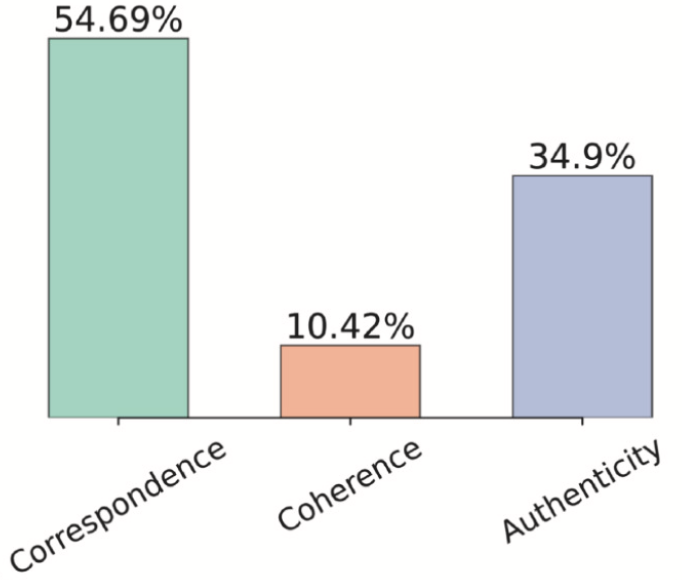
In other words, just a bare majority believes that truth is defined by factual reality.
The researchers then wanted to see if these concepts of the truth remained stable in individuals over time. So three months later, they managed to contact 128 of the original participants and ask them to consider what is the truth in the above Maria vignette. In this case, the choice was binary: Was Maria’s statement true or false? As the researchers explained, “A ‘true’ response reflects an authenticity- or coherence-based understanding, as it emphasizes Maria’s sincerity or justification at the time of speaking, while a ‘false’ response reflects a correspondence view, judging truth based on factual alignment with reality.” I have no trouble accepting that Maria could try to justify her sincere and honest belief that Tom was at the party, but the plain truth is that he wasn’t there.
In the later survey, it turns out that an individual’s concept of truth does modestly predict how he or she evaluates the truth of Maria’s statement. The researchers report, “Overall 68 (53.13%) participants responded that Maria’s answer was false (agreeing with correspondence theory) and 60 (46.89%) that her answer was true (agreeing with an authenticity or coherence notion of truth).” Again, a bare majority endorsed factual reality as the standard for determining what is true.
In an article describing their findings over at Psyche, the researchers outline how different conceptions of the truth can cause conflict:
Imagine someone makes a statement about climate change. The discussion unfolds predictably: one side posts links to data (correspondence), the other side cares less about data and replies with accusations of bad faith (authenticity), or they argue that the statement is untrue because it doesn’t fit everything else they already believe to be true (coherence). In such disagreements, giving more of the evidence that convinces you could risk making the conflict worse, not better.
We have all been there, haven’t we? Even for those who endorse the correspondence theory of truth must still grapple with the pervasive problem of confirmation bias.
As I reported a while back, research by the Yale law professor Dan Kahan finds that as scientific literacy goes up, so too does partisan polarization on the issue of climate change. In other words, the more science people know, the more they are able to seek out and find information justifying their beliefs.
Nevertheless, the European researchers suggest hopefully that understanding the differences in the conceptions of what is true may help us more fruitfully navigate political and policy disagreements.
[ad_2]
Source link
