
[ad_1]
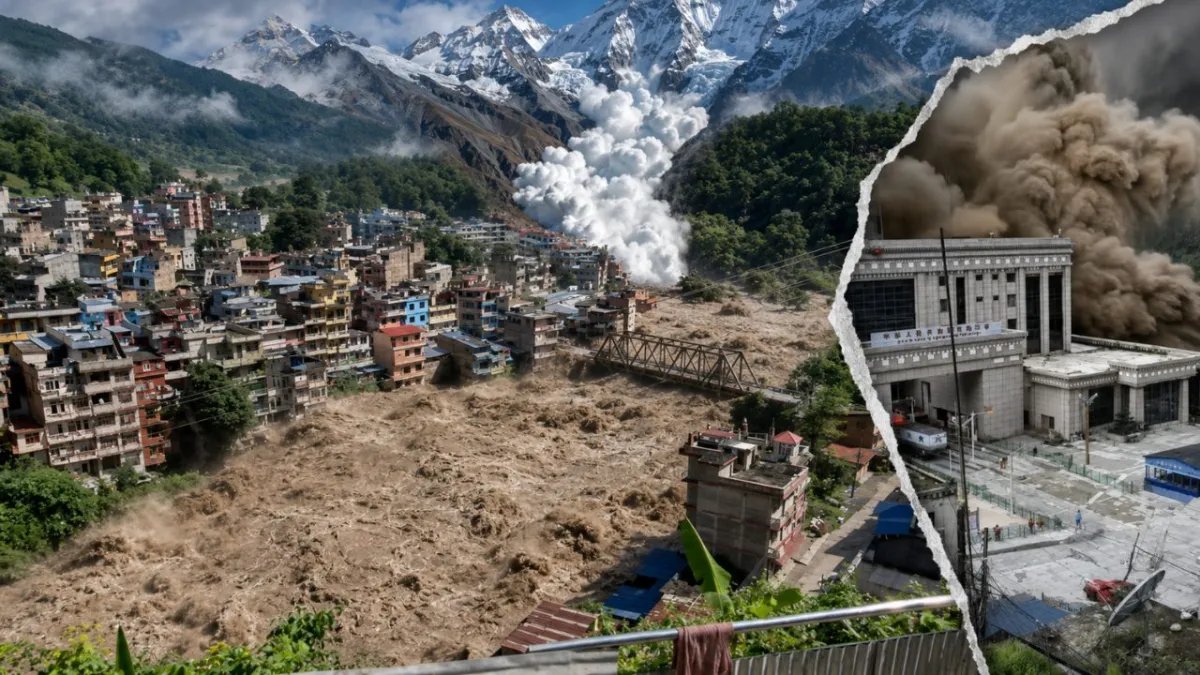
Climate change devastated towns and villages of Nepal on August 26 with enormous flash floods that were produced by a melting glacier. The size, speed and relentlessness of those monstrous waters shocked anyone who saw the videos. Hundreds are dead, likely thousands are missing. What is more frightening yet is that this flooding is only the beginning, since we are rapidly heating up the earth by burning coal, fossil gas and petroleum in such mass quantities that we’re putting 38.1 billion metric tons of the dangerous heat-trapping gas, carbon dioxide, into the atmosphere every single year.
The “nose” of a glacier near the border between Nepal and China broke off, falling with rocks into a river and blocking it briefly, after which the pent-up waters, added to by the massive glacier melt, surged down the valley. The likelihood is that the event was contributed to by global heating, and in any case global heating is causing substantial glacier melt that is set to accelerate.
Lili Pike and Laura Millan at Bloomberg write, “Himalayan glaciers melted 65% faster between 2010 and 2020 than during the previous decade, the U.N. said, while the risk of glacial lake-related flooding across the broader Hindu Kush Himalaya region is expected to roughly triple by the end of the century.”
What Actually Triggered the Nepal–Tibet Border Flash Flood?
A massive ice and rock avalanche from a glacier triggered a chain reaction near the Nepal–China border. The avalanche and debris blocked the river, forming a temporary barrier lake. When the blockage gave way, a… pic.twitter.com/raaCcjQClO
— Deadly Kalesh (@Deadlykalesh) August 27, 2026
I’ve traveled in India near to the Nepali border and knew Nepalis in Delhi. It is a small country about the size of Iowa, but its population is closer to that of Texas, at around 31 million people. About four fifths of people are Hindus, but it has substantial Buddhist (8%) and Muslim (5%) minorities. From the nineteenth century until 2008 it was a Hindu monarchy. Then it became a secular republic and is now a parliamentary democracy, though its politics have been roiled in recent years by protests over wealth inequality.
The language used for official purposes, Nepali, is spoken by about 44% of the population as a mother tongue. It is related to Hindi and other North Indian languages of the Indo-European language family. Therefore, it is distantly related to English. About 16% of people speak Tibeto-Burman languages. In mountainous regions with weak states, languages and dialects retain their distinctiveness, and people speak over 140 languages as mother tongues in the country.
The British in India tried to conquer the Gorkha kingdom of Nepal in the early nineteenth century, an episode I treated in my first book. At that time, in 1814, there was a Shiite Muslim-ruled state, Awadh, in North India, which the British had not yet annexed. But they had surrounded it and they attempted to coerce it in various ways. Ironically, to pursue their war with Nepal, they took a loan from the Nawabs of Awadh, on which they paid 4% interest. Some of that interest was remitted by Awadh’s ruling families to the Shiite clerics in Najaf, Iraq, and since it was paid out by the British, it gave London some leverage over Shiite clerical leaders in Iraq into the 20th century. Since bank interest was considered usury in traditional Islamic law (though not by Muslim modernists), the idea of Iraq’s major Shiite clergy receiving interest from the East India Company is ironic.
In any case, the British military campaign led by Boston-born David Ochterlony against Hindu and Buddhist Nepalis paid for with a loan from Shiite Nawabs in Lucknow, ended in a draw in 1816. He who signed an armistice with the Gorkha dynasty. The agreement allowed the British to recruit some Nepalese soldiers, called Gurkhas, into the army of the East India Company. Gurkhas were considered a “martial race” and were valued fighters. Some 100,000 Gurkhas fought for Britain during WW I in France, as well as against the Ottomans in Iraq. They also fought in places like Italy and Burma in the British army during WW II, during which 30,000 Nepalis were killed defending the British Empire from the Axis.
Devastating Visuals from Flood in Nepal😳 pic.twitter.com/l3kagu6GAS
— Ghar Ke Kalesh (@gharkekalesh) August 26, 2026
Nepal has the shape of a rectangle that straddles the lowlands near the Gangetic valley and, upland, the Himalayas. It is the location of Mount Everest, Himalayan mountains with the greatest elevation, which is viewed as a goddess in Sherpa oral tradition. Indeed, throughout Nepali languages and literature, the Himalayan mountains are viewed as living gods and spirits that serve to protect human beings. How strange that we are melting them and turning them into a menace. Glaciers have collapsed before, but in the nineteenth and twentieth centuries it was because of earthquakes, rockfalls, or instabilities in the crust on which the glacier rested.
There are about 200,000 glaciers in the world. High-mountain Asia hosts about 90,000 of them and most of these are of an intermediate size, according to Lander van Tricht, et al., writing in Nature Climate Change .
As global heating from burning fossil fuels has accelerated during the past 80 years, we have begun seeing glaciers melt, in the Himalayas, the Alps and the Andes, with catastrophic effects. Right now, we are losing around 750 glaciers a year. We are already at roughly 1.2ºC (2.2ºF) above preindustrial norms.
These authors tell us that if we go to 3ºC (5.4ºF) above preindustrial levels, toward which we are now rapidly heading, then by 2050 approximately 3,000 glaciers will be going extinct every year. That would be like all the glaciers in the European Alps evaporating in just one year.
3,000 glaciers a year disappearing is obviously much worse than 750.
And it will get worse yet if we go on as we are. Even if nations meet their current CO2 emissions targets, limiting global heating to 2.7ºC (4.9ºF) above 1750 levels, we will lose 80% of glaciers by 2100. By contrast, if we swing into action and limit heating to 1.5º C (2.7ºF), some 50% of glaciers could survive until 2100.
What happens if 80% of glaciers melt over the coming decades? Well, a lot of towns and cities in Nepal get washed away, as we saw happen on Wednesday. But if you can believe it, such flash floods are not the worst part, horrendous and heartbreaking as they are. What about afterwards? The glacier isn’t there any more. But it was melting a bit in the spring, providing an input into rivers, before freezing again the next autumn. No glaciers, no spring melt, no downstream water. About 2 billion people in the world — a fourth of humankind — depend on glacier melt for their water.
The melted glaciers flow into rivers and then go out to the seas. Since this ice was locked up on land, and now is going into the oceans, it increases the amount of water in the oceans, which means that their level rises. Mountain ice melt of this magnitude (80% glacier loss) would cause the oceans to rise over a foot. The oceans are also getting hotter, which makes them expand and take up more space, adding another half a foot.
The Arctic and Antarctic ice melt is calculated separately from the mountain glaciers, and it could contribute another few feet. A four to six foot rise in sea level doesn’t sound dramatic except if you imagine the patrons of the Benny’s on the Beach restaurant in West Palm Beach trying to eat their burgers and fries while under water. Soggy.
Editor’s Note: At a moment when the once vaunted model of responsible journalism is overwhelmingly the play thing of self-serving billionaires and their corporate scribes, alternatives of integrity are desperately needed, and ScheerPost is one of them. Please support our independent journalism by contributing to our online donation platform, Network for Good, or send a check to our new PO Box. We can’t thank you enough, and promise to keep bringing you this kind of vital news.
You can also make a donation to our PayPal or subscribe to our Patreon.
Please share this story and help us grow our network!
[ad_2]
Source link
