
[ad_1]
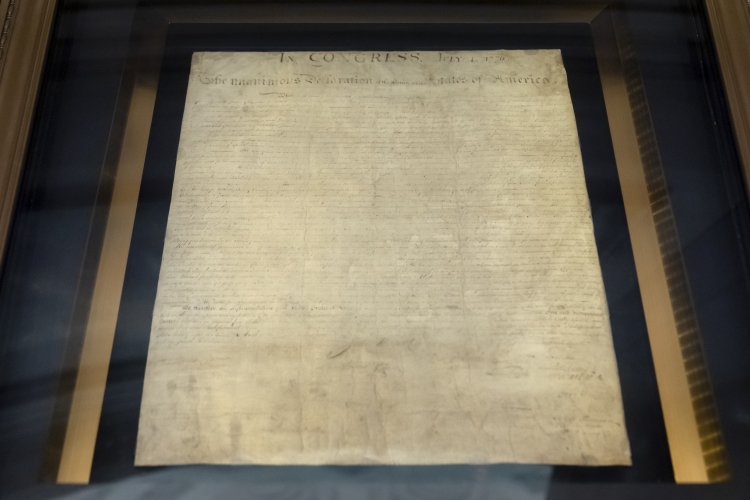
I was six when I first saw the Declaration of Independence. There, in its old marble shrine in the Rotunda of the National Archives, it seemed as powerful to me as the Ten Commandments. Around me, people of all ages stood transfixed, straining to make out the faint words and signatures. Once I had stared in awe at the dim parchment, my parents took me to the gift shop and bought me an “antiqued” copy, printed on golden-brown, crinkly paper. I pinned it up on my bedroom wall and can still remember its sweet-sour aroma. When I looked up at it over the following years, it symbolized to me the basic ideals of America.
Though I didn’t understand it at the time, my encounter with the Declaration—one that tens of millions of people have shared—reflected its three lives: as America’s most revered relic, as a symbol of our most deeply held principles, and as an ever-present part of American culture. This book tells the story of how those three lives came together to create one nation.
The “official” engrossed parchment has survived two hundred and fifty years, overcoming neglect and abuse, heroically saved in times of war, and preserved by ingenious technology. Though it was nearly forgotten for a time when the Constitution seemed the more important founding document, for most of its existence it has been a priceless relic, protected by custodians, conservators, and armed guards. It has been displayed in bright sunlight and locked in dark cabinets, rescued from the flames, hidden in a cellar, carried in carts, moved secretly by train, and secured by the world’s most sophisticated security systems. The scroll is a time machine, drawing visitors in a never-ending stream to gaze in wonder at the very parchment touched and signed by the larger-than-life men who founded America.
The Declaration’s second life is as a noble ideal, making it the central expression of the American experience. This is the basis for Abraham Lincoln’s claim, at Gettysburg, that ours is a nation “conceived in liberty and dedicated to the proposition that all men are created equal.” Every major political program and piece of legislation, and so many of our most memorable speeches, refer to, build upon, or argue with the Declaration. It envisions a common destiny for the “one people” who chose to separate from the King of England and his Parliament. If the Constitution tells us how to live together as a political community, the Declaration tells us how we should want to live. How the Declaration came to be the supreme symbol of our national ideal is the story of America over two and a half centuries. These two lives are linked together by a third: the transformation of this statement of lofty principles into a central element of American culture. The story of this third life is largely untold, though in many ways it is the one that has brought the Declaration closest to Americans. The Declaration has inspired heroic paintings and mass advertising, as well as melodramatic movies and a high-minded musical. It has been commodified to sell posters, T-shirts, hats, and scarves. We have carried the Declaration into our homes, schools, and offices, hanging that crinkly fake parchment on our walls or displaying a commemorative plate or medallion. In 2025, a limited-edition printing of the Declaration on calfskin parchment was marketed for well over one thousand dollars. While writing this book, I visited the National Park Service’s Franklin Court Printing Office in Philadelphia and bought paper copies of the two earliest typeset Declarations fresh off a reproduction eighteenth-century printing press. The frames I bought to hang them in were more than ten times as expensive as the prints, but as Lincoln observed, what is inside the frame is worth its weight in gold. As an object and commodity, the Declaration has for over two centuries been part of our culture, linking us deliberately and tangibly to our founding moment.
Yet although the Declaration seems everywhere, its history and our relationship to it remain less known. Some persistent myths remain, such as the belief that the document was signed on July 4. Other questions are more intriguing. What explains its power to guide settlers on the banks of the Mississippi in the early 1800s and, nearly a century later, inspire my immigrant ancestors arriving in Chicago to assimilate and embrace American values? More difficult is understanding how the same document was used both by those fighting for equality throughout American history and by those who sought to separate from the United States to “preserve” their liberty. How could it contain eternal truths and yet be repeatedly reimagined to fit the needs of the time?
As a child I didn’t know that John Locke’s philosophy, or any other, had influenced Thomas Jefferson. Growing up in the North, I wasn’t aware that Southerners had justified secession by appealing to the Declaration’s claim that the governed could withdraw their consent, or that, a century later, Black Panthers and separatist militias alike would invoke its language to justify violent resistance to the federal government. For my friends and me, it was enough simply to hang the Declaration on our bedroom walls, as Americans had done in the 1820s, and 1880s, and 1940s, tying us just as powerfully to a shared national history.
The country we live in today came into focus roughly a century ago, when massive numbers of people flocked to our shores, radically transforming the fabric of a society that was industrializing and urbanizing. We went from being an agricultural, Anglo-Saxon Protestant nation of a few million souls in 1776 to a nation of immigrants from around the globe. How would these newcomers—poor, often illiterate, few of whom spoke English—become American? When the Librarian of Congress Herbert Putnam decided to enshrine the Declaration in 1924, it was part of a deliberate effort at civic education: our founding document taught people like my grandparents that they had as much a right to be considered American as the generation of ’76, but that they had an equal responsibility to embrace the principles and values that gave rise to the Nation’s founding and shaped our society afterward.
Throughout our history, new citizens have eagerly embraced both these new rights and new responsibilities, proudly joining those whose families have been here for generations and thinking of themselves as nothing other than Americans. In my family, the Declaration was a living document, always contrasted to the oppression of the old country. When my uncles shipped off to Europe and the Pacific in World War II to fight for freedom, they carried its values with them. This would link them, just a few decades later, to those at home who invoked the document in the Civil Rights Movement.
I am a historian of the nineteenth century by training and spent most of my career writing about America’s relations with Asia. Living in Japan, where the government designates the country’s most important historical artifacts as “national treasures,” brought home to me how unique it is that America has a founding document that expresses its values and principles. The Declaration is undeniably our National Treasure. But only recently have I come to understand why the Declaration is just as important to us now as it was to John Adams and Thomas Jefferson. While usually interpreted as either a passionate assertion of equality or a searing call for liberty (including rebellion), it is only by telling the whole story of the Declaration—from its inception to today—that we can recognize its vital role as an enduring symbol of unity and civic assimilation. Hence this book was conceived, in which the overlapping lives of the Declaration—as relic, symbol, and cultural object—are dug up, dusted off, explored, debunked, celebrated, critiqued, and woven into a single fabric for the first time.
Three decades ago, Pauline Maier’s American Scripture revealed the deep and broad seams of colonial thought that informed Jefferson’s immortal draft. More recently, Danielle Allen’s Our Declaration brought the document’s philosophy of equality to life for a modern audience by connecting her own experience in the classroom and her family’s history to make a case for taking seriously its claim of equality for all. Fifty years earlier, the influential conservative political philosopher Harry Jaffa insisted that Lincoln’s reading of the Declaration contained a powerful argument against moral relativism. Gordon Wood showed how the Declaration’s philosophy was expanded by Americans almost as soon as the country was founded. In our fractured times we can take solace in the fact that people across the political spectrum find inspiration and meaning in the Declaration.
A constitutional republic is a fragile creation, for only the people’s adherence to its principles and rules preserves it. It is easy to undermine belief in democracy, and since the founding of the Republic, claims that either mob rule or shadowy cabals are destroying the people’s sovereignty have been prevalent. Just as damagingly, moments of social dissension and political partisanship have flared throughout American history, most tragically in the Civil War and again in the 1960s and 1970s.
Against such views, our founding document remains a powerful statement of unity, as much today as two hundred and fifty years ago. It has as much to teach us about the bonds that tied generations of Americans together as it does about liberty and equality. The unity it creates is expressed not just in abstract philosophical ideas but also in common hopes and shared beliefs of what life is meant to be in America, of what we have long called “the American Dream.” The Declaration speaks of one people in its opening line. The representatives adopted their document for the “united States,” even as they believed in state sovereignty. And the Signers set an enduring example by pledging to each other “our Lives, our Fortunes, and our sacred Honor.” They shared a similar set of values and assumptions—biblically inspired, steeped in natural law, and drawn from England’s constitutional traditions. The new country they created embraced pluralism, but it saw individual liberty and political responsibility as tightly bound together. Equality was important, and its meaning would expand over time, but so were those sacred bonds.
It is the spirit of the Declaration that called forth the great defenses of national unity expressed by George Washington in his Farewell Address and by Daniel Webster’s famous reply to Hayne and that animated Abraham Lincoln’s entire political philosophy. Union was imposed by force, it is true, during the Civil War, but the Declaration’s appeal has more often worked through persuasion and inspiration, by providing a cohesive, if evolving, set of beliefs that define the American ideal. Unity meant something different to Americans in 1776 than it did in 1789, let alone in 1861 or 1924. Yet even as our definition of unity has changed, the Declaration remains the bedrock upon which each generation has built its beliefs.
Unity and Union are no less important today in a vastly more multiethnic and multicultural America than the one that came into being in the 1770s and was torn apart and patched together in the 1860s. The Declaration, I believe, remains the starting point for defending that precious achievement. We can only do so by embracing the principles and preserving the traditions that gave rise to the world’s first durably self-governing and self-correcting nation.
This is not a cynical or angry book—we have far too many of those already—but neither is it naive. It is an optimistic and hopeful book, celebrating America’s successes and acknowledging our shortcomings. The story of the Declaration is an unfinished one, as we seek together to build a happier, more just, and more prosperous society, one “constantly labored for . . . even though never perfectly attained,” as Lincoln put it in 1857. Each generation becomes part of a chain stretching back to 1776. What we learn from the history of the Declaration of Independence is our own history, ever evolving, ever striving.
Michael Auslin is a historian at Stanford’s Hoover Institution and the author of The Patowmack Packet on Substack.
[ad_2]
Source link
