
[ad_1]
 As we anticipate the Artemis II launch, now slated for early April with plans to take four astronauts on a trip around the Moon and back to Earth, NASA has been unveiling some significant changes to its plans for returning to the Moon and beyond. If you have fallen behind these announcements, here is a summary of the important bits.
Artemis II will continue as planned, marking the first crewed deep space mission since 1972 (Apollos 17). The original plan was for Artemis III to land on the Moon in 2027, but this mission has been pushed to an Artemis IV mission in 2028. A new Artemis III mission has been inserted – this will go only to low Earth orbit (LEO) and will test the integration of all the systems necessary to land on the Moon. This will include docking with one or both of the two landers, one being built by SpaceX and one by Blue Origin. This sounds like a really good idea, and it did seem unusual that they were planning on going straight to the Moon without ever test docking with the lander.
Even though landing on the Moon will be delayed by at least a year, NASA says this will set them up to have at least annual landings on the Moon after that, with a goal of a landing every six months. The reason for this frequent pace is the the more recent announcement by NASA last week – that they are putting on pause plans for a Lunar Gateway in lunar orbit and instead are going to focus on building a permanent Moon base near the lunar south pole.
In order to make this possible, and to support the future Moon base (no word yet on whether this will be called Moon Base Alpha, as it should) NASA plans about 30 uncrewed robotic landings on the Moon every year. They will be scoping out the location for the base and delivering equipment and supplies.
What about the Space Launch System (SLS)? When hearing these plans one of my first questions was – are they going to do this all with the SLS? Each SLS launch costs $4.1 billion, with the cost of the single-use ship itself being $2.2-2.5 billion. This is one of the biggest criticisms of the SLS system – they are designed as single-use rockets. Meanwhile, the rocket industry has moved on to reusable rockets, which dramatically reduces the cost. As of now, NASA has approved SLS launches through Artemis V. After that they have not committed to a specific plan. But – they have stated that their goal is to transition to “commercial hardware.” This almost certainly means SpaceX and Starship. I guess they cannot fully commit because Starship is still in development. But if it is ready in time, it seems likely NASA will start relying on Starships to get to the Moon.
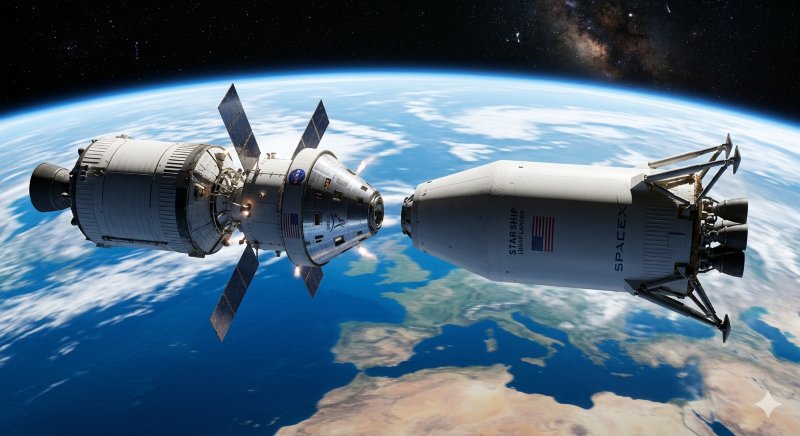
This makes a lot of sense. SpaceX’s lander is really a modified Starship – it is stripped of anything it needs to land back on the Earth and is optimized for landing on the airless lunar surface. So – why go all the way to the Moon then dock with a Starship lander to land on the Moon. Why not just dock with the Starship in LEO then take the lunar-modified Starship all the to the Moon and then down to the lunar surface? That seems to be what NASA is planning. For now they will use the SLS to get into LEO, then go the rest of the way on a modified Starship. After Artemis V they may take one Starship into LEO and another to the Moon. They are not fully committing to SpaceX because they don’t want to give them a de-facto monopoly, so the door is open for other companies to compete for this service.
The apparent plans are for the base to be on the surface near the south pole. NASA has been investigating lunar lava tubes as a potential location for a moon base, but there are not identified sites or specific plans right now. This means the surface base will have to be heavily shielded. Perhaps the permanent presence will allow them to build a future base inside a lava tube, which would be much better protected from radiation and micrometeors.
Once all this is worked out, and we have a lunar base serviced by a system to frequently land crew on the surface and return them to Earth, NASA plans to use that lunar base as a stepping stone to Mars. This makes great sense. Remember – 90% of the energy you need to get anywhere in the solar system you expend just getting into LEO. Getting off the lunar surface is relatively easy. This means that a lunar base is an excellent platform from which to launch ships throughout the solar system, including Mars. A ship launching from the Moon can use most of its fuel getting to Mars faster, by spending more of that fuel accelerating to Mars then decelerating to insert into Martian orbit. This is critical because getting to Mars fast is the best defense against radiation exposure by the astronauts.
Along those lines NASA has also announced their plans to use nuclear power in space. This has two components – the first is using nuclear power for the Moon base itself. This is a great idea because you do not want to rely on fuel, which is expensive to ship to the Moon. Solar power on the Moon can be great, but you only see sunlight half the time. This is actually part of the reason to build the base at the south pole, where there are high peak regions that see sunlight 90% of the time. That will likely be an important source of power for the base. The other reason is that the poles also have deep craters that see light 0% of the time, which means there may be some frozen water there, which can be mined as a resource of the base. But even 90% sunlight still means 2-3 days with no sun, which would require significant battery backup. This is fine, but a mini nuclear plant (like the kind of thing you would have on a nuclear submarine) could provide years of reliable power for a lunar base.
The second use of nuclear power in space is for their planned nuclear electric propulsion spaceship. NASA plans for Space Reactor-1 (SR-1) Freedom, a ship propelled by a nuclear electric engine, to be launched in 2028. Nuclear propulsion has been long anticipated, and honestly we should have developed it long ago. This gets beyond the limits of chemical propulsion, and would cut the travel time to Mars. SR-1 Freedom will fly to Mars, and take 1 year to get there. This trip is optimized for efficiency, not speed, as it is a test mission. Once mature it is estimated that nuclear propulsion will reduce a typical trip to Mars from 7-9 months down to 3-4 months, with a theoretical advanced system getting to Mars in 45 days. Now we’re talking.
This also relates to why a lunar base is so important to Mars missions. Nuclear engines are efficient, but do not have the thrust to launch from Earth’s surface into orbit. You would have to launch any such vehicle with chemical fuel then switch to nuclear for the trip to Mars. But – if you are already on the lunar surface, you still need chemical rockets, but only small boosters rather than something the size of SLS or Starship.
Taking all of this into account, it really does seem that NASA has a well-thought out plan for developing the infrastructure to maintain a presence on the Moon and for missions to Mars (and potentially other solar system destinations). This is much better than the one-off (so-called flags and footprints) missions of the past. Honestly, this is what I naively expected would happen back in the 1970s or 80s to follow up the Apollo missions. It took 50 years longer than expected, but it’s good to see happening now. I know not everyone agrees with the priority of sending any people into space, and would rather have an entirely robotic space program, but that is a discussion for another day.
[ad_2]
Source link
