

[ad_1]
Article Metrics

0
CrossRef Citations
In the October 2024 flash floods in Spain, social media posts falsely claimed authorities were concealing the number of casualties. The narrative centered on a flooded parking structure in Valencia, where hundreds of bodies were falsely claimed to be trapped. This narrative gained traction even after videos showing the premises had been evacuated. This illustrates a growing challenge for fact checkers: During crises, storylines that group isolated claims into emotionally resonant and causal arguments can prevail and persist beyond factual corrections. We explore how narrative monitoring and argument checking can complement fact-checking, shifting focus from single claims to the discursive logics that make them enduring.

Introduction
The increasing complexity of disinformation in recent years has made it necessary to rethink the tools and strategies used by fact checkers (Gelado-Marcos et al., 2025). This complexity becomes especially visible in times of crisis and emergency, where uncertainty fuels an exponential increase in rumors and disinformation due to the unpredictable and chaotic nature of these events (Flores-Saviaga & Savage, 2021). The uncertainty and the delay in institutional communication in the early stages of a catastrophe converge with high levels of social anxiety (DiFonzo & Bordia, 2007). This drives processes of collective sensemaking (Starbird et al., 2016) in which the urgency to understand what is happening and anticipate potential consequences often overrides the critical evaluation of information (Chen et al., 2023; Güme, 2024).
Under these conditions, people can compulsively seek and share information that often turns out to be false or misleading (Fernández-Castrillo & Ramos, 2025; Fraser & Fitchett, 2022; Sharma et al., 2022). They also tend to accept explanations consistent with their prior beliefs—confirmation bias (Nickerson, 1998)—making them especially receptive to narratives that, although false, fit pre-existing ideological dispositions. At the same time, disinformers systematically exploit the information void (Aslett et al., 2024; Golebiewski & Boyd, 2018). Some do so for economic purposes, leveraging attention monetization and clickbait dynamics to generate traffic and revenue, while others operate strategically to exert political influence, discredit adversaries, and foster institutional distrust narratives that weaken democratic systems (Sánchez Duarte & Magallón-Rosa, 2023).
Although fact-checking efforts have proved effective in correcting specific false claims under certain conditions (e.g., Cagé et al., 2025), recent research suggests that this method alone is not sufficient to disrupt the persistence, adaptation, and persuasive power of disinformation narratives (van der Linden, 2022) that often survive even after being debunked (Swire-Thompson et al., 2023). Conspiracy-based disinformation narratives in crisis contexts tend not to collapse under refutation but instead they adapt to accommodate new evidence, adjusting their alternative explanatory framework rather than abandoning it (Starbird et al., 2019).
Scholars such as Suau Martínez and Juarez Miro (2024) have emphasized the importance of understanding disinformation narratives as evolving units that group multiple hoaxes under a shared explanatory framework. In this model, each rumor and false claim functions as a link in a larger, emotionally resonant, and adaptable narrative. Building on this perspective, Larraz et al. (2025) argue that to understand the goals of those spreading disinformation (and, above all, to respond more effectively), it is crucial to map the dominant narratives, track their evolution, and design interventions aimed at deactivating them as a whole rather than only at the level of isolated claims. This approach is based on the premise that disinformation is not limited to the spread of false statements but also exploits cognitive biases and logical fallacies to reinforce its persuasive power (Rubinelli & Diviani, 2025). Hence, we argue that while traditional fact-checking is necessary, it is insufficient, as it limits itself to verifying isolated claims without addressing the persuasive power they acquire when inserted into complex argumentative structures and narrative frameworks. In this sense, argument-checking, grounded in argumentation theory, is proposed as a complementary strategy, as it starts from the recognition that facts are often “embedded in argumentative discourse” and that “true facts can be used to support false conclusions” (Brave et al., 2022). Unlike fact-checking, which asks whether something is true or false, argument-checking assesses how premises (whether true or not) are used within reasoning to reach certain misleading conclusions (what causal assumptions, logics, and fallacies structure those arguments).
In situations such as the Valencia flash floods of October 2024, whose magnitude and resulting uncertainty triggered a wave of disinformation unprecedented in both the volume and coordination of misleading content (Maldita.es, 2025c), narrative monitoring and argument-checking emerged as complementary tools that enabled fact checkers to appeal to the audience’s ability to stop and think. This strategy is somewhat related to inoculation theory, which posits that exposing audiences to weakened forms of misleading reasoning can foster cognitive resilience against future disinformation (Cook et al., 2018; McGuire & Papageorgis, 1961). While inoculation is a form of prebunking (by alerting the public to manipulation tactics before they encounter disinformation), and argument-checking is primarily a form of debunking (applied in response to live disinformation, dismantling its internal logic after it has already begun to spread), both approaches share the same underlying principle: building resistance by exposing the public to the persuasive techniques used by disinformers. That said, argument-checking also has an anticipatory dimension, since by identifying recurring fallacies and discursive patterns in active narratives, it generates reasoning templates that can serve as a basis for future prebunking interventions. In the following sections, we illustrate this proposal through a case study on the conspiracy theory of alleged hidden victims in a flooded underground parking structure, drawing on the response of Maldita.es, a Spanish non-profit organization, verified signatory of the International Fact-Checking Network (IFCN) Code of Principles, that combines journalistic verification with data-driven tools for narrative monitoring.
The Valencia parking structure conspiracy: “They are hiding the bodies”
On October 29, 2024, Spain suffered one of the most severe climate disasters in its recent history. A DANA (“depresión aislada en niveles altos” or isolated depression at high levels) caused severe flooding in eastern Spain, particularly in Valencia, resulting in over 230 reported deaths and 78 affected municipalities (Real Decreto-ley 7/2024, 2024; La Moncloa, 2025). High uncertainty, limited verified official information in the early stages, and intense emotional responses created favorable conditions for the spread of disinformation narratives that complicated emergency management and attempted to undermine institutional trust at a critical moment (Arcos et al., 2025; Maldita.es, 2025a; Newtral, 2024; VerificaRTVE, 2024).
One such narrative claimed that “the authorities were hiding the real number of deaths” and had its epicenter in a flooded underground parking structure at the Bonaire shopping center in Aldaia (Valencia), which remained inaccessible for days. The combination of restricted access, intense public demand for information, and the lack of official data produced an information vacuum that fostered the emergence of baseless rumors before any rescue team had physically entered the site. Within hours, platforms such as TikTok, Telegram, and X were flooded with posts falsely claiming that hundreds of bodies remained trapped inside (Maldita.es, 2024e).
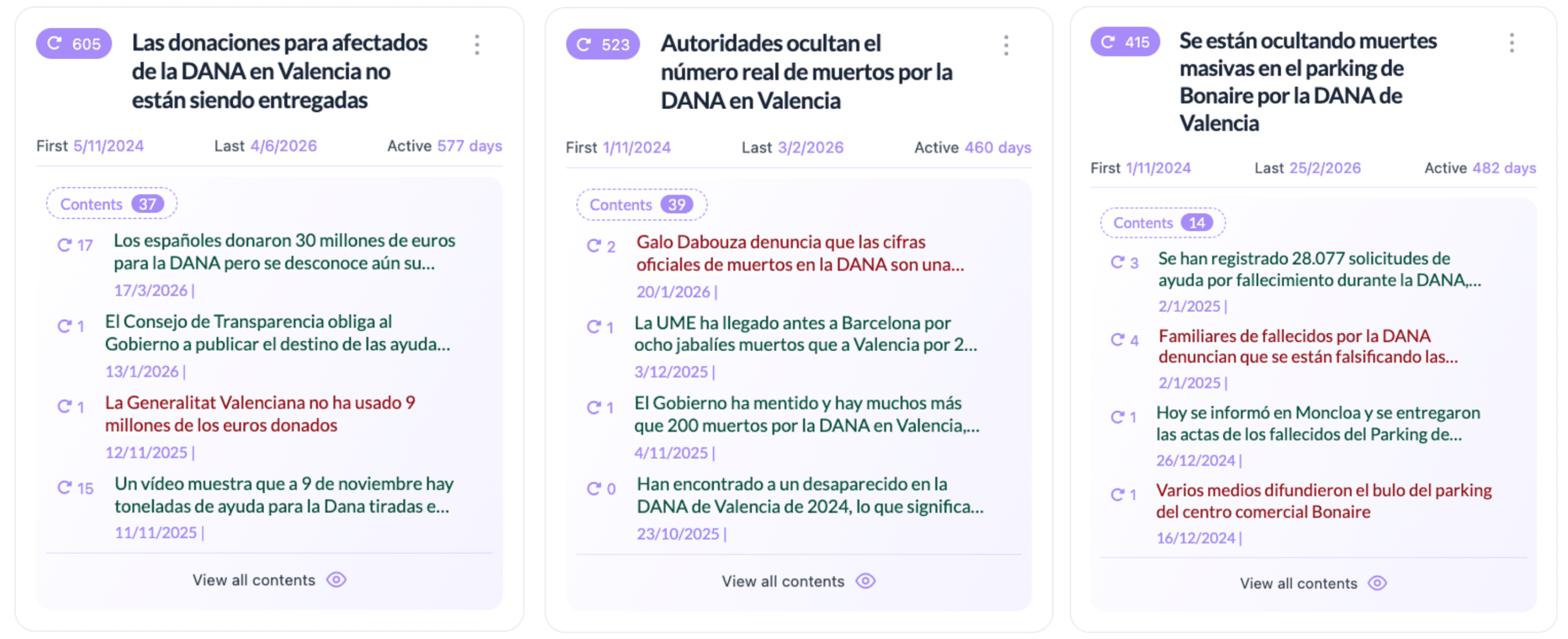
On November 1, 2024, the first indication of this narrative was recorded by Maldita.es through a user inquiry regarding “44 bodies” allegedly found in the parking structure several days before cleaning and inspection work had begun. By the following day, an explicit piece of content was identified, a WhatsApp screenshot with forwarded messages stating:
All the garages are full of dead people. My colleagues are going to Bonaire because they say it’s a cemetery. We have to drain the water, take them out, lift the bodies, etc. They told us that if we find anyone during the day, we shouldn’t remove them. We’ll cover them and take them out at night so people don’t get scared.
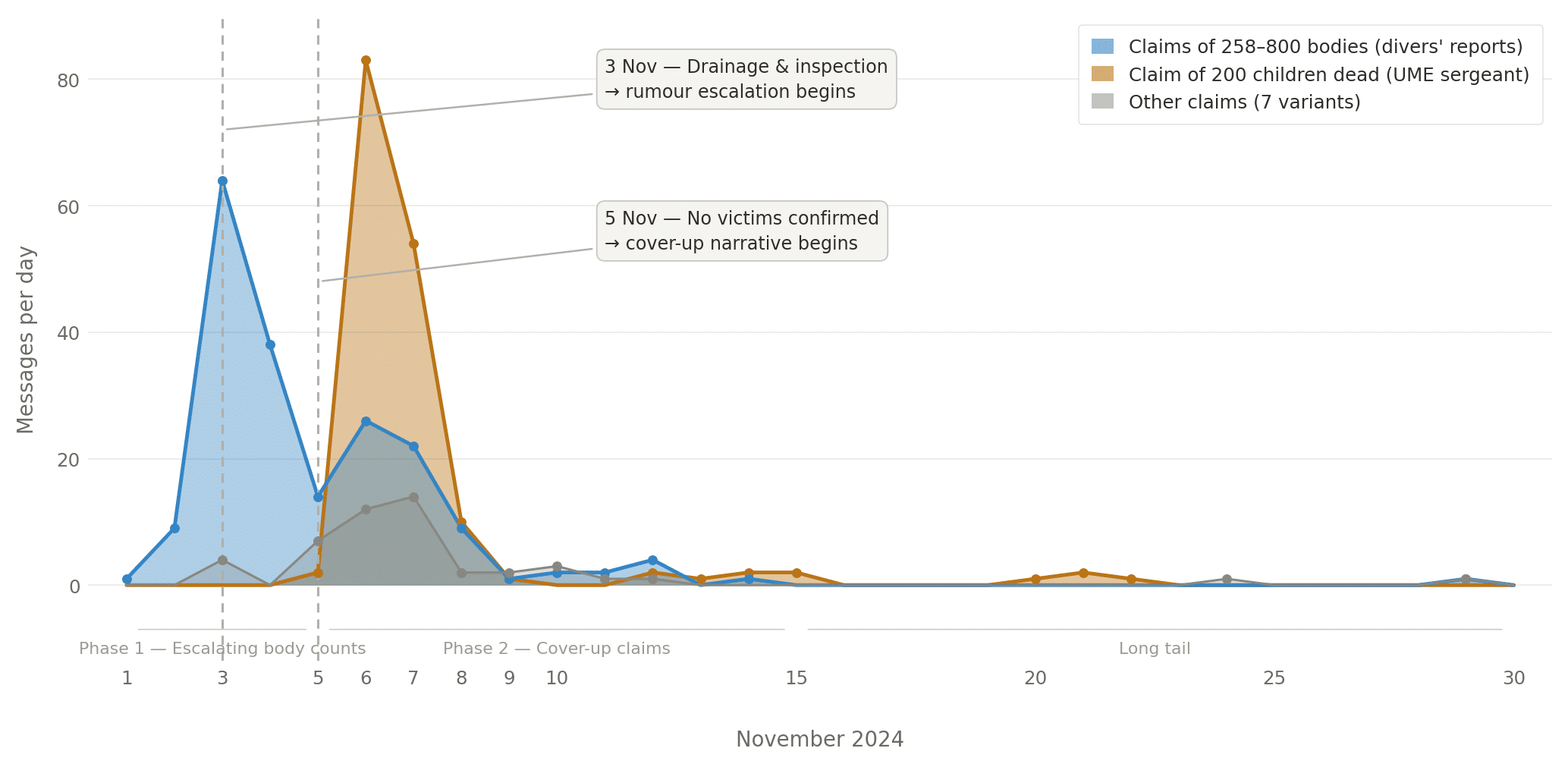
Through narrative monitoring procedures—which, at Maldita.es, involve the systematic real-time tracking of user queries, social media posts, and forwarded messages via an AI-assisted platform that clusters thematically related claims and maps their evolution over time—it became possible to observe how this initial rumor evolved within a few days into a full-fledged conspiracy narrative incorporating a series of shifting claims (see Figure 2). In the first phase, when the parking structure had not yet been water drained, increasingly higher figures of supposed victims circulated online: first 86, then 258, then more than 800, and even 1,000 bodies.
On November 5, 2024, official sources confirmed that no bodies had been found. Rather than dissolving the narrative, this triggered a second phase in which the rumor evolved into a conspiracy theory. Claims now alleged that at least 200 children were among the victims, that police were blocking access to the area, that bodies had been secretly removed in refrigerated trucks under cover of night, and that government officials, emergency personnel, forensic staff, and journalists were all complicit in a coordinated cover-up to conceal the true scale of the disaster and suppress public outrage (Maldita.es, 2024a; Maldita.es, 2024d). The conspiracy at this point was constructed around rhetoric based on anonymous and unverifiable testimonies that functioned as proxies for truth: “A Civil Guard officer told me,” “A diver friend who works with the police told me,” “A relative from the UME (Emergency Military Unit) just confirmed it,” “They’re saying we haven’t found any bodies when we’ve been pulling people out all night,” “I repeat, I have a direct military relative at the Bonaire parking structure, and they’re taking bodies out nonstop but have orders to say there’s nothing.”
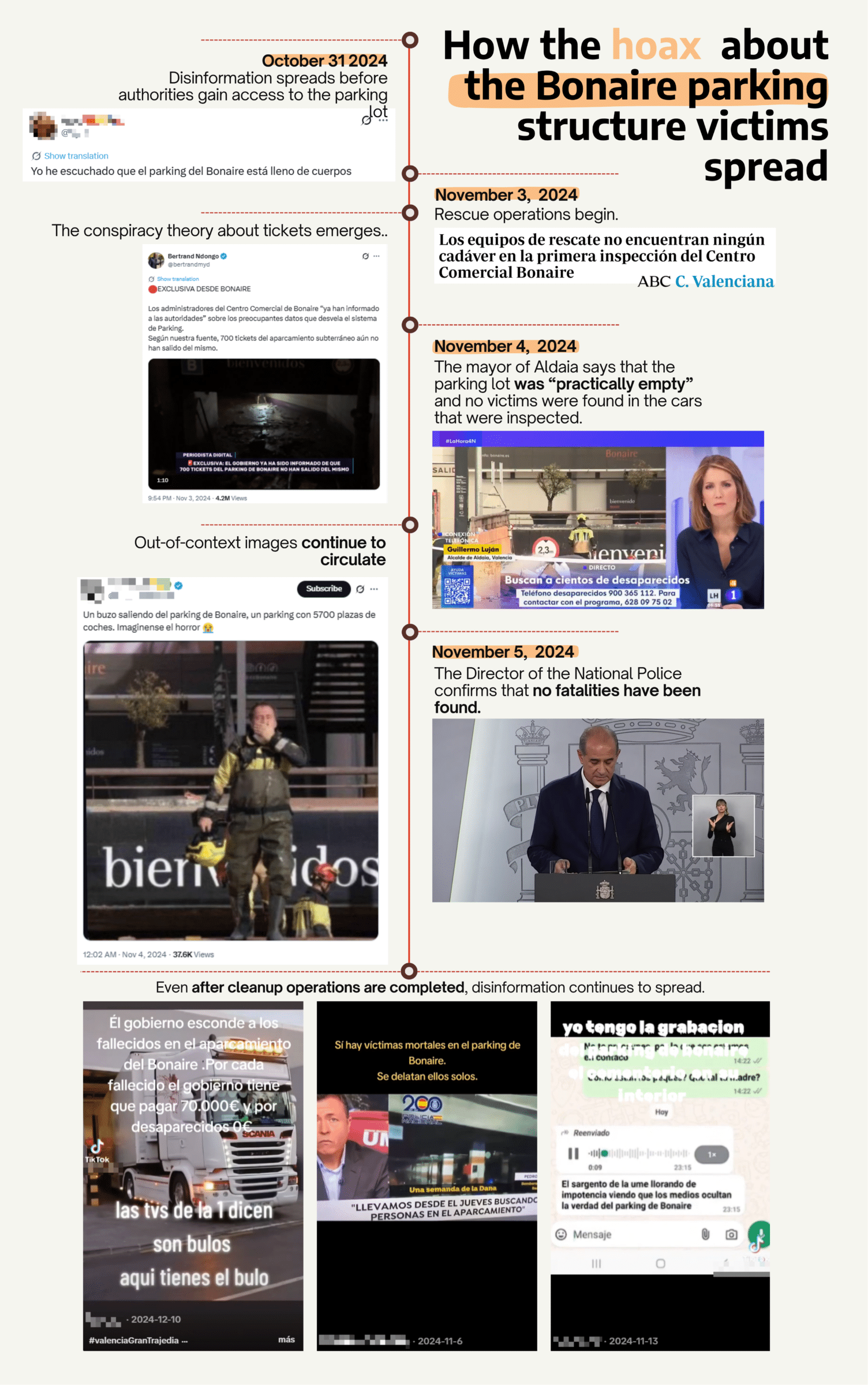
Although official statements, media investigations, and visual evidence all contradicted these claims (in reality, no fatalities were found in the parking structure), the conspiracy persisted and adapted to overcome refutations and accommodate new available data through these kinds of testimonies. These accounts, while lacking evidence, relied on persuasive tactics centered on the credibility of the source and emotional manipulation, mechanisms that make disinformation inherently persuasive (Rubinelli & Diviani, 2024). Narrative monitoring allowed Maldita.es to document this evolution in real time, understand the tactics used by disinformers, and anticipate how future claims might mutate.
The central strategy employed through these anonymous testimonies, such as the references to “a Civil Guard officer” or “a relative from the UME,” was establishing legitimacy, aimed at lending credibility to the disinformation by invoking seemingly authoritative sources and markers of expertise. This method operates as an appeal to authority argument (Walton, 2010), citing individuals who, by virtue of their position, would be presumed to have privileged knowledge. However, given the anonymous and unverifiable nature of these statements, where supposed witnesses were never identified by name (Maldita.es, 2025b), this tactic amounts to false attribution (Rubinelli & Diviani, 2025). Similarly, the disinformation also invoked alleged official documents withheld by the authorities, for example, posts claimed the existence of a municipal report from the Valencia City Council recording the removal of more than 220 bodies on the first day of the parking operation (Maldita.es, 2024b), or documents delivered to the Spanish government reporting over 800 victims in Bonaire alone (Maldita.es, 2025b). In neither case was there evidence of such documents provided, nor were the individuals cited as sources ever identified by name.
The plausibility of the conspiracy was further reinforced through detailed storytelling and personal experience appeals. Vivid claims—such as a viral audio recording that amassed millions of plays, allegedly featuring a crying UME sergeant saying that “they were being forced to keep quiet,” that “they had been removing bodies all night,” and that “at least 200 children” had been found dead—used the tactic of fabricating narrative with details and the argument from personal experience (Rubinelli & Diviani, 2025; Walton et al., 2008). These stories can be particularly convincing and emotionally engaging, functioning as a substitute for factual evidence by relying on individual cases to support the broader conspiratorial claim.
Furthermore, the nature of the disinformation (that “authorities were concealing a massive number of victims”) exploited the crisis context to employ emotional appeals. The messages sought to provoke anger and outrage, relying on the appeal to emotion and fearmongering arguments (Innocenti, 2011). Such emotional manipulation is highly effective, as negative emotions have a direct effect on people’s tendency to “misperceive false news as accurate” (Martel et al., 2020), increasing the likelihood that users will share content “without reading it first to verify its accuracy” (McLoughlin et al., 2024).
Beyond fact-checking: Applying argument-checking in practice
While some claims were quickly debunked, the speed and flexibility with which the narrative evolved, along with the volume of messages received (which reached 13,000 in just seven days, a figure four times higher than average) (Maldita.es, 2024c), prompted a shift in responses. From a practitioner perspective, it was observed that debunking isolated claims was insufficient to disrupt the complex explanatory framework that combined emotional urgency, institutional distrust, and speculative causality. In other words, the key was not only to disprove that there were bodies in the parking structure, but to deconstruct the internal coherence of the narrative as a whole.
Recurring fallacies were identified, such as the post hoc ergo propter hoc argument (“Twenty-six dams were demolished in Valencia months earlier, so that was the cause of the flooding”), non sequitur reasoning (“the parking structure flooded, therefore there must have been deaths,” “there are 700 cars trapped, therefore there must be a similar number of bodies”), the argument from ignorance (“no one can prove there were no victims”), false authority (“a voice message from an alleged anonymous official confirms the bodies”), and the slippery slope (“if we don’t expose this now, more tragedies will be hidden in the future”). To address these, Maldita.es applied argument-checking, a methodology that, unlike traditional fact-checking that primarily assesses the veracity of premises, examines how conclusions are drawn by analyzing causal links, logical coherence, and the rhetorical mechanisms underpinning reasoning (Brave et al., 2022; Plug & Wagemans, 2024).
Applying argument-checking to the Valencia case involved systematically questioning the plausibility and internal logic of the conspiracy through critical questions that challenged its premises. The focus shifted from the fact itself (whether there were bodies or not) to a critical assessment of the structure of the argument that the secrecy could be maintained. First, the logistical feasibility of concealing hundreds of victims was questioned. Based on David Grimes’s probabilistic model on the sustainability of conspiracies (Grimes, 2016), it was explained that an operation requiring the silence and coordination of hundreds of actors with different interests (authorities from various political parties, UME personnel, Civil Guard, firefighters, forensic staff, journalists, morgue and cemetery workers, etc.) would statistically collapse within weeks. Not a single anonymous leak, photograph, or internal complaint was ever produced. Second, the absence of circumstantial evidence was treated as a logical inconsistency, noting that if hundreds of people had died, the inevitable logical consequence would be families publicly reporting their disappearance. The lack of such reports was presented as a factor that rendered the conspiracy theory untenable and was reinforced with video evidence filmed by employees during the evacuation, showing the parking structure with no visible signs of trapped vehicles or human presence.
These counterarguments were designed as accessible and adaptable reasoning patterns for communication on social media, with the goal of providing the public with cognitive tools not only to reject disinformation but to reason about it. In practice, the published content was formulated as questions or intuitive lines of reasoning easily understandable to a general audience. For example: considering circumstantial evidence (e.g., “If there were hundreds of deaths, where are the reports from their families? Not a single report, name, or photo?”) or logistical feasibility (e.g., “Is it reasonable to think that hundreds of people with very different interests from different parties, organizations, and institutions could coordinate a cover-up without leaks?”) (Maldita.es, 2025c; Maldita.es, 2024d).
Ultimately, argument-checking enabled Maldita.es to rethink and optimize their interventions, achieving two primary objectives: (1) an anticipatory response (by identifying the discursive logic of a narrative, it is possible to preemptively neutralize future adaptations) and (2) a transferable response (identifying recurring logical fallacies provides reasoning patterns that the public can apply to similar narratives in future crises). The aim is to provide the public with an argumentative toolbox that enables them, on the one hand, to identify what does not make sense and why, and, on the other, to reuse these arguments within their own social environments so that they can explain to others (in everyday conversations or on social media) why certain claims are fallacious or incoherent.
Conclusions
Drawing on the Valencia floods case, this commentary advances three main claims. First, fact-checking remains necessary but insufficient to disrupt narrative persistence and adaptation during crises. Some research shows that corrected beliefs tend to regress over time as the correction is forgotten rather than actively rejected (Swire-Thompson et al., 2023) and claim-level corrections alone do not fully neutralize narrative momentum, especially when claims are woven into broader, emotionally resonant storylines that serve as collective sensemaking tools in conditions of high uncertainty (Starbird et al., 2016). Second, interventions that target arguments (e.g., explicitly testing causal premises and warrants) lead to more anticipatory and transferable responses across claim variants. While direct empirical evidence on argument-checking as a standalone intervention remains limited, research on adjacent approaches suggests that interventions which expose logical fallacies and manipulation techniques have been shown to produce larger effects on conspiracy belief change than purely factual counterarguments (O’Mahony et al., 2023) and that prompting active reasoning reduces false information sharing (Fazio, 2020; Kozyreva et al., 2022), particularly in contexts where prior beliefs and emotional engagement make factual updates less effective (Ecker et al., 2022). The Valencia case illustrates the practical conditions under which this matters: an information vacuum, emotionally charged content, and a conspiracy narrative that resisted claim-level debunking. Third, integrating narrative/argument maps with routine debunks can improve situational awareness for authorities and newsrooms and may reduce spillover harms (e.g., institutional trust erosion), even when specific rumors persist.
We conclude by proposing a hybrid workflow: (1) rapid claim-level verification to meet immediate public information needs, (2) concurrent narrative surveillance to detect storyline recombinations, and (3) argument-checking templates to expose recurring fallacies and causal leaps identified in step two, providing citizens with a logical “toolbox” that functions as a form of cognitive inoculation against future crises by encouraging deeper, slower processing that helps overrides automatic responses. Rather than rejecting fact-checking, the proposed workflow reframes it as one layer in a broader “narrative and argument integrity” strategy. Future research should test whether the reasoning patterns generated through argument-checking produce durable effects across different crisis contexts, audiences, and formats, and whether they can scale as preventive tools in high-uncertainty information environments.
[ad_2]
Source link
