
[ad_1]
Joshua Scheer
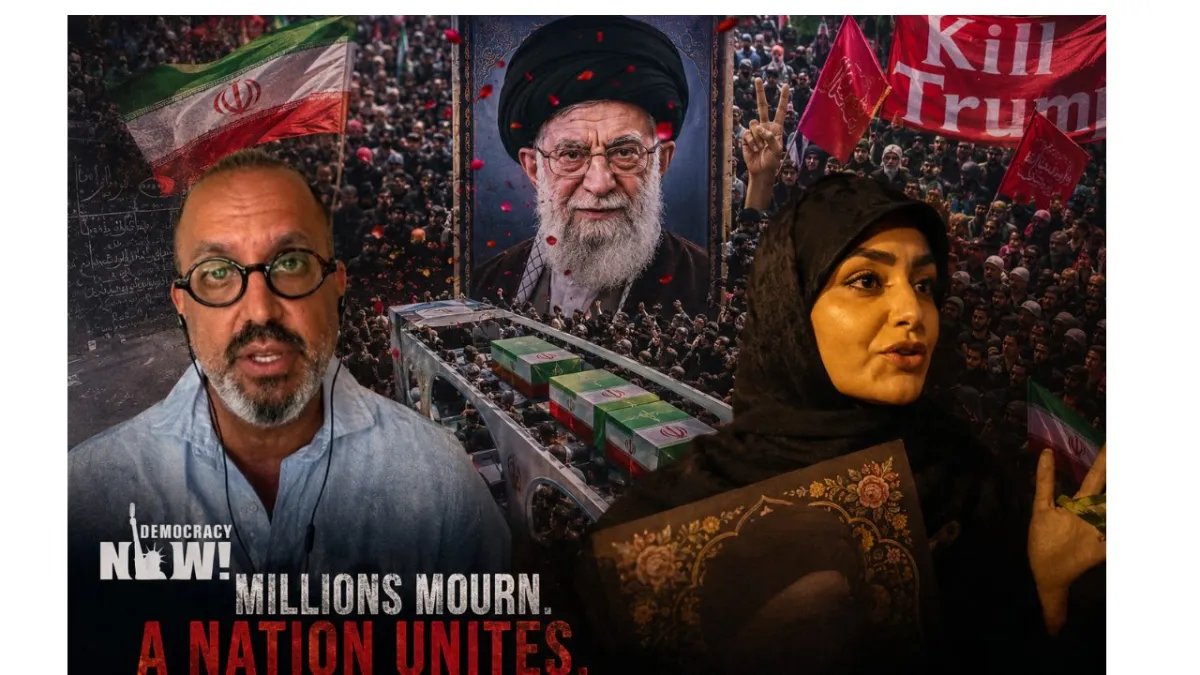
Before the bombs fell, many Western officials and commentators predicted that the assassination of Iran’s Supreme Leader, Ali Khamenei, would fracture the Islamic Republic from within. Instead, images emerging from Tehran this week have presented a very different picture. According to estimates cited during funeral coverage, millions of mourners filled the streets over several days, transforming Khamenei’s funeral into both a religious ceremony and a political statement. In an interview with Democracy Now!, Tehran-based journalist Reza Sayah described the gathering as the largest public assembly he has ever witnessed and argued that, for many Iranians, Khamenei’s death has recast him as a symbol of resistance against U.S. and Israeli power rather than simply the country’s longtime leader. Whether one agrees with that interpretation or not, the funeral has become an important moment in understanding how the war has reshaped public sentiment inside Iran and challenged many of the assumptions that dominated Western coverage throughout the conflict.
In an interview with Democracy Now!, hosts Amy Goodman and Juan González spoke with Tehran-based freelance journalist Reza Sayah, who has been reporting from inside Iran on the funeral of the country’s slain Supreme Leader, Ali Khamenei. As much of the Western media has focused on the geopolitical fallout from the war, Sayah offered a firsthand account of what he described as an unprecedented public mobilization. According to his reporting, millions of mourners filled the streets over several days, transforming Khamenei’s funeral into both a religious ceremony and a political statement. Sayah argued that, for many Iranians, Khamenei’s death has recast him as a symbol of resistance against U.S. and Israeli power rather than simply the country’s longtime leader. Whether one agrees with that interpretation or not, the scenes emerging from Tehran challenge many of the assumptions that dominated Western coverage throughout the conflict and provide an important window into how the war has reshaped public sentiment inside Iran.
Mourners were also seen throwing stones at a billboard displaying President Trump’s face that hung from a bridge. “The US killed our father. We won’t let you go!” the sign read, according to BBC.
“I came with honour and pride to show all the people of the world how much we loved him and how committed we are to the system, the people, and the Islamic Republic,” 22-year-old university student Melika Nourian told the AFP news agency.
Iran’s President, Masoud Pezeshkian, was also filmed walking among mourners in Tehran. Earlier, he wrote on X that Khamenei had taught Iranians that the country’s “greatest asset” was “its people and their unity,” adding that the nation would “continue the path of Iran’s honour, progress, and glory.”
Another mourner, Marzieh, said she attended to honor Khamenei, who ruled Iran for nearly four decades.
“We came here to tell our martyred leader that his blood is not wasted. We came here to renew our allegiance to him,” she said.
One notable absence from the ceremonies was Khamenei’s successor and son, Supreme Leader Mojtaba Khamenei, who has not been seen in public since before his appointment a week after his father’s death. Mohammad Eslami, a research fellow at Tehran University, told Al Jazeera he believed Mojtaba’s absence was due to the ongoing security situation.
“The war is not over,” Eslami said. “There is a very fragile ceasefire between Iran and the United States and Israel. Right now they are talking about very hard topics to negotiate. With their security arrangements, there’s not really a chance for him to appear in public.”
Mojtaba is widely believed to have been seriously wounded during the February 2026 U.S.-Israeli airstrike that killed his father. Officials and analysts have attributed his continued absence to both security concerns and his recovery. While Mojtaba did not appear, his three brothers—Mostafa, Meysam, and Masoud—were present and prayed beside the coffins during the Tehran ceremonies.
As Al Jazeera noted, his prolonged absence has fueled speculation about the extent of his injuries and raised questions about the security of Iran’s new leadership.
“My country is no longer the Iran of old, where the leader is publicly present,” 26-year-old Masoumeh said from Tehran, where he was attending the funeral. “Mojtaba’s absence is irrelevant. But his presence is a sign of the country’s security, and I now have the feeling that the former security does not prevail in my country. The late supreme leader was the meaning of Iran’s power.”
Not everyone viewed Mojtaba Khamenei’s continued absence as a cause for concern. Speaking from the funeral, 35-year-old Faezeh said she believed it was a necessary security precaution.
“I feel that for [Mojtaba Khamenei’s] safety, he should not be present in public and we should wait a little,” she said. “The fact that the new leader has not been seen yet does not mean anything bad to me because I know that the enemy did not show mercy to the former leader and will not show mercy to Mr Mojtaba either.”
Faezeh argued that the supreme leader’s absence had not disrupted the functioning of the government, adding that many Iranians understood why he had remained out of public view. “I think people are justified in saying that there is no need to see him in person right now. It is like believing in a mystical subject or the unseen imam of the Shia or even the existence of God: something you do not see, but believe in.”
As in any political transition, opinions varied. What is clear from the reporting, however, is that after months of war, bombings, and immense loss, many Iranians came together to support one another and mourn. Debates over leaders, succession, and the country’s future will continue—as they do in every nation—but the funeral also revealed a society grappling with tragedy while searching for unity in the aftermath of war.
Reza Sayah argued that Western media remain committed to a narrative that downplays Iran’s resilience. He described the funeral for Ali Khamenei as the largest public gathering he has ever witnessed, yet noted that many Western news reports characterized the event as involving only “thousands” of mourners or questioned whether attendees had been paid or otherwise incentivized to participate. According to Sayah, that skepticism reflects a broader unwillingness to acknowledge how the February 28 war reshaped public sentiment inside Iran. In his view, many supporters of the Islamic Republic believe the country not only survived the conflict but emerged politically stronger and ultimately victorious. Which is clear to anyone with open eyes.
Editor’s Note: At a moment when the once vaunted model of responsible journalism is overwhelmingly the play thing of self-serving billionaires and their corporate scribes, alternatives of integrity are desperately needed, and ScheerPost is one of them. Please support our independent journalism by contributing to our online donation platform, Network for Good, or send a check to our new PO Box. We can’t thank you enough, and promise to keep bringing you this kind of vital news.
You can also make a donation to our PayPal or subscribe to our Patreon.
Please share this story and help us grow our network!
[ad_2]
Source link
