
[ad_1]

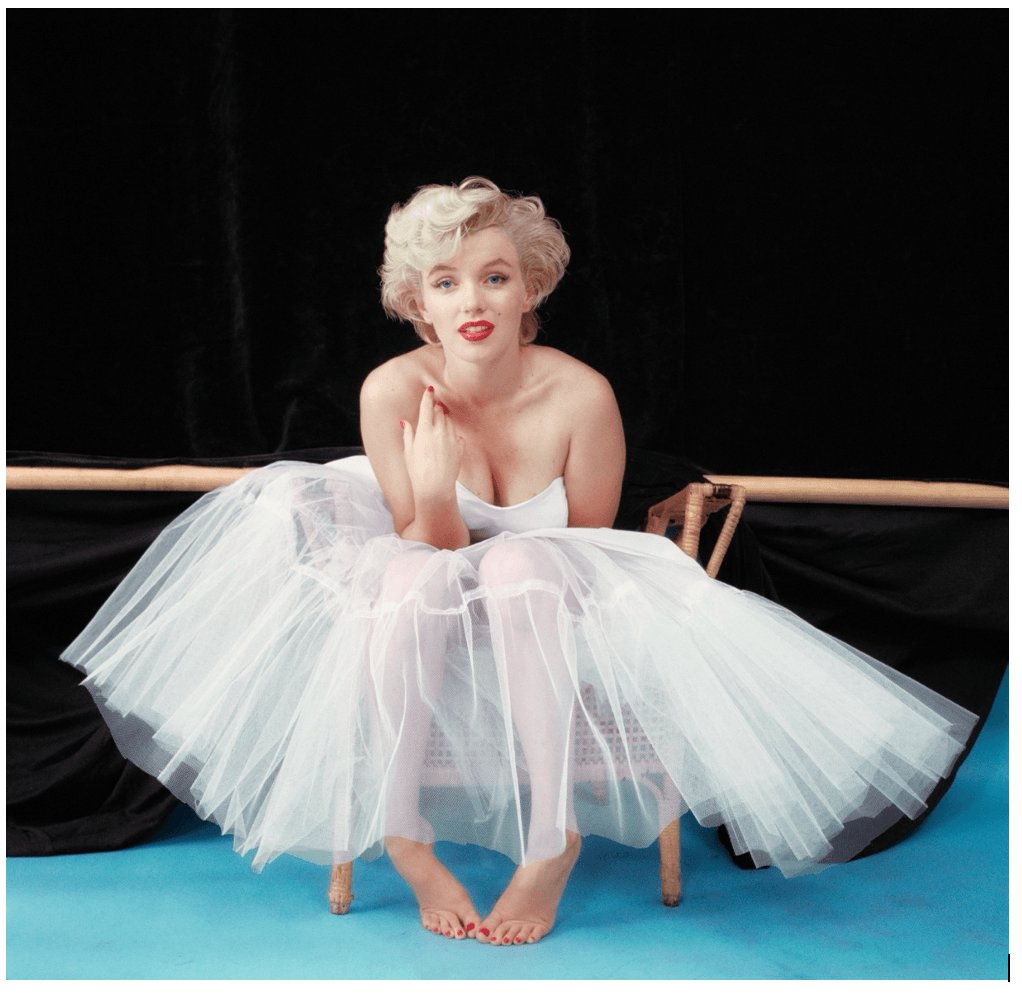
Milton H. Greene, Marilyn Monroe ‘Ballerina’ sitting, 1954. Photo: Courtesy National Portrait Gallery.
Marilyn and Joe D.
If any, it was baseball that was Marilyn Monroe’s game. In 1954, she married the recently retired, New York Yankees great Joe DiMaggio. She attended games with Joe and was once photographed standing at home plate with a baseball bat on her shoulder. In truth, she knew little about the game and didn’t care about sports – “I’ll leave those things to the men,” she said.
Maybe she chose DiMaggio for his grace – he didn’t run so much run as glide toward flyballs in center field; or maybe his steadiness – in 1941 he set a record for getting hits in 56 consecutive games. But whatever the reason, she picked wrong. After showing up uninvited on the location set of The Seven Year Itch on East 58th Street in Manhattan, he grew incensed watching take after take of the famous subway grate scene and onlookers ogling his wife. Did he think he married Eve Arden? The marriage was over before it barely started.
I went to see Marilyn Monroe: A Portrait, at the National Portrait Gallery in London, the morning after the much-anticipated World Cup football game between England and Argentina. I’m not a big sports fan, and have no attachment to the English squad, but after weeks of public build-up, discussion and expectation, the debacle in Dallas was deflating. I was ready to think about something else and MM seemed an undemanding choice. Little did I guess the exhibition would describe another kind of catastrophe — one more personally affecting than the one that befell English football.
Choosing sides in the World Cup
Though I wanted to be a good ex-pat and root for the American team to win the World Cup, that was impossible. A victory (unlikely though it was) meant a team visit to the White House and Trump crowing that the U.S. was the “hottest” country in the world. And if that wasn’t enough to turn me off the American team, supporters in stadiums chanting “U S A! U S A!” were. They might have been attending a MAGA rally. Trump’s successful overturning of the red card against the American star Folarin Balogun was the clincher. I couldn’t root for a team helped by the cheater-in-chief
England was the natural place to land. I live in Norwich, U.K. and know lots of people who are big supporters of the English squad. It’s nice to fit in. But that too proved difficult. Could I forget English captain Harry Kane’s golf game with Trump? Would he have said about Hitler what he said about the president: “His golf is pretty good to be honest with you.”
Then there’s the matter of the St. George’s Cross, unfurled on playing fields, waved by fans, and painted on faces and bared (mostly male) torsos. In recent years, the red and white banner has become a sign of British chauvinism, racism and xenophobia. A few journalists have said the proudly multi-cultural English club has reclaimed the banner from the far right. But that’s overly optimistic. A few weeks ago, my wife Harriet and I visited the town of Caister-on-Sea in Norfolk. St. George banners and pennants flew from poles at homes and businesses, and atop the light posts on the high street. Unsurprisingly, the town votes mostly Reform UK or the even further right Great-Yarmouth First Party, an offshoot of Restore Britain, led by Rupert Lowe, Nigel Farage’s rebel angel. Among the policies they support are mass deportation of “illegal migrants,” restoration of the death penalty, strengthening Britain’s “Christian heritage,” and banning halal and kosher meat. UK football fans have no business carrying the St. George Cross unless they want to be associated with that.
And finally, there’s the national anthem sung before English games. It has the same melody as the American contrafactum, “My Country Tis of Thee”:
God save our gracious King! Long live our noble King!
God save the King! Send him victorious, Happy and glorious,
Long to reign over us, God save the King.
Many Brits don’t know the words. When I asked Harriet if she did, she replied “of course!” and sang: “God save our dah-dah king, dah dah dah, dah, dah-dah, God save our King.” But there on the football field in Atlanta, was the English squad, singing every word. You’d think the nation would long ago have retired the song. Imperial nostalgia has for generations crippled the country. It lay behind the Suez debacle in 1956, the elections of Margaret Thatcher, John Major, David Cameron, Teresa May and Boris Johnson, Brexit and the U.K.’s senseless and self-destructive participation in the American wars against Afghanistan and Iraq. The yearning for past, imperial glories (aka crimes) has fortified Britain’s fascist right for a generation and now fuels the rise of the fascist and corrupt Farage. So please, British people, no “victorious” king to “reign over us.” Love your team (and even savvy old Charles) but skip the anthem!
I couldn’t support Argentina either. Though the country was subjected for most of the 19th and early 20thcenturies to dependence on the “British world system,” as Adam Tooze has recently written, that relationship is long over. The country is now governed by the corrupt, autocratic, obnoxious and chain-saw loving President Javier Milei whose politics are a throwback to the years of the military junta and Dirty War (1976-’83). He was recently re-elected after receiving a promise from his friend Trump and Treasury Secretary Scott Bessant of a $20 billion currency swap and another $20 billion of private investment. Rooting for Argentina against England was out of the question.
And to be honest, the sight of skinny, pale, Anthony Gordon in the match against Argentina, sprinting toward the goal to tap in Morgan Rogers’ cross was thrilling – I cheered wildly. But just then, with at least 25 minutes left in the game, the English coach Thomas Teuchel, a lean, tough talking German whose last name is uncomfortably close to Teufel (devil), pulled out Gordon and several other attackers and replaced them with a defensive team unable to mount an offense. The result was predictable: almost the entire rest of the game was played near the English goal, the one place on the field were Lionel Messi, perhaps the greatest of all time, had a freehold. He directed the attack and himself teed up two perfect passes for Argentine scorers. Just after the game ended, I bought my next morning, senior-discount, off-peak, day-return (in American “round-trip”) ticket to London.
Disaster pictures
Around the corner from the much larger National Gallery on Trafalgar Square, catercorner to the church of St. Martin-in-the-Fields on St. Martin’s Lane, sits the National Portrait Gallery, established in 1856, and housed in its current premises since 1896. Formerly a staid institution, stuffed with portraits of kings, queens and notables, it has received successive face lifts and lately a new mission – to bring in more tourists, new audiences, and more money. It has obliged in the expected ways: by mounting exhibitions of portraits by younger and non-white artists, and more significantly for the bottom line, celebrity themed and fashion forward exhibitions. Marilyn Monroe on her 100th birthday was a no-brainer.
The material in the exhibition was cleverly organized by photographer and date. While Monroe worked with a few photographers for nearly the whole of her adult life (she died in 1962, aged 36), she mostly moved from one to another: So, the story of her photographic history is also the story of her life. First the teenager was documented by Andre de Dienes and Bruno Bernard; then in her 20s by Cecil Beaton, Milton H. Greene, and Sam Shaw; then Richard Avedon, Alfred Eisenstadt, Eve Arnold, Inge Morath, Bert Stern, and so on.
Monroe was a confident and canny model. Almost from the beginning, she understood the value of establishing a close relationship with her photographers (sometimes sexual) and insisting upon editorial discretion. She would examine contact sheets, circling the ones she liked and crossing out with a marker the ones she didn’t. Sometimes, as in the case of Bert Stern in 1962, she even reviewed the negatives, using a stylus to scratch an X on the ones she rejected, making them unusable. (Stern nevertheless printed these disfigured images after Monroe’s death – some are in the exhibition.) In just a few cases, she allowed photographers to publish images she didn’t like – that was the case with Richard Avedon’s sad Marilyn, titled Marilyn Monroes, Actress, New York, 1957. Monroe knew a genius when she met one.
The exhibition also includes painted homages to Monroe, mostly posthumous. An exception is Willem de Kooing’s Marilyn Monroe from 1954. It’s a good, Abstract Expressionist painting, with advancing reds and yellows held in check by brushy black contours. But it would be hard to call it a portrait; we learn nothing from it about Monroe because nothing is said. The same is true for the famous Warhol images, three of which are in the exhibition. The paintings (made with paint and screens) and screen prints (made with ink and screens) are concerned with celebrity, commodity, repetition, desire and surfeit – but not Marilyn Monroe. Indeed, it’s her disguise that we see — heavy lidded eyes, open-mouthed half smile, yellow hair and beauty mark — not her character or temperament. This is icon, not individual.

Gene Kornman, publicity portrait of Marilyn Monroe as Rose Loomis in the 1953 film Niagara, Wikimedia Commons; and Andy Warhol, Green Marilyn, 1962. National Gallery of Art, Washington D.C. Photo: Courtesy National Portrait Gallery, London.
The latter is what we search for in photo after photo of Marilyn but rarely discover. Even in her nudes, she kept herself to herself. There are perhaps glimpses of sorrow in Avedon’s photos, self-reflection in Shaw’s pictures of her and her husband, playwright Arthur Miller, and vulnerability in Milton Greene’s image of Marilyn as a ballerina from 1954. That was the year she became a bona fide star from three films released the year before: the Hitchcockian noir Niagara, and two comedies, How to Marry a Millionaire and Gentlemen Prefer Blondes. I still cry from delight and admiration every time I see her, dressed in a pink satin, floor length, strapless gown and matching pink opera gloves, singing “Diamonds Are a Girl’s Best Friend.” The song and its performance offer one answer to Marxist-feminist Evelyn Reed’s contemporaneous argument that capitalism progressed “from selling women as commodities, to selling commodities to women.” Marilyn’s fetish-forward production number argues that women should use the promise of sex to trick wealthy men into giving them diamonds. A gift economy is the antithesis of capitalism.
The earliest Warhol picture in the exhibition, Green Marilyn, was part of his “Disaster Series” (1962-67) which represented plane crashes, car crashes, the electric chair, suicides, and similar subjects. They are widely considered the artist’s best works because they appear to undermine the image of the U.S. – still widespread on the cusp of the Vietnam War – as a land of affluence and ease. In 1963, even before the assassination of Kennedy, Warhol said about the series:
The big plane crash picture, the front page of the newspaper: ‘129 Die.’ I was also painting the Marilyns. I realized that everything I was doing must have been Death. It was Christmas or Labor Day—a holiday—and every time you turned on the radio, they said something like ‘4 million are going to die.’ That started it.
Knowing how the story ends — Marilyn Monroe’s suicide by drug overdose — nearly every image at the National Portrait Gallery exhibition is a disaster picture.
Parapraxis on Sutton Place
One work especially brought this home to me. It wasn’t the small paintings by Margaret Harrison (Marilyn is Dead! 1998) and Marlene Dumas (Dead Marilyn, 2008) based upon autopsy photographs. It was the photo by Sam Shaw of her and Monroe’s husband Arthur Miller standing on Sutton Place near their apartment at 444 East 57th Street in Manhattan. Behind them is the Queensboro Bridge. I know that location well because of a childhood misunderstanding, a kind of Freudian parapraxis.
My family lived on the other side of the Queensboro Bridge, in Forest Hills, about nine miles east on Queens Boulevard. I have just a few, but clear memories of Monroe’s death on August 4, 1962. Everybody was talking about it, my parents and two older siblings included. In addition to being famous and beloved, Monroe had married Miller a few years before and converted to Judaism, making her one of us. Though I was just six, I remember my mother crying and the two-word headline of the New York Daily News, “Marilyn Dead.” (It’s possible the latter is a false memory, and I only saw the newspaper headline later. My parents mostly read The New York Times.)

Daily News, “Marilyn Dead,” August 6, 1962; and Wurts Bros., Facade of 444 East 57th Street. 1949. Collection of the Museum of the City of New York, MNY243067. Public Domain.
Soon after that, coincidentally, my father drove with me beside him over the Queensboro Bridge into Manhattan. Exiting the bridge from the lower ramp, he pointed toward the building off Sutton Place where Monroe lived, and I assumed, died. Before then, I’d never thought about death as occurring at a specific time and nearby place.
Though I learned some years later that Monroe died in her little house with a pool in the Brentwood neighborhood of Los Angeles and not in her New York penthouse, Sutton place continued for years to invoke for me the actuality of death. Every time I crossed the bridge by bus or car and exited via the 59th Street off-ramp, there it was, 444 East 57th Street. I haven’t returned there in years, but Sam Shaws’s picture of Marilyn and Arthur Miller brought it back to mind.
Monroe’s premature death was the result of multiple factors: illness, miscarriages, spousal abuse, drug addiction, psychiatric mistreatment, professional anxiety, loneliness and depression. Together they caused a tragedy -– that’s what was so vividly staged at the National Portrait Gallery.
World Cup final
A few days after my return to Norwich, Marilyn’s death safely secreted again in memory, I was back to watching football: the final game of the World Cup between Spain and Argentina. What a disappointment! On the Spanish side, there was lots of passing but little finishing; on the Argentine, lots of fouling and copious diving. At one point, the great Messi, after a collision with Spaniard Aymeric Laporte, lay on the ground, stiff and straight as a board, like a child playing dead. He got a foul but not the penalty kick he was hoping for. On another occasion, after Argentina’s Enzo Fernández was rightly given a red card for upending the Spanish Pau Cubarshe, Messi spotted Spanish left-back Marc Cucurella momentarily covering his mouth as he spoke. Messi ran to the nearest referee, pointed to Cucurella, and insisted he be thrown off the field for covering his mouth, a rule drafted to prevent racist abuse. (Messi is white – part Spanish and part Italian; Cucurella said nothing racist). The referees quickly dismissed the ploy. After the game, Messi claimed that “the system was rigged” against the 39-year-old, billionaire footballer.
In the end, Spain, the far better team, prevailed. As important, 80-year-old Donald Trump used up three hours of his limited term of office and respiration, watching a boring game. He also had to endure Gianni Infantino’s ingratiation and the nearly 30 minute half-time show, featuring Madonna’s lip-synced, frozen-faced mash-up of pop and disco; Shakira lip-syncing the FIFA anthem titled “Dai Dai” (“C’mon, C’mon”) dressed in a Hula-skirt; and a somnambulist troubadour Justin Bieber performing his Gospel-lite “Everything Hallelujah.” He wore, naturally, items from his own clothing line: Hoodies $160, sunglasses $200.
Equally gratifying, Trump and Infantino were greeted with lusty boos when they walked on the field after the game to present awards. Then things went from bad to worse for them. First, Infantino wouldn’t let the president by himself carry the 18th carat gold, World Cup Trophy, apparently worried the kleptocrat-in-chief would make off with it. Then after shaking a few reluctant Spanish hands, Trump was ushered aside by team captain Rodri — no yellow card was issued, but the Secret Service must have been nervous. The U.S. president was subsequently edited out of the official Spanish and FIFA World Cup champions photographs.Trump, who two weeks ago called Spain “hopeless” and a country with “bad people,” was beaten. He now praised the country’s team and denied any previous trash-talking: “I have no tension. I have no tension with anybody.”
At about the same time in Argentina, President Milei was mocked for failing to delete his pre-scheduled posting on X declaring a national holiday for “the victory celebrations for the Argentine National Team.” Elsewhere, Palestinians and their allies celebrated the victory of Spain, whose president publicly recognized that Israel’s conduct in Gaza constituted a genocide and said that its president, Benjamin Netanyahu was “a criminal who must be arrested immediately.” For a little while, there were glimmers of justice.
[ad_2]
Source link

