
[ad_1]
Note: The following is a modified version of an address given by Greg King in Jenner, California on June 12, 2026
During the mid-19th century, Henry David Thoreau wrote, “Nowadays almost all man’s improvements, so called, as the building of houses and the cutting down of the forest and of all the large trees, simply deform the landscape, and make it more tame and cheap. … How can you expect the birds to sing when their groves are cut down?” Thoreau concluded, “A man is rich in proportion to the number of things which he can afford to let alone.”
Thoreau found himself angered by belief systems that ignored or denied the damage that the nation’s swiftly expanding consumer lifestyle was having on Nature. Living for two years at Walden, he especially disliked the logging that was often ongoing around the pond, and he decried justifications that declared deforestation to be a “good idea” — a great advancement for humanity and even for the land. Today we gather here in Jenner to discuss, and garner support for the permanent protection of an 1,100-acre property that encompasses significant portions Sheephouse Creek and Jenner Gulch, and is surrounded on three sides by the Jenner Headlands Preserve. As in times past, the owner of this property thinks it would be a good idea to log it, no matter that timber operations have occurred there several times in recent decades, and that today the forest provides critical habitat for both endangered spotted owls and endangered coho salmon.
Seventeen years ago the eminent fisheries biologist Pat Higgins wrote to CalFire:
The only way that Coho Salmon can be restored in the Russian River is if lower river tributaries such as Sheephouse Creek … are recovered to functional Coho salmon conditions. If we want salmonids to recover, then we must stop or severely limit logging in a heavily degraded watershed such as Sheephouse Creek …

Sheephouse Creek runs through dense forestland before entering the Russian River near Jenner.
But what we’ve learned over the past year or so is that the owner’s intention to log this eleven-hundred-acre forest cannot be viewed in isolation. It comes in tandem with the targeting of nearly 250,000 acres of Sonoma County forestland for what is called “forest resilience” logging. The “waste wood” from these operations would be hauled from throughout the county to a defunct sawmill not far from Sheephouse Creek. The sawmill is owned by the same person who wants to log in Sheephouse Creek and Jenner Gulch. A newly formed business is attempting to purchase the mill to manage the wood processing. The mill would turn out a variety of products, including fuel for bioenergy production.
This is all happening very quickly. Last year a newly formed non-profit organization called Regenerative Forest Solutions published a groundbreaking 178-page report titled, “Assessing the Viability of Wood Recovery and Utilization in Sonoma County.” The paper cited nine studies and reports, all of them published since 2018, that support the paper’s conclusion that “forest health and wildfire resilience treatments are feasible in 242,365 of Sonoma County’s 513,000 forested acres. … Oversight of procurement and management of wood resources is the primary focus of this report.”
Just this year some folks at Regenerative Forest Solutions founded Timbershed, a for-profit company that is currently attempting to purchase the sawmill and convert it a wood recovery and utilization facility that will accept and process all that wood from throughout the county.
Logging in the guise of “forest health” is a rapidly growing business model in the country and now especially in the West. Assertions that the action is not logging but “thinning,” that the forest will become more “resilient” against wildfire, and that the “waste wood” can be turned into “green products,” particularly “green energy,” are themes that suffuse the recent literature. Stated outcomes include healthier forests and reduced fire danger — a win-win scenario that also includes economic growth. In an ideal world this may be the case. But we don’t live in that world. In recent years this business model has spawned new organizations and franchises, robust research publications, massive public and private funding, government oversight and legislation, and creation of new not-for-profit organizations that together have largely snowed the rhetorical and physical landscape with robust and widely accepted, though often fallacious justifications for widespread industrial logging — justifications organized under the compelling banner of “forest resilience.” We now see this dynamic at play in Sonoma County.
Before I go further into what is admittedly a skeptical analysis, I want to emphasize that some thinning of densely stocked stands of recovering forest can contribute significantly to forest health, and that commercial gain from the thinning is not always ill gotten. A colleague of mine in Humboldt County owns a small sawmill and runs a restoration forestry business whose work on the ground is excellent. Likewise I’m a big supporter of the City of Arcata’s logging efforts on more than 2,000 acres of redwood forestland owned by the city. Arcata manages its forest for old-growth characteristics, using very light-touch methods to cut only about 5 percent of a stand on a few acres, retaining the biggest trees, putting roads to bed after they are used, and leaving the site looking as if no logging had ever occurred. My organization, Siskiyou Land Conservancy, has thinned 100 acres of densely stocked Douglas fir forest on a tract we manage in Del Norte County, and we will conduct similar small operations on portions of a 353-acre riverfront reserve on the Mad River, in Humboldt County, that we acquired last year. Nor am I ignoring the dangers of a warming planet, the obvious and catastrophic changes that are predicted and already occurring.
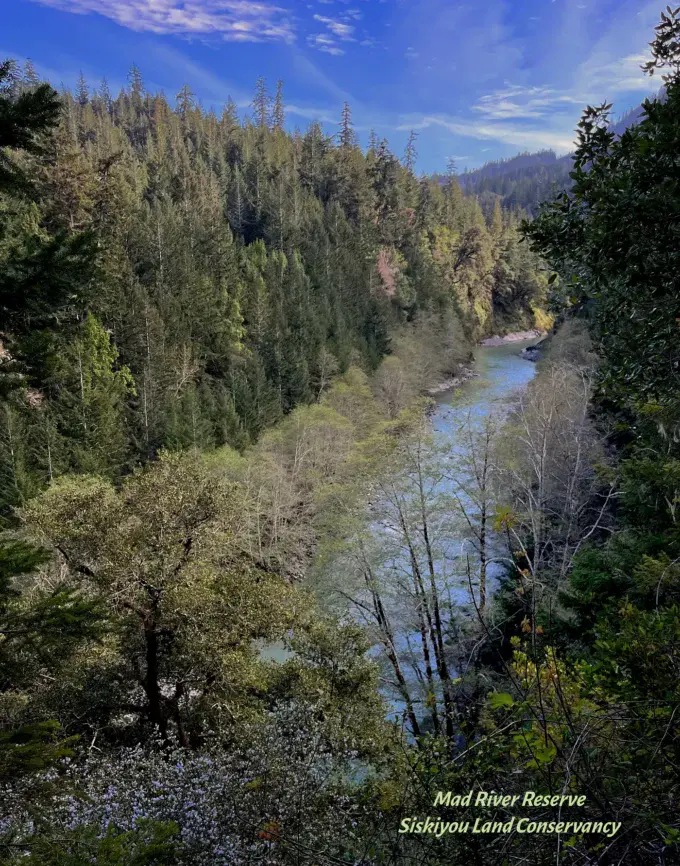
Critical forest habitat and 1.5 miles of river frontage are protected by Siskiyou Land Conservancy’s Mad River Reserve.
Additionally, I have enjoyed communicating with one of Timbershed’s primary organizers, who seems earnestly dedicated to achieving healthier forest ecosystems and a healthy regional economy. Still, the enterprise they propose is inherently fraught. The danger lies in the broader trend of good people being co-opted — whether willingly or unwittingly — by powerful economic forces whose dedication to forest health is rhetorical at best. The political and financial obligations inherent in these very new and quickly evolving timber partnerships and coalitions present a clear and present danger to California forestlands.
The public has recognized these dangers. Almost exactly one year ago the newly formed Golden State Natural Resources Agency responded to public outcry and abandoned its plan to build one of the largest wood pellet manufacturing plants on the West Coast of the United States. The plant would have been fed by “waste wood” taken from huge “forest resilience operations” in the Sierra Nevada to make wood pellets to fuel giant cogeneration electricity plants, many of them in Europe. Since that time just one year ago I’ve tracked what appears to be a pivot toward creating several regional wood processing facilities rather than a few giant ones. I believe that is the intended use for the sawmill in Jenner, to create the Sonoma County branch of a much broader, integrated statewide network of wood processing plants.
So who supports this effort by Timbershed? The organization’s web site notes that its bid to purchase the local sawmill has already received more than $1 million in financing from Cal Fire, the US Forest Service, the Governor’s Office of Land Use and Climate Innovation, and the Bay Area Council Foundation. These are not what I’d call environment-first entities. No other agency in California is more responsible for the wholesale and often illegal destruction of private forestlands than Cal Fire. If you read my 2023 book The Ghost Forest, you’ll find Cal Fire perpetrating some of the most egregious and preposterous legal violations in the history of California government regulation. The same could be said for the US Forest Service on public lands. The Governor’s Office of Land Use and Climate Innovation is largely dedicated to weakening the California Environmental Quality Act in favor of housing developers. The Bay Area Council Foundation is robustly pro-business, with an Executive Committee made up of corporate leaders from PayPal, PG&E, Genentech, Bank of America, Kaiser Permanente, United Airlines, AT&T, Visa, Wells Fargo, and the San Francisco Giants, among others. Not a single environmental group is represented on the committee.
Last year, Regenerative Forest Solutions spearheaded creation of the six-member Wood Products Manufacturing & Technical Assistance Project, a “cross-regional initiative spanning five of California’s key economic development regions.” The Project has identified 18 million acres in need of “resilience” logging in Northern California. Another founding member of the Project is the Northeastern California Forest Biomass Authority, which itself is targeting 12 million acres in Shasta, Siskiyou, Lassen, and Modoc counties, where the Authority will “aggregate the supply of woody biomass to support small-scale, community-based bioenergy facilities and keep forest restoration economically viable.”
In addition, this year the Hoover Institution at Stanford University named the founder of Timbershed as one of eight fellows under the Institution’s Enviropreneur Fellowship Program, which is part of the Hoover Institutions Markets vs. Mandates program. The fellowship program is run by senior fellows Dominic Parker and Terry L. Anderson. Parker comes to the program from his post with the Property Environment Research Center, in Bozeman, Montana. Among environmentalists PERC is notorious, most prominently for attempting to weaken the federal Endangered Species Act. Last March PERC sued the Interior Department to eliminate automatic protections for species listed at “threatened” under the act, an effort then repeated last November by the Trump Administration.
Anderson also comes to Hoover Institution via PERC. He’s a leading advocate for what he calls “free market environmentalism,” as if that were a thing. Anderson has published several books on the theme. According to PERC, “free market environmentalism” tactics include selling off public lands to private corporations.
The report by Regenerative Forest Solutions cites nine papers and studies as important to the organization in determining that a quarter-million acres of Sonoma County forestland requires industrial thinning, and that the sawmill just up the road is the best place to process the spoils. The weightiest of these studies, said the paper, is “an important report entitled ‘Accelerating Forest Restoration: Stimulating a Forest-Resilience Economy in California’s Fire-Adapted Forests.’” This report was produced in 2020 by The Nature Conservancy and the consultancy firm Bain & Company. Regenerative Forest Solutions noted that the report “focuses on small-scale infrastructure as essential to re-invigorating forestry-sector livelihoods in rural communities while offsetting costs to forestland owners. The report’s set of goals and actions are particularly important within the landscape of Sonoma County.”
I want to briefly examine this report and, more broadly, its seminal placement in the canon of current trends in forestry — trends in large part driven by robust collaborative efforts to leverage the fear of wildfire to access billions of dollars in public funds allocated for wildfire prevention, and to achieve public support for logging in areas that public sentiment might otherwise rally against. The Nature Conservancy is a leading force in these efforts. Last year the Nature Conservancy led the creation of the Wildfire Solutions Coalition, a collection of sixty-nine California organizations that includes founding member Regenerative Forest Solutions. It’s important while examining the Nature Conservancy report to have an understanding that its co-creator, Bain & Company, is one of the largest management consultancy firms in the world. Mitt Romney was the company’s first chief executive. The controversial firm primarily caters to Fortune 500 CEOs. So why is Bain working with The Nature Conservancy?
The Nature Conservancy is no run-of-the-mill environmental organization. The Conservancy is a worldwide corporate influencer that leverages an annual budget of $1.5 billion and holds $10 billion in assets. Nature Conservancy leadership is widely drawn from industry and government. In many instances the organization has operated as a broker or enabler of corporate activities whose greatest victim is nature itself. In 2022 one hundred fifty-eight environmental organizations signed an open letter to the Nature Conservancy titled, “Stop Perpetuating Forest Destruction, Pollution, Carbon Emissions and Environmental Injustice.”
According to the conservative outlet Influence Watch, “The Nature Conservancy has a strong business relationship with some of the nation’s largest energy producers, such as Chevron and Duke Energy, and many large businesses such as Dow Chemical. TNC has also maintained associations with the political center-right: Former Senate Republican Leader Bill Frist is a member of the TNC board.”
Another Nature Conservancy director is Jeffrey Ubben. Ubben is a partner at Nasdaq and, until 2026, was a director of ExxonMobil. Ubben remains a director of several other major corporations, including Enviva, the world’s largest producer of wood pellets for biomass electricity generation. Enviva is the controversial scourge of the South, where hundreds of thousands of acres have been logged to produce so-called “clean energy” pellets that are burned to make electricity.
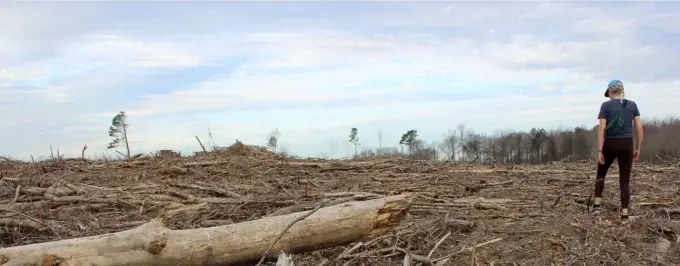
Logging in North Carolina for production of wood pellets.
Much of this logging is done under the banner of “forest resilience.” Yet the environmental damage to southern forests, watersheds, habitat, and communities has been widespread and has led to major uprisings. Most of Enviva’s wood products are sold to the British energy giant Drax, which burns the pellets in the world’s largest wood-fired power plants.
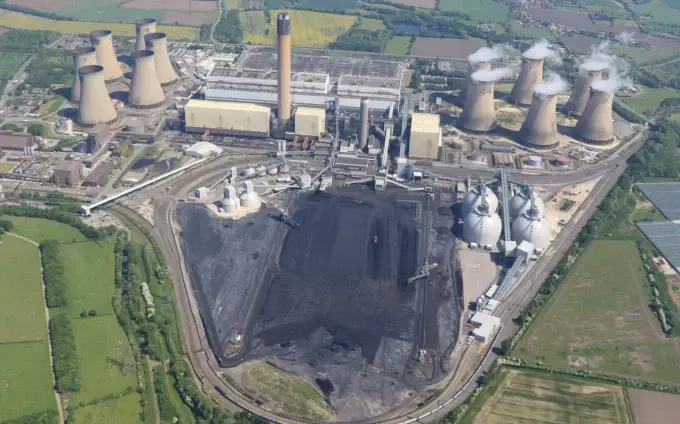
A Drax power plant in North Yorkshire, England, recently converted from coal power to burning wood pellets.
Now Enviva is moving into the American West to strip forests here as well, under the guise of “restoration” and “forest resilience.” The Nature Conservancy is a major driver of these sorts of efforts. The Nature Conservancy owns 500,000 acres of land in California alone and is currently a partner in 275,000 acres of forest “thinning” in the Sierra Nevada, where today logging for fuel wood is epidemic. Meanwhile, the Nature Conservancy leverages its forest holdings to sell millions of dollars in carbon credits, including to Blackrock, JPMorganChase, and Disney. Similarly, the organization is addressing power consumption by promoting “nature-positive data centers.” That this organization is among the primary influencers of Regenerative Forest Solutions is discomfiting at best.
The stated goal of the 24-page report produced by The Nature Conservancy and Bain — which has been so influential with organizers at Regenerative Forest Solutions — is to “accelerate forest restoration.” Sort of sounds good so far, until you get to the first page, the executive summary, and find the word “bioenergy” three times in the first paragraph. The report notes that Bain “evaluate[d] the role marketable wood products sourced from smaller-diameter trees (such as wood used for bioenergy or lumber) can play in accelerating the restoration of California’s fire-prone forests. … [The aim is to make] economic use of the by-products of forest restoration [by expanding] the use of existing technologies … such as bioenergy and sawmills. However, despite the technological readiness of bioenergy and sawmills, we found that the viability and growth of these two high-priority markets will continue to be challenged without significant changes in public policy and administrative processes. … Bain identified multiple systemic barriers relating to existing land-management policies … and limitations on the size of forest-restoration projects.”
Here’s an example from the past few years of what we might expect from this new wood products industry in Sonoma County and across the West. In 2019 an organization raised $15.65 million to purchase the last large, privately-owned grove of giant sequoias. This was a stand of 530 acres in the Alder Creek watershed adjacent to the Giant Sequoia National Monument in the southern Sierra Nevada. This group vowed to protect the grove and eventually transfer the land to the federal government as a park addition. But the following year the Sequoia Complex fire swept across the southern Sierra, burning through 174,000 acres of forestland, including Alder Creek Grove. Much of Alder Creek survived the fire unscathed, and the burned areas immediately sprouted thousands of giant sequoia seedlings that grew in thickets so dense as to appear magical. Sequoia scientists did not see the fire as catastrophic. Over the past century one of the greatest challenges to reproduction of the giant sequoia ecosystem has been fire suppression. Giant sequoia forests rely on high-intensity fire not only to release sequoia seeds from their closed cones, but also to provide them with the nutrient-rich ash and high levels of sunlight they need to grow, survive, and thrive. In giant sequoia time, hot fire is the natural order of things, guaranteeing survival of the species.
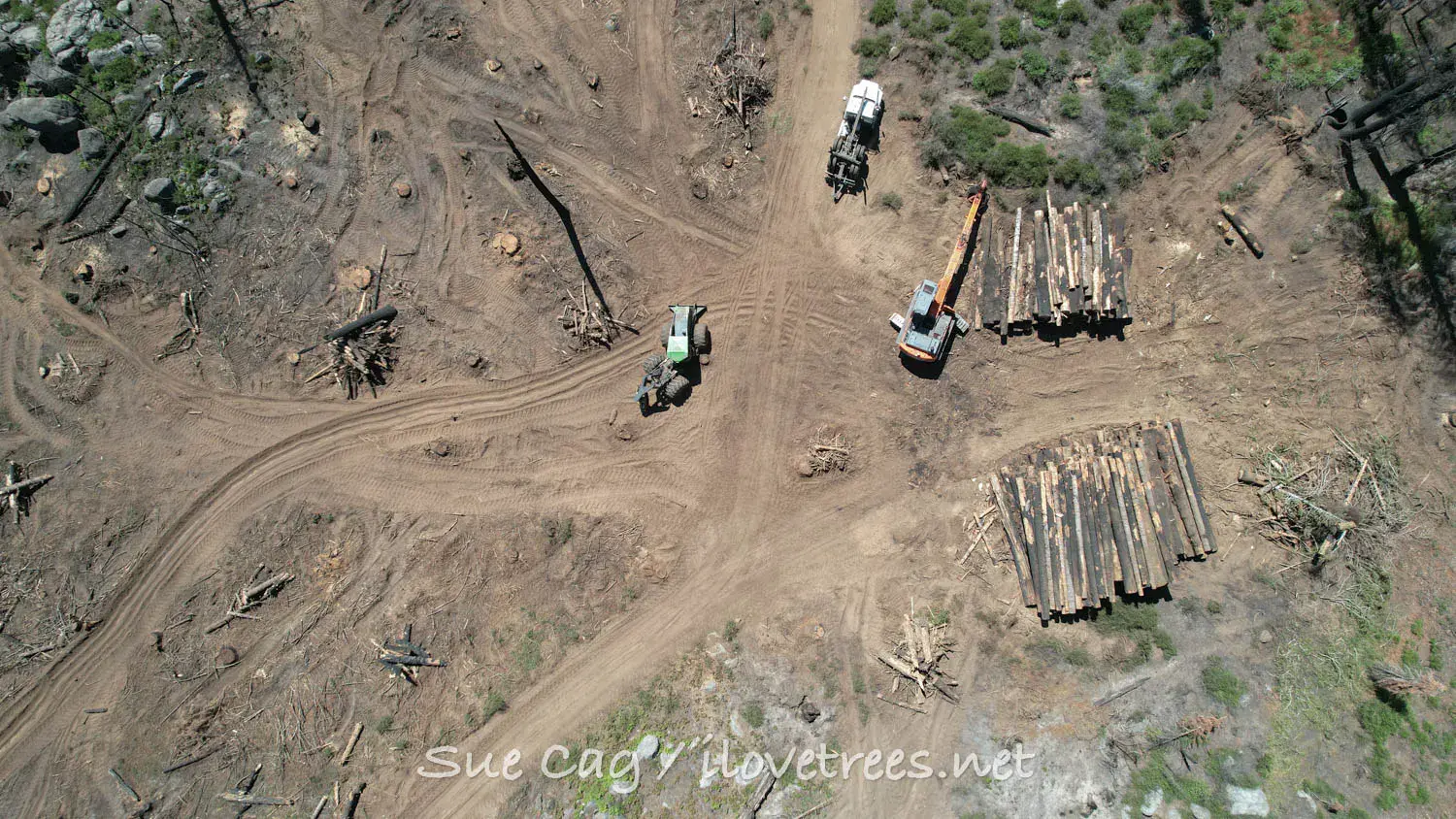
Nonetheless, the new owners of Alder Creek went to work “restoring” the grove by clear-cutting large areas in the forest, trees both living and dead. In the process they bulldozed thousands of naturally regenerating sequoia seedlings, then doused the landscape with the carcinogenic herbicide RoundUp. The result was a moonscape of stumps and bare dirt. Then the owners produced videos that depicted workers planting nursery-grown giant sequoia seedlings, as if to lovingly restore a fire-ravaged tableau. Many of the new seedlings died and had to be replanted. For this effort the owners received $2.2 million in grants from the state of California and millions of dollars from supporters, and they earned nearly a million dollars by selling the wood culled from the land, much of it for biomass electricity production. The name of this new owner was Save the Redwoods League.
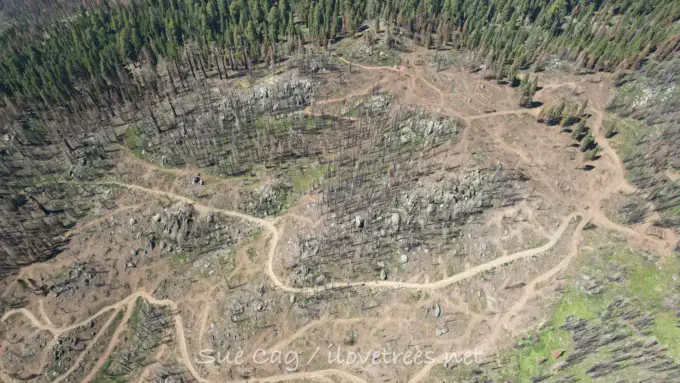
In-progress clear-cutting and herbicide spraying by Save the Redwoods League in the Alder Creek giant sequoia grove. Photo ©2026 by Sue Cag.
I find the League’s treatment of Alder Creek shocking but not surprising. The Ghost Forest covers a lot of ground, from the land grant thefts of the nineteenth century to my own ancestors’ logging of ancient redwoods, through the entire history of redwood logging and protection efforts to the very last of those campaigns, the fight for Headwaters Forest and other groves attacked by Houston-based Maxxam Corporation from 1986 until 2007. But I give special attention to Save the Redwoods League. As The Atlantic magazine noted in its review of the book, the League’s actions during the twentieth century constituted “the greatest act of greenwashing in American history.” I think it’s worth examining this history in the context of today’s robust and institutionalized greenwashing of forest resilience operations in the West and throughout the country.
The Ghost Forest notes that the men — and it was virtually all men — who founded Save the Redwoods League in 1917 and ran the organization through the twentieth century “were second-generation scions of West Coast industrial pioneers whose interests included mining, logging and lumber milling, railroads, steel manufacturing, petroleum extraction and refinement, hydroelectric power, construction and community development, agriculture, dry goods, road building, government, and finance. At the same time, they created a new business tool called “public relations” that developed thickets of obfuscating and glorifying documentation, a model that today continues to produce manufactured impressions of corporate beneficence.
The men who ran Save the Redwoods League peddled the wares and results of destructive industries as “good ideas,” and they understood the potent and widespread belief held by the public that it would be a “good idea” to save the redwoods. So the League simply claimed that good idea for themselves, operating with stealth under the imperative of retaining industry’s predictable flow of essential redwood products to undergird their many business enterprises. These industries included petroleum — redwood lumber was used to build oil derricks, oil storage tanks, and oil pipelines — railroads, for ties and railway stations; telecommunications for poles and switching stations; farms for barns and silos and stakes; and of course business and home construction. But the greatest of all applications of redwood lumber was the stave pipe — an incredibly “good idea” that emerged near the end of the 19th century and would transform the American West and jump-start the building of California into the world’s fifth-largest economy.

Constructing a redwood stave pipe.
Unlike nearly every other type of wood, redwood didn’t rot after just a few years. A redwood stave pipe was a sound investment with an assurance of longevity. By the turn of the century the rapid expansion of redwood stave pipes allowed businesses to transport massive quantities of water over rugged terrain for dozens of miles to cities, industries, farms, and, most importantly, to hydroelectric plants. Hundreds of major power plants now sprang up throughout California, the nation, and the world, most of them watered through redwood stave pipes. The resulting development and widespread distribution of electricity fed the greatest expansions of industries, cities, farming, and wealth in human history, by an order of magnitude.
By 1920 the world’s biggest consumer of Redwood Stave Pipes was PG&E. The world’s largest supplier of redwood stave pipes, and of a dozen other redwood lumber products, was the Redwood Manufacturers Company, or Remco, which was located in the East Bay Area in what is now Pittsburg. That year the president of PG&E was an industrial lawyer with the pulp-fiction name of Wigginton Creed. The president of Remco and several other major redwood firms was also Wigginton Creed — making this fellow Creed both the world’s largest supplier and the world’s largest consumer of redwood stave pipes. It was also in 1920 that Wigginton Creed became the most important founding director at the newly incorporated Save the Redwoods League. That year he wrote the organization’s articles of incorporation and bylaws. Also in 1920 the League successfully sabotaged a bill in Congress, submitted by Santa Rosa Congressman Clarence Lea, that would have preserved as a National Park the entire stand of 64,000 acres of ancient redwood on the Klamath River. Creed largely ran Save the Redwoods League until his untimely death in 1927, but his spirit guided the organization for decades, and still influences corporate greenwashing. What else to say about someone like Jeffrey Ubben, the single largest shareholder of Enviva, the world’s largest wood pellet firm, also directing forest policy at one of the world’s largest and most influential environmental organizations? These are ties that bind.
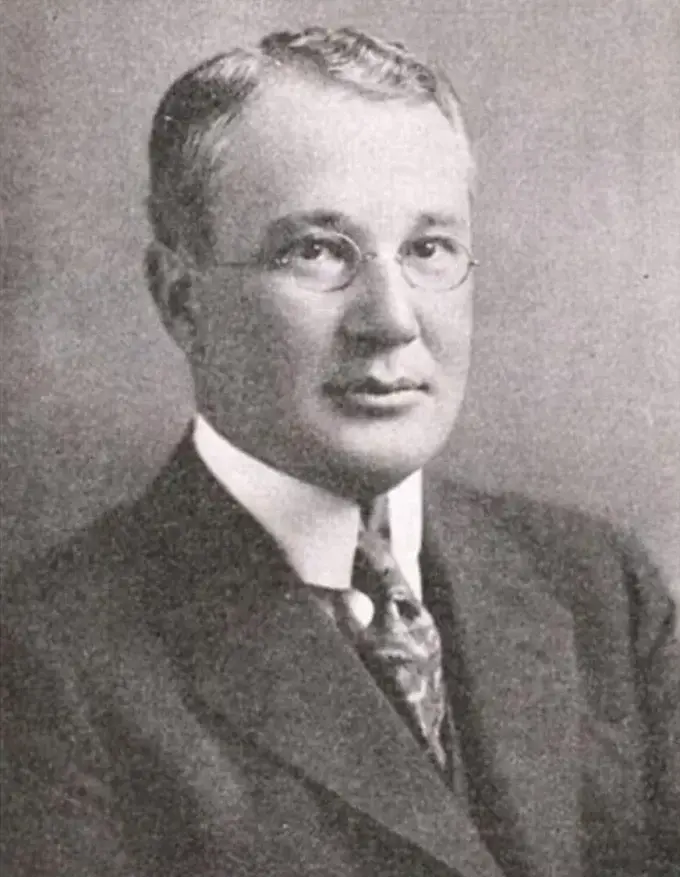
Wigginton Creed, 1923.
Now a century later Save the Redwoods League continues to work in mysterious ways. Alder Creek is not the only Sierra forest where the League has been active. In 2022 the U.S. Forest Service contracted with the League to “restore” more than 1,000 acres in the Giant Sequoia National Monument, using means similar to those at Alder Creek. The Sierra Club and the John Muir Project sued, and although the lawsuit remains ongoing, so does the logging.
The League has not looked kindly upon challenges to its work. For instance, on July 10, 2023, several scientists who specialize in forest ecology received a remarkable email from Garrison Frost, director of communications at Save the Redwoods League. At the time, Frost and the League were leading a coalition of biomass energy corporations, timber firms, and elected officials who were backing the Save our Sequoias Act — a bill that is still circulating in Congress and was drafted by that paragon of environmentalism, former Republican House Speaker Kevin McCarthy. Exactly three so-called “green organizations” support the legislation — Save the Redwood League, the Nature Conservancy, and the National Audubon Society — but more than eighty environmental groups oppose it.
The startling note from Frost infuriated the scientists who received it, as it hit the palate with hints of bullying an aftertaste of gangland intimidation.
Frost wrote, “Over the last couple of years I’ve been following the efforts of a number of researchers and conservation leaders to push back against the messages being put out there by Chad Hanson and his followers. I’m sure you’ve seen the recent op-ed that he published in the Los Angeles Times. At Save the Redwoods League, we find his work extremely frustrating, as we’re trying to build support for strategies to save the giant sequoias from high-severity wildfire.”
Frost goes on to suggest that, together, he and these fellow scientists could ameliorate the threat posed by this fellow Chad Hanson to the good work of Save the Redwoods League. “The League doesn’t have any particular plans to address this recent op-ed,” he writes. “But we’d like to connect with you and others to see if there’s something that can be done. We’re anxious to lend our support to any group effort.” (Frost resigned from Save the Redwoods League in 2024. The following year League President and CEO Sam Hodder also resigned.)
Chad Hanson is the founder and executive director of the John Muir Project, a leading California environmental organization that focuses largely on protecting the forests of the Sierra Nevada. Hanson doesn’t have “followers,” as Frost contends — as if the man were a berobed guru trailed through the forest by slavering acolytes. But he does have many colleagues who support and collaborate on his work. Hanson holds a law degree from the University of Oregon and a PhD in ecology from UC Davis. He stands among the nation’s leading experts on both the ecology and politics of wildfire in the West.
In 2021 Hanson published a groundbreaking book called Smokescreen: Debunking Wildfire Myths to Save Our Forests and Our Climate. I encourage you to read it. Hanson bristles at claims that “forest health thinning” will reduce the threat of wildfires or that burned forests need to be “treated” with bulldozers and chainsaws. He’s quick to point out that most material taken today from western forests is destined for electricity plants.
In the LA Times op-ed that riled Frost and Save the Redwoods League, Hanson criticized the Save Our Sequoias Act as deceptive, and challenged the assertion that the only good fire is a low-intensity fire. He wrote, “Managing for homogenous low-intensity fire, and attempting to prevent and exclude higher-intensity fire, is like managing for the extinction of giant sequoias.”
After I published The Ghost Forest, I spoke with Hanson several times. I was exploring what the future might look like for Western forestry. What’s next? Hanson had some ideas about that.
“People don’t understand that 21st century logging is mostly about dirty fuel,” he said. “It’s not about lumber. Lumber is secondary. It’s mostly about dirty fuel. The logging industry these days sees our forests as a source of energy. They look at trees as giant sticks of coal, that’s what’s happening, that’s logging in the 21st century.” Hanson points out that the burning of wood for fuel is not at all clean; it produces more carbon emissions than burning coal. Yet bioenergy is a rapidly growing means of producing electricity, owing largely to the odd decision by the international climate community to declare biomass energy “carbon neutral,” because trees grow back and therefore replace the carbon.
Hanson charges that thinning forests for ostensibly for fuels reduction and resilience is often worse than leaving it alone. He  points to the 2018 Camp fire, which scorched 153,000 acres in the Sierra foothills of Butte County, California. The Camp fire tore through the town of Paradise, destroying 18,000 homes and killing 86 people — the deadliest wildfire in the United States in a hundred years. It was also among the fastest moving fires in modern history — a speed resulting not from a lack of “fuels reduction” and “thinning” in the forest that surrounded Paradise but, said Hanson, because of it.
For the decade preceding the fire, the US Forest service allowed timber companies to log nearly 10,000 acres of intact forest that surrounded Paradise and a small nearby community called Concow. The Forest Service often labeled the logging as “fuels reduction” and “thinning” and told residents that it was being done to slow wildfires. But really it was “just logging,” said Hanson. Studies by Hanson and other scientists have demonstrated that even moderate logging can produce a drying effect on the forest and open up wind corridors that tend to exacerbate fires. Hanson and a colleague specifically studied the speed of the Camp Fire, which he said was shocking. Hanson told me that a typical western forest fire moves “at one-twentieth or one-fiftieth of a mile per hour, typically, on average. And they’ll have these brief runs where it’ll move one-tenth of a mile per hour, or even half a mile per hour. That’s pretty fast for a forest fire through mature forest. The first six hours of the Camp Fire, between the point of origin and reaching the towns of Concow and Paradise, spread between two and three miles per hour. That’s basically unheard of. You have to just go and dig deep into history to find examples where even for a moment fires spread that fast.”
A similar effect occurred on federal lands that surround Alder Creek Grove and several private homes. Residents of the Alder Creek area, such as Sue Cag, were told that what looked to be heavy logging in the area prior to the fire was actually done to protect her. Cag has worked as a giant sequoia naturalist for the National Geographic Society, and her web site, Ilovetrees.net, is an important source of information about sequoia groves and the recent fires, including logging by Save the Redwoods League. When the Castle Fire ripped through the “treated” forest and destroyed her home, and then the bulldozers and chainsaws and Roundup arrived to further the damage, Cag said, “I don’t feel protected.”
Hanson said that “intact, mature, closed-canopy old forests” that haven’t been thinned or logged, “just slow fires down. Fires move very slowly through dense forests, they just do. But when a lot of tree removal happens — regardless of what you call it, thinning, fuels reduction, fuel break, post-fire salvage, whatever — when a lot of tree removal happens fires are going to move through those areas faster. There’s less of an impediment to fire spread, the microclimate is different, there’s less wind break effect. The reason that matters is that the fire got to Paradise so fast that a lot of people didn’t even know it was happening by the time the embers were already landing and igniting homes on fire. Then the smoke was thick and people couldn’t see, they couldn’t breathe, and they were panicking trying to get out.”
Hanson believes that, had the forest around Paradise never been logged few people would have died. “They would have had an extra two, two-and-a-half hours at least, I believe, based on other fires in intact forest, in similar extreme fire weather.”
I don’t cite Hanson to argue against thinning, which on small and surgical scales can offer a necessary and productive component of authentic forest health restoration. Hanson points out that thinning and fuels reduction are especially, and often only effective immediately near homes. But it’s important to identify and call out the pitfalls of allowing mega-economics to infiltrate our wildfire strategies and dominate the science, politics, institutions, and funding that appear to be coalescing to target 18 million acres of forestland in California, and 250,000 acres in Sonoma County, with sweeping and potentially devastating logging whose primary impacts could be loss of biodiversity and a bitterly ironic increase in fire danger.
A leading proponent of this trend is the state of California itself. The state now requires California utilities to generate a percentage of its electricity production from bioenergy sources, specifically prioritizing the use of biomass fuels sourced from forests that have been thinned for fire resilience. CalFire maintains a Wood Products & Bioenergy Grant Program that provides funding for thinning forests in support of biomass electricity production.
I’d like to wrap up by bringing us back to the specific issue now facing the Jenner Community — and all of Sonoma County, really — the reason we’re here today in Jenner, which is the proposed logging of Sheephouse Creek and Jenner Gulch. That the logging could be tied to a much broader effort to jumpstart a massive new timber industry in Sonoma County makes this protection effort even more imperative. If anyone can achieve this protection, it’s the people of Sonoma County and the Sonoma Coast.
To simplify, simplify the proud and important ethos behind local efforts to protect Sonoma County’s backyard, the Sonoma Coast — or any place that you call home — I will turn once again to that great American hero, Henry David Thoreau.
One hundred eighty years ago Thoreau said,
What are the natural features which make a township handsome? A river, with its waterfalls and meadows, a lake, a hill, a cliff or individual rocks, a forest, and ancient trees standing singly. Such things are beautiful; they have a high use which dollars and cents never represent. If the inhabitants of a town were wise, they would seek to preserve these things.
Copyright © 2026 by Greg King/All rights Reserved.
[ad_2]
Source link
