

[ad_1]
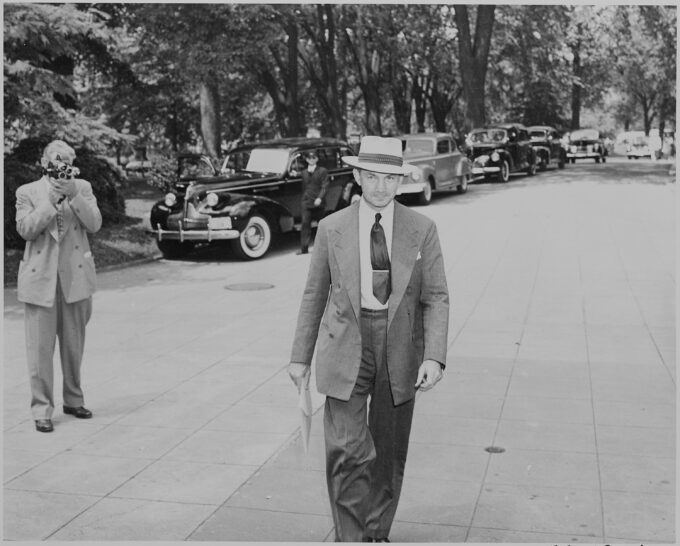
Forrestal arrives at the White House for a Cabinet meeting, c. 1945 – Public Domain
My guess is not many Americans know that in 1947 our first Secretary Of Defense believed a Jewish state in the Middle East was a bad idea for the United States, let alone that he met his death falling from a 16th story window.
But James Forrestal should be of interest to anyone who is repulsed by the ruthless timidity of the Democratic Party, excited by the possibilities of the Democratic Socialists, and eager to push back on the fictional narrative of Israel as our eternally indispensable ally.
Fortunately, no matter how mislaid and dust-covered, history is always shouting at us, always desperate to start a conversation. So it was with a genuine sense of amazement that, after spending 4 bucks at a used book sale, I let James Forrestal talk to me.
Who was James Forrestal?
Like the new American nation of 1776, the new American empire of 1945 also had its Founding Fathers of bankers, diplomats and lawyers. Forrestal, a Princeton grad, bond salesman and ardent capitalist, toiled beside the Harrimans, Kennans, Bohlens, Lovetts, Achesons and McCloys to invent a conqueror’s foreign policy. These were men who lunched and drafted white papers and sent cables as they transformed the United States military from one which trained with broom handles prior to 1941 into an atomic superpower.
One of my favorite books about World War II is Winston Churchill’s “The Hinge Of Fate”. The entire thing is about logistics. How the Allies’ superior ability to move men and material around the globe enabled them to defeat the Nazis.
That was Forrestal – an efficient administrator who spent his days trying to figure things out. As a special assistant to FDR he oversaw industrial mobilization and procurement during the war, then, as Secretary of the Navy under Truman, he oversaw demobilization after it.
Yet nothing came calmingly. Where Dean Acheson was pleased enough with himself to magisterially title his memoir “Present at the Creation”, Forrestal analytically scribbled a diary. It combined gnawing unsureness about the future with extraordinary prescience about the problems contained in what these wise men were creating.
Some of the diary is charmingly dated. For Forrestal, the difficulty of government work was that it “not only has to be well done, but the public has to be convinced that it is being well done.” Today’s Democratic leadership, having managed to streamline that process into appearing-to-govern-by-saying-words-at-realities, would chortle at such sincerity.
Then too, much of the diary is personally annoying. I have always believed that the Pentagon does not exist to promote freedom – it exists to protect monied interests from the consequences of their avarice. Forrestal, on the other hand, wasn’t merely a cold warrior, he was cryogenic.
A passionate foe of Henry Wallace and ever fearful of the Soviet menace, Forrestal was more than willing to champion Senator Arthur Vandenberg’s immortal and perpetually followed advice to Harry Truman on how to acquire defense appropriations: “The only way you are going to get what you want is to make a speech and scare the hell out of the country.” And, truth be told, there are entries in the Forestall Diaries which certainly scare the hell out of me.
For instance, years after Hiroshima, no one in the evolving security structure of the United States, including Secretary Of Defense Forrestal, seems to have had any conception of the destructive power of the atomic bomb. The bomb itself was just another optional weapon to quell geopolitical disturbances, and individual branches of the service wanted control of their own nuclear arsenals.
The situation produced a Forrestal diary note which is positively Hegsethian in its casual derangement:
By now, you might be asking yourself why I’m asking you to read what James Forrestall has to say when I myself disagree with much of it?
Simple. It’s because when he pushes back against Zionists and Israel, Forrestal is both a kindred spirit and an honest breath of never-mentioned air.
On Israel these days, only certain people are required to explain their positions by jumping through inquisitory hoops: Platner in Maine. El-Sayed in Michigan. Mamdani-backed candidates. Any voters horrified enough by the butchery in Gaza, Lebanon and the West Bank to vote accordingly.
Meanwhile, all the wrong people are under no such obligation. Frauds who portray the Diaspora as a Dantean level of hell profit handsomely while going unchallenged: Deborah Lipstadt, a dingbat whose racist ravings somehow qualified her to be Joe Biden’s Antisemitism Czar. Mark Levin, the “Lord Haw-Haw of Fox News”, and an out-and-out propagandist for a foreign country who does not even pretend to aspire to dual loyalty. Bill Maher, a duplicitously hectoring prick who somehow managed to receive the Mark Twain Prize for American Humor on the extraordinary grounds of never having uttered a challenging satirical thought.
For these people, Palestine and Palestinians do not exist. But they did for Forestall. And his diary reminds us of a time when they existed for many. In fact, views on Zionism and Israel’s founding, for which Democratic Socialists are attacked today, were held by members of the cabinet during Israel’s founding!
I’ll let the diary speak.
Here, talking with the former Secretary Of State, he discusses Israel in terms of the money and political considerations which prevented a one state solution. His closing sentence would work in any DSA campaign today.
In the end, his lack of calm caught up with Forrestal. Five weeks after resigning as Defense Secretary, while undergoing psychiatric observation, he took his own life by jumping from a 16th floor window at the National Naval Medical Center. His New York Times obituary is here and worth reading in its entirety as both a story of personal anguish and a far more honest account of political realities than would ever be published today: “He was widely denounced by persons who felt that he favored the Arabs over the Jews, and Mr. Forrestal was said to be particularly distressed by a statement that “he cared more for oil than he did for the Jews.” Mr. Forrestal also felt he was being deserted by his former friends in business as well as unjustly attacked by so-called liberals who misunderstood his role on the Palestine question.”
As anyone who ever opposed the official narrative on Israel can tell you, there’s a price to be paid for your efforts. Forestall paid his in full. Having read the Diaries, the last line of the obituary is poignant – showing Forrestal still trying to figure things out: “On the window sill from which Mr. Forrestal jumped were marks suggesting he might have changed his mind and tried to climb back into the window.”
Fortunately, James Forrestal left something more than marks on a window sill. He left this nation a diary containing indispensable advice on how a decent political party should decide what it stands for.
[ad_2]
Source link
