
[ad_1]
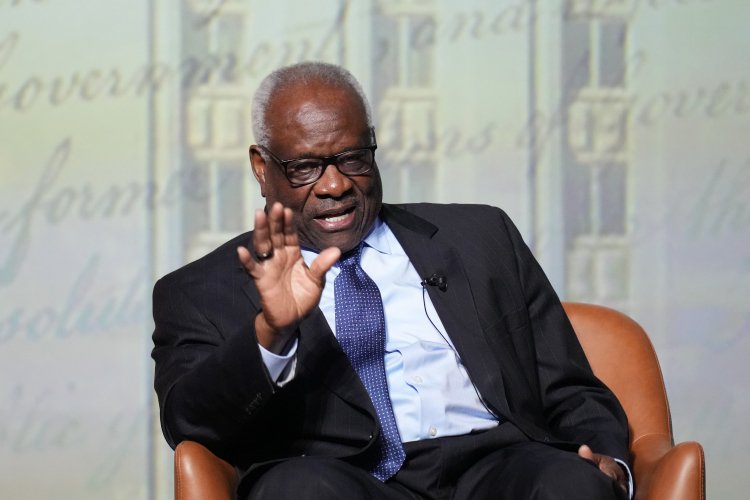
Supreme Court Justice Clarence Thomas argued that the principles of the Declaration of Independence should be lived, not treated as abstract, intellectualized theories
.
“Even those who support them too often talk about them as if they were academic playthings. They overcomplicate them, take the spirit out of them, and discuss them in a way that puts us to sleep,” he said. “But the principles of the Declaration of Independence, as I encountered them, are a way of life. They are not an abstract theory that you only learn in college or law school, but the basic premises of our Constitution and government that you can learn from the people all around you.”
“We knew that life, liberty, and property were sacrosanct. Those truths were self-evident to the adults in our lives and were taught to us as indelible, undeniable truths.”
“Throughout my youth, these truths were articles of faith that were impervious to bigotry and discrimination,” he said. “Despite the multiplicity of laws and customs that reeked of bigotry, it was universally believed among those blacks with whom I lived, and who had very little or no formal education, that in God’s eyes and under our Constitution, we were equal.”
“This was also the case with my nuns, most of whom were Irish immigrants,” he said. “Though not a literate man, my grandfather often spoke of our rights and obligations coming from God, not from architects of segregation and discrimination.”
“All too often, there is an unfortunate tendency, when discussing the Declaration, to make these self-evident truths and first principles of government obscure. Intellectuals want you to believe that our founding principles are matters of esoteric philosophy or sophisticated debate.”
“Those around us would endure, or could endure, the insults of segregation with dignity because they knew that in God’s eyes they were equal,” he continued. “Men were not angels. They were subject to the constraints of antecedent rights. And we were not subject to these men, even as we were subjected to their whims.”
“When Alexis de Tocqueville visited early America from France, he was struck that there was no country in the civilized world where they were less occupied with philosophy than the United States. But there was likewise no country where the principles of the Declaration were more deeply ingrained or more fiercely defended than those same United States.”
Even as so much of our God-given and constitutional rights were denied us, we still faithfully said the Pledge of Allegiance, memorized the preamble to the Constitution, and yearned for the fulfillment of its promised ideals.
Sadly, these sentiments are not as widely shared among our fellow citizens today, and they certainly do not seem to have that sustaining strength that they had back then. In fact, all too often, the sentiments tend toward cynicism, rejection, hostility, and animus toward our country and its ideals.
With the foregoing in mind, I would like to begin by addressing my first encounter with the principles of the Declaration of Independence. It is perhaps not what you would immediately think.
The second paragraph of the Declaration proclaims, “We hold these truths to be self-evident, that all men are created equal, that they are endowed by their Creator with certain unalienable rights.”
Throughout my youth, these truths were articles of faith that were impervious to bigotry and discrimination. The American Heritage Dictionary of the English Language defines “self-evident” as “obviously true and requiring no proof, argument, or explanation.”
Whether they had a divine source or a worldly one, they were never questioned. They were the holy grail, the north star, the rock: immovable and unquestioned.
Despite the multiplicity of laws and customs that reeked of bigotry, it was universally believed among those blacks with whom I lived, and who had very little or no formal education, that in God’s eyes and under our Constitution, we were equal. This was also the case with my nuns, most of whom were Irish immigrants.
At home, at school, and at church, we were taught that we are inherently equal, that equality came from God, and that it could not be diminished by man. We were made in the image and likeness of God. That proposition was not debatable and was beyond the power of man to alter.
Others with power and animus could treat us as unequal, but they lacked the divine power to make us so.
Somehow, without formal education, the older people knew that these God-given, or natural, rights preceded and transcended governmental power or authority.
When you lived in a segregated world with palpable discrimination, and the governments nearest to you enforced laws and customs that promoted unequal treatment, it was obvious that your rights or your dignity did not come from those governments, but rather from God.
Though not a literate man, my grandfather often spoke of our rights and obligations coming from God, not from architects of segregation and discrimination. Men were not angels. They were subject to the constraints of antecedent rights. And we were not subject to these men, even as we were subjected to their whims.
We knew that life, liberty, and property were sacrosanct. Those truths were self-evident to the adults in our lives and were taught to us as indelible, undeniable truths.
Those around us would endure, or could endure, the insults of segregation with dignity because they knew that in God’s eyes they were equal.
All too often, there is an unfortunate tendency, when discussing the Declaration, to make these self-evident truths and first principles of government obscure. Intellectuals want you to believe that our founding principles are matters of esoteric philosophy or sophisticated debate.
Even those who support them too often talk about them as if they were academic playthings. They overcomplicate them, take the spirit out of them, and discuss them in a way that puts us to sleep.
But the principles of the Declaration of Independence, as I encountered them, are a way of life. They are not an abstract theory that you only learn in college or law school, but the basic premises of our Constitution and government that you can learn from the people all around you.
When Alexis de Tocqueville visited early America from France, he was struck that there was no country in the civilized world where they were less occupied with philosophy than the United States. But there was likewise no country where the principles of the Declaration were more deeply ingrained or more fiercely defended than those same United States.
That is the sense in which I knew the principles of the Declaration in my childhood. That is the only sense in which those principles can sustain our country. And that is the sense in which I will speak to you about those principles today.
I believe now, as I did then, that the Declaration of 1776 provides us with the principles to guide us as citizens of our republic.
Even in this time of questioning and criticism of our founding, we should not forget that the Declaration established the principles that produced, despite all of our imperfections, our miscues, and our tragic mistakes, the freest, wealthiest, and most powerful nation in the history of the world.
It provided the moral principles by which Frederick Douglass, Abraham Lincoln, and Martin Luther King would criticize the institutions of slavery and segregation.
The Declaration, in fact, along with the Gospels, is one of the greatest anti-slavery documents in the history of Western civilization.
It did not establish a form of government. That was the work of the Constitution that followed. But it stated the purpose of government.
The Declaration made it clear that the purpose of government is to protect our God-given unalienable rights, rights that all individuals equally possess.
As Abraham Lincoln declared in 1858, in the midst of his great debates with Stephen Douglas, “Drop every paltry and insignificant thought for any man’s success. It is nothing. I am nothing. Judge Douglas is nothing. But do not destroy that immortal emblem of humanity, the Declaration of American Independence.”
The ideas of the Declaration are so powerful that our nation could not coexist with the contradiction created by the great evil of slavery. Those principles were so powerful that hundreds of thousands of Americans fought and died in the Civil War to make men free. Those ideas have been so powerful that they convinced our nation to finally end segregation.
They continue to be so powerful today that they have inspired people throughout the world to throw off the shackles of their own oppressors.
And it all began with our founders declaring in 1776 in the Declaration of Independence that “we hold these truths to be self-evident, that all men are created equal, and that they are endowed by their Creator with certain unalienable rights, that among these are life, liberty, and the pursuit of happiness.”
We should also not forget the important sentence that follows: “That to secure these rights, governments are instituted among men, deriving their just powers from the consent of the governed.”
To secure these rights, governments are instituted.
The principle of consent follows from the principle of equality. We the people can never legitimately consent to the violation of our God-given equality.
However, when I encounter the Declaration of Independence anew today, I am most struck by the final sentence.
It can be easy to forget, 250 years later, the courage it took for those 56 men to sign the Declaration. Arguably, those men committed treason against the king, risking death at the hands of an empire far mightier than the newborn United States.
They thus concluded with the memorable final sentence, and I quote: “And for the support of this Declaration, with a firm reliance on the protection of divine Providence, we mutually pledge to each other our lives, our fortunes, and our sacred honor.”
I will say it again: “We mutually pledge to each other our lives, our fortunes, and our sacred honor.”
Recently, I came across a definition of courage that is attributed to President Franklin Delano Roosevelt: “Courage is not the absence of fear, but rather the assessment that something else is more important than fear.”
In essence, the signers of the Declaration were saying that they were willing to die for the principles they were asserting, the supreme act of courage. Those principles were more important than their fear.
Nothing in the Declaration of Independence, I now realize, matters without that final sentence. Without that sentence, the rest of the Declaration is but mere words on parchment paper. Nice words, but nonetheless just words.
What changed the world was not the words, but the commitment and spirit of the people who were willing to labor, sacrifice, and even give their lives — what Lincoln at Gettysburg called “the last full measure of devotion” — for the Declaration’s principles.
It is that devotion to which we owe our rich inheritance.
[ad_2]
Source link
