
[ad_1]
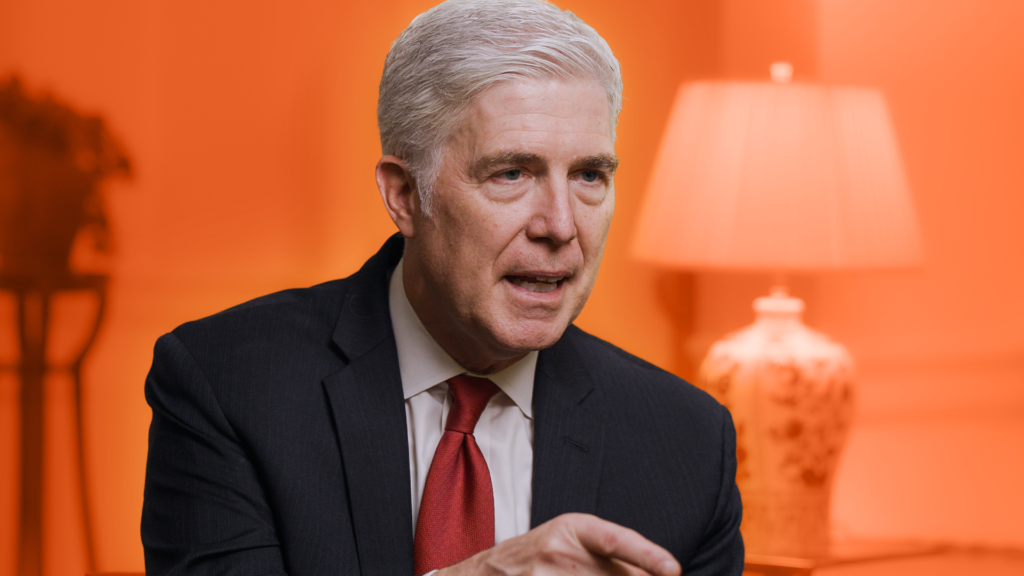
The Dissident Right is furious after Supreme Court Justice Neil Gorsuch told Reason and several other outlets that America is a “creedal nation.”
“The Declaration of Independence had three great ideas in it,” Gorsuch said in a recent interview with Nick Gillespie. “That all of us are equal; that each of us has inalienable rights given to us by God, not government; and that we have the right to rule ourselves. Our nation is not founded on a religion. It’s not based on a common culture, even, or heritage. It’s based on those ideas. We’re a creedal nation.”
“Our nation is not founded on a religion. It’s not based on a common culture, even, or heritage. … We’re a creedal nation,” Justice Neil Gorsuch tells @nickgillespie on The Reason Interview podcast. pic.twitter.com/wfdkSbrVUX
— reason (@reason) May 6, 2026
What will strike many as a run-of-the-mill lesson in American civics has been interpreted as an unforgivable transgression by scores of right-wing influencers and their reply guys.
“I want all of the so called conservatives who believe stuff like this launched into the sun,” posted the pseudonymous (one presumes) account Tony Rigatoni.
“I simply refuse to accept the idea that every other people group on planet earth are allowed to have a country to call home except for native Americans,” posted William Wolfe, a former Trump administration official, evidently referring to something like Anglo-Protestants rather than indigenous Native Americans.
Gorsuch’s comments give off “cuck energy,” posted the blogger Curtis Yarvin.
A telling response came from Jeremy Carl, a commentator who had to withdraw from consideration for a State Department post after he came under fire for remarks about the need to protect “white identity” earlier this year. “In all sincerity,” he wrote on X, “the fact that this nonsense is being spouted by ‘the best’ of Trump’s three Supreme Court nominees is indicative of the broad intellectual failure of the conservative legal movement.”
Carl’s disgust with Gorsuch is part of a larger trend. MAGA influencers have also deemed Supreme Court Justice Amy Coney Barrett a disappointment and a “diversity hire,” and President Donald Trump has said he regrets taking the advice of the Federalist Society, which vets judicial nominees from an originalist perspective, when making his first-term appointments.
The overarching implication is that the conservative legal movement has lost the plot. But if Trump’s own Supreme Court nominees and the country’s pre-eminent right-of-center legal society are all too liberal for you, consider that you may be the one who’s out of touch.
The belief in a “civic” nationalism—the idea that the United States is a “propositional nation,” as the Catholic theologian John Courtney Murray put it, rather than one based on blood and soil—is mainstream among Americans of all stripes, including conservatives. Besides Gorsuch, recent expositors of that view have included the anti-woke former presidential candidate Vivek Ramaswamy, the eminent historian of the Revolutionary War era Gordon S. Wood, and at least one Heritage Foundation senior fellow (who in turn has cited the Catholic writer G.K. Chesterton).
The polling outfit YouGov last year queried respondents about what makes someone an American. The top answers were overwhelmingly legal and creedal: obeying U.S. laws, supporting the U.S. Constitution, and believing in the principles of the Declaration of Independence. Also last year, Gallup found strong agreement with the statement, “The U.S. is stronger as a nation because it has people from different races, religions and cultures.” The American people just don’t share the Dissident Right’s obsessions.
I’m not sure it’s wise to exclude culture, as Gorsuch did, from the creedal understanding of American nationhood. It’s true that the United States neither has nor needs a “common culture” in an ethno-religious sense. We don’t all have to worship the same way, eat the same food, listen to the same music, wear the same clothes. These are elements of culture that can change over time and differ across regions or within subgroups that nonetheless remain authentically American. I imagine this reading of “culture” is more or less what Gorsuch had in mind.
At the same time, there are elements of culture that must represent a consensus if the Republic that the Founders bequeathed us is to endure. First and foremost, we need a culture of mutual forbearance, where people want to coexist peacefully even with those who see things differently, and where people take pride in the ideals of human liberty and equal treatment under law, recognizing that America’s commitment to those ideals is a large part of what makes it great.
These values and attachments can probably only successfully be passed from one generation to the next through culture. But unlike cuisine, say, they’re still creedal in nature—related not to a common way of life in a thick sense but to a shared political and philosophical project.
That project (and the values and attachments on which it relies) are under attack from voices at both ends of the political continuum. They’re absolutely worth defending, but the Dissident Right, which rejects the very notion of mutual forbearance in favor of a “will-to-power” political approach, doesn’t have the answer. You can’t save America’s culture by sacrificing its creed.
[ad_2]
Source link
