
[ad_1]
It is tempting to argue that Israel’s new military doctrine is predicated on perpetual war – but the reality is more complex.
Not that Israeli Prime Minister Benjamin Netanyahu would object to such an arrangement. On the contrary, his relentless drive for military escalation suggests precisely that. After all, his openly declared quest for a “greater Israel” would require exactly this kind of permanent militarism – endless expansion and sustained regional destruction.
However, Israel cannot sustain an open-ended fight on multiple fronts indefinitely.
Israeli officials boast about fighting on “seven fronts,” but many of these are, in military terms, largely imaginary rather than sustained battlefields.
The real wars, however, are entirely of Israel’s making: from the genocide in Gaza to its unprovoked regional wars.
Still, that fact should not blind us to another reality: in the lead-up to the war on Iran, and in the escalation against Lebanon, there was near-total consensus among Jewish Israelis. An Israel Democracy Institute survey conducted on March 2–3 found that 93% of Jewish Israelis supported the joint US-Israeli attack on Iran. Support cut across all political camps.
The same enthusiasm for war accompanied the Gaza genocide and the various wars and escalations in Lebanon.
Even Yair Lapid – so often and so falsely marketed abroad as a “dove” – fully backed these wars, admitting after the Iran ceasefire that Israel had entered them with “rare consensus” and that he supported them “from the very first moment.”
His repeated criticisms, like those of other Israeli politicians, are not of the war but of Netanyahu’s failure to deliver a strategic outcome.
And this is the crucial distinction. Israelis mostly support the wars, but many no longer trust Netanyahu to translate destruction into strategic victory. By mid-April, 92% of Jewish Israelis gave the army high marks for its management of the Iran war, but only 38% gave high ratings to the government.
In other words, the public still believes in war but increasingly doubts the leadership waging it.
That distinction may not matter much to us, since the outcome remains mass death, devastation, and colonial violence. But in Israel’s own military and strategic calculations, it matters enormously. Its wars have historically followed a familiar model: crush resistance, impose military and political domination, and translate battlefield violence into colonial expansion.
Netanyahu delivered none of that.
This is why the uproar in Israel over the April 16 Lebanon ceasefire has been so fierce, and why the fears surrounding a possible stalemate with Iran run even deeper.
The Lebanon ceasefire clearly did not secure one of Israel’s central declared aims: the disarmament of Hezbollah. Israel kept troops in southern Lebanon, but the agreement halted offensive operations and fell far short of the promised “total victory.”
For many in Israel, any outcome that falls short of total victory is immediately read as defeat. One northern Israeli regional leader, Eyal Shtern, captured that mood with brutal clarity when he reacted to the Lebanon ceasefire by asking how Israel had gone “from absolute victory to total surrender,” in remarks reported by CNN.
That is the real crisis now confronting Israel: not that it has discovered the limits of permanent war, but that it has once again discovered that exterminatory violence does not automatically produce political victory.
While Iran possesses political leverage that could allow for a long-term, or even permanent, truce, Lebanon and Syria remain in a far more vulnerable position. However, no one is in a more precarious condition than the Palestinians, particularly those in Gaza.
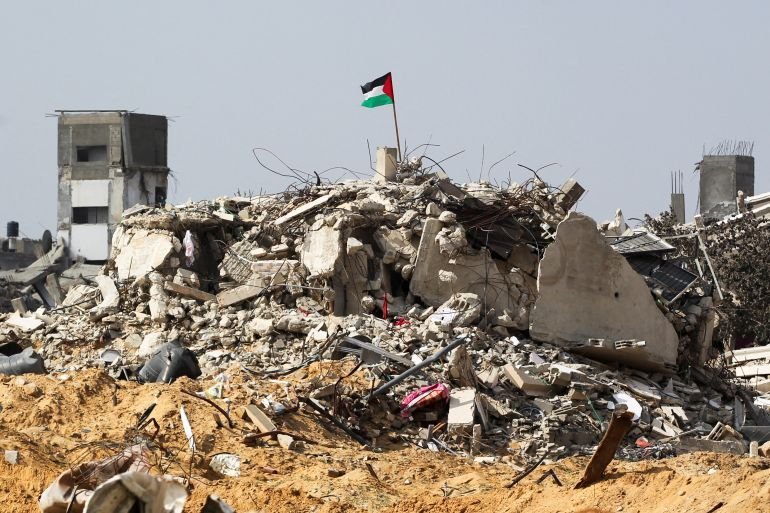
Unlike others who retain some political margin and space to maneuver, Palestinians live under Israeli occupation, apartheid, and siege. Gaza, in particular, has been reduced to a sealed enclave of devastation.
Its hermetic siege has produced one of the most horrific humanitarian catastrophes in modern history: an entire population surviving on polluted water, with infrastructure destroyed, food critically scarce, and thousands still buried beneath the rubble.
Aside from their legendary steadfastness – sumud – Palestinians operate under severe constraints in their ability to impose conditions on Israel, particularly as it continues to receive unconditional support from the United States and its Western allies. Yet their resilience, collective action, and enduring presence remain powerful forms of leverage that cannot be easily contained.
Netanyahu – and those who will come after him – will always find in Palestine a space in which war can be waged continuously and at relatively low cost to Israel itself. Unlike other battlefields, where war becomes politically, militarily, and economically unsustainable, Israel has turned its occupation of Palestine into a permanent battlefield.
Even if Netanyahu, now politically diminished and aging, exits the political scene, the underlying paradigm will remain intact. Future Israeli leaders will continue to wage war on Palestine, not despite its costs, but because of its perceived benefits: it is financially subsidized, colonially advantageous, and politically sustainable within Israel’s current structure.
To break this paradigm, Palestinians must generate leverage – real leverage. This cannot come from futile negotiations or appeals to long-ignored international law. It can only emerge from sustained collective resistance to colonialism, reinforced by meaningful support from Arab and Muslim states and genuine international allies, and amplified by global solidarity capable of exerting real pressure on Israel and, crucially, on its principal benefactors.
For now, Netanyahu continues his wars because he has no answer to his own strategic failures. Here, escalation is not a strength; it is the last refuge of a leadership that cannot deliver victory.
This, however, also reveals something else: Israel is entering a moment of unprecedented vulnerability.
That vulnerability must be exposed – clearly, consistently, and urgently – by all those who seek an end to these senseless wars, an end to the Israeli occupation of Palestine, and a path toward justice that has been denied for far too long.
[ad_2]
Source link
