

[ad_1]
Reprinted from Andy Worthington’s website.
On Sunday evening (July 19), a group of some of the most repulsive, ghoulish people on the face of the earth marched towards the perimeter fence separating the Gaza Strip from the rest of the world to declare their intention to re-colonize Gaza, to re-establish three Israeli settlements that were dismantled in 2005 when, under Ariel Sharon, 21 settlements in total were abandoned, occupied, at the time, by 8,000 Israeli settlers.
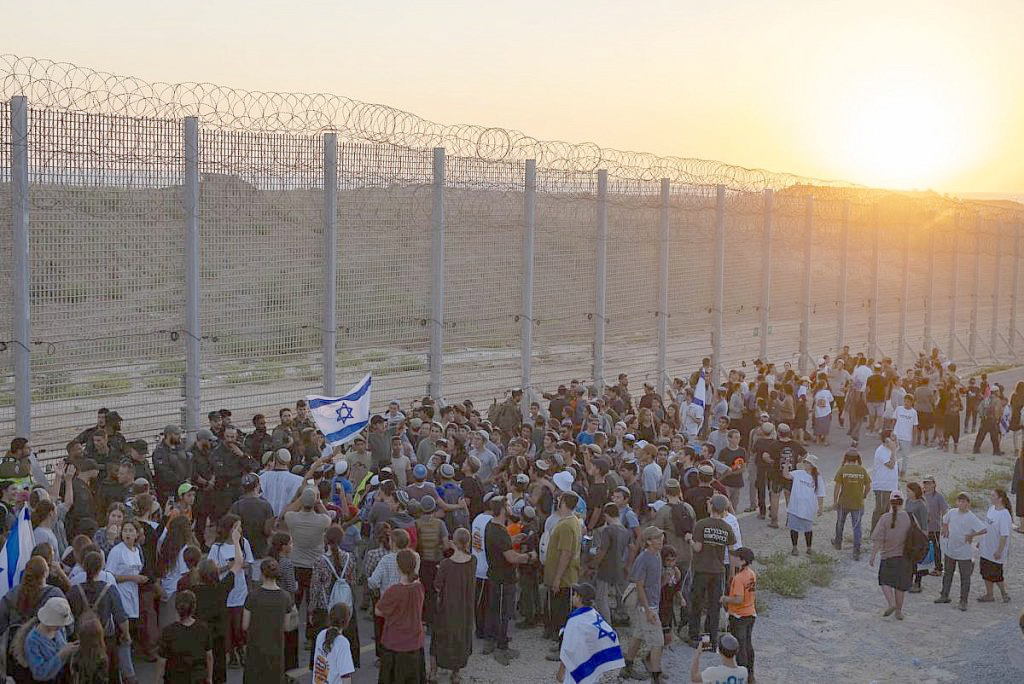
Settlers at the Gaza perimeter fence on the evening of July 19, 2026 calling for new Israeli settlements to be built on the site of a still-ongoing genocide. (Photo by Oren Ziv, accompanying his July 20 article for +972 Magazine, “Nearly half of Israel’s government joins march vowing Gaza settlements”).
These fanatical Israeli settlers, on what was billed as the “March of Thousands”, although only a few hundred people attended, were led by the two far-right ministers in Benjamin Netanyahu’s coalition government — Itamar Ben Gvir, the Minister for National Security, who is in charge of Israel’s prisons, which, for Palestinians, have become a gulag of torture facilities since October 7, 2023, and Bezalel Smotrich, the Minister of Finance, and also the minister in charge of settlement affairs within the Defense Ministry, who has played a huge role in the ever-growing, and ever more violent expansion of Israel’s illegal settlements in the West Bank.
Speaking at the rally, Ben Gvir said, “If someone had said three years ago that we would control 70% of the Gaza Strip, no one would have believed it. So today I say: there will be Jewish settlement throughout Gaza. We are returning home. Gaza is ours.”

A screenshot from a video of Itamar Ben-Gvir making a speech about colonizing Gaza while marching with supporters towards the perimeter fence of the Gaza Strip on July 19, 2026.
Smotrich, meanwhile, warned that a change of government in the forthcoming elections in October, could “roll back all the Zionist and national settlement revolution” undertaken over the last four years.
The two men were accompanied by more than two dozen ministers and legislators, as well as the 80-year old settler fanatic Daniella Weiss, who told the crowd, “They ask me, ‘What will happen to the Arabs in Gaza?’ There will be no Arabs in Gaza, unequivocally.”
Netanyahu’s reticence in the face of selective western outrage about the West Bank
Although Benjamin Netanyahu’s Likud Party was listed as a sponsor of the rally, Netanyahu was noticeably silent about it. This, undoubtedly, wasn’t because he fundamentally opposes the settlers’ aspirations to re-colonize Gaza, but because, while western countries have been and continue to be largely indifferent to the almost immeasurable military slaughter and destruction in Gaza, they have been far more outspoken about settler activities in the West Bank.
On May 28 this year, the EU imposed sanctions on three individuals and four violent settler movements, including Daniella Weiss and her Nachala Settlement Movement, which, as they described it, “encourages and facilitates coercive acts that lead to the forced displacement of Palestinians”, and whose “outposts obstruct access to Palestinian agricultural and grazing land and have been persistent sources of settler violence.”
Netanyahu is also aware that both Ben-Gvir and Smotrich were sanctioned last June by the governments of the UK, Australia, Canada, New Zealand and Norway “for their repeated incitement of violence against Palestinian civilians” in the West Bank, followed by Slovenia and the Netherlands in July, and Spain in September, even though neither man has yet been issued an arrest warrant by the International Criminal Court — for war crimes and crimes against humanity — as is the case with Netanyahu himself, and his former defense minister, Yoav Gallant.
While the IDF sought to prevent the settlers’ rally, designating the surrounding area as a “closed military zone” for 24 hours, and setting up barriers with the military police, which the settlers mostly managed to avoid, it would be unwise to think that Israel Katz, Israel’s current defense minister, is unsympathetic to the settlers’ cause.
Tiresomely well known for identifying any gathering of Palestinians or Lebanese as a “terror nest”, Katz said, just last week, on Israel’s Channel 14, “I intend to establish three Nahal outposts, which is also a military entity, in those places that were in northern Gaza” — a reference to military bases that, as Nour Odeh explained for Al Jazeera, “combine farming with an armed presence in a bid to consolidate control over a territory.”
Although the settlers claimed that they were “returning home after 21 years,” as a banner declared, this is nothing but historical revisionism, as the decision to withdraw from Gaza in 2005 was an act of deliberate “disengagement” that was meant to stymie further Palestinian demands, as Belén Fernández explained in May last year.
Psychotic indifference to genocide — from Israel to Jared Kushner
What was particularly sickening about Sunday’s rally was the gleeful indifference of those gathered — as a beautiful sunset incongruously lit up the sky — to the fact that they were overlooking a vast concentration camp, the size of east London, which is littered with the buried corpses of at least 10,000 Palestinians.
Almost all civilians, they remain buried under 60 million tonnes of debris — “20 times the combined amount generated by conflicts worldwide since 2008”, in the Guardian’s words — which has been created as a result of Israel’s still-unending 33-month genocidal assault, in which, at the barest minimum, over 73,000 Palestinians, again, overwhelmingly civilians, have been killed.

A screenshot from a video of Daniella Weiss speaking to supporters about the colonization of Gaza at the perimeter fence of the Gaza Strip on July 19, 2026.
As I watched the video of the monstrous Daniella Weiss, I realized that I hadn’t been so sickened by callous indifference to the industrial slaughter of an entire people since January this year, when, at Davos, Jared Kushner, Donald Trump’s son-in-law, and a prominent real estate investor, first presented his AI-generated vision of “New Gaza”, a futuristic high-rise coastal tourist resort on Gaza’s shoreline, which, as I described it, captured “the callous, ghoulish, cruel and heartless opportunism of those who see the world only through a lens of business opportunities and maximum profit-making for themselves and their cronies.”
As I further described it in February, when Trump’s Board of Peace held its inaugural meeting in New York, what was so grotesque about Kushner’s vision, as it was paraded for a second time, was that it was “a techno-futuristic vision rising up not in some pristine desert, or on some sort of neglected brownfield site, but on a genocidal crime scene of unparalleled depravity.”
Kushner’s vision was also devoid of Palestinians, as, of course, is the settlers’ vision.
On Sunday, as on most occasions when the settlers address the world, they made a point of emphasizing that the solution, for the Palestinians, is “voluntary migration”, a lie that is regular wheeled out to create an illusion that Israel’s intent is anything other than the persistent extermination of the Palestinian people through every means available — primarily, direct military action, starvation, disease and the destruction of the entire healthcare sector.
However much Daniella Weiss rants and raves about western countries “helping out” with Israel’s Palestinian “problem”, no one is going to become involved in what would be the largest and gravest crime of ethnic cleansing in history. Muslim countries won’t do it, if for no other reason than that it might destabilize their regimes through their populations’ sympathy with the Palestinians, and western countries won’t, because Weiss has failed to recognize that every single western country is now struggling with massive opposition to any kind of immigration whatsoever through a resurgence of far-right racism.
Israel strangles Trump’s Board of Peace
When it comes to Jared Kushner’s grandiose, heartless, profit-driven visions of a futuristic “New Gaza”, the realities of dealing with the Israelis seem to have made it evaporate, as Julian Borger reported for the Guardian in an article last week, entitled, “Trump’s Board of Peace drops full Gaza recovery plan in favour of tiny pilot scheme.”
The Board of Peace first emerged last October, under Trump’s 20-point “Peace Plan” for the future of Gaza, much of it hammered out over long months of negotiations between Qatar, Egypt, the US, Israel and Hamas and the various other Palestinian factions in Gaza, even though Trump tried to take credit for it all.
It led, immediately, to an end to Israel’s sickening carpet-bombing of Gaza, and its deadly land-based assault on Gaza City, which was clearly a huge step forward, and it also led to the release of the last Israeli hostages seized on October 7, 2023, in exchange for around 1,900 Palestinian prisoners and hostages.
There, however, the success ended. As Israel kept killing Palestinians, although in smaller numbers, it also steadily increased the amount of Palestinian land under its control, from 53% at the time of the ceasefire to nearly 70% now, with no sign of any agreed withdrawal. It has also persistently refused to allow the entry into Gaza of the agreed 600 trucks of humanitarian aid a day, and has also failed to properly re-open the Rafah Crossing, to allow desperately ill patients to travel abroad for urgent medical treatment, and to allow those who want to return to come home.
Moreover, with Trump AWOL, having lost interest after he was feted for bringing peace to Gaza, the various components envisaged in his plan — for which UN Security Council approval was secured in November — have unravelled. The Board of Peace is largely spectral, its most prominent member being the former UN official Nikolay Mladenov, who has taken Israel’s side, calling on Hamas to disarm before any further negotiations can take place regarding Gaza’s future, even though Hamas never agreed to that, having wisely tied disarmament to future discussions regarding Gaza’s governance.
For this, a Palestinian committee appointed by the Board of Peace was supposed to begin the day-to-day running of Gaza, taking over from Hamas, which was willing to oblige, but Netanyahu refused to let them in, and has left them, humiliated, living in hotel rooms in Cairo. Equally spectral is the International Stabilization Force envisaged to maintain order.
As Borger described it, “The Gaza recovery plan being pursued by Donald Trump’s Board of Peace (BoP) has shrunk dramatically from an ambitious blueprint for the reconstruction of the whole territory to a small pilot project in the south of the strip.
Even the envisaged pilot scheme — involving a temporary camp for a tiny fraction of Gaza’s 2 million displaced people, with a Palestinian administration, police and a small international security force — is not expected to take shape before the end of the year.”
As Borger added, “Incremental steps have been announced in recent weeks. A few Moroccan and Kosovar officers have arrived in Israel where they are intended to be the kernel of an International Stabilization Force (ISF), tasked with protecting the pilot camp. A logistical base for this future force to store vehicles, equipment and other material is nearing completion at the Kerem Shalom crossing between Israel and Gaza.”
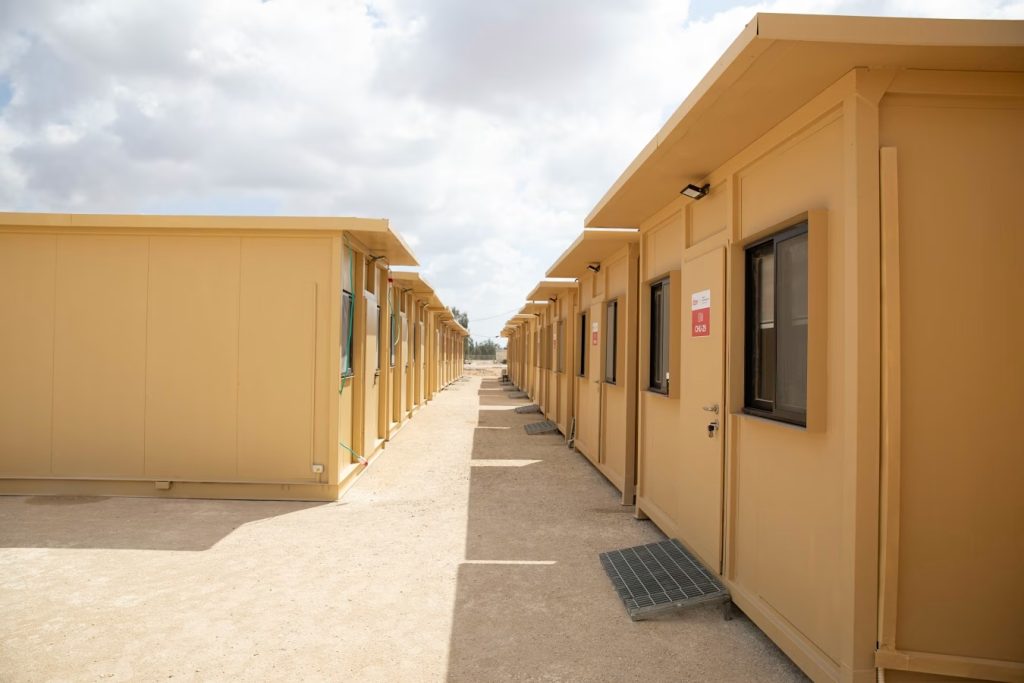
A photo of the base for the International Stabilization Force (ISF) in Gaza, by the Kerem Shalom Crossing, made available to the Wall Street Journal, and used in their article on July 9, “Trump Wanted 20,000 Peacekeeping Troops in Gaza. He Is Starting With 10 to 20.”
“However”, as he also explained, “preparatory work on the pilot camp near the southern Gaza of city of Rafah has not begun, nor has construction of the camp’s ISF support base. Satellite images of the area show disturbed earth but no new structures”, with no “substantial progress” expected before the elections on October 27, in which Netanyahu is hoping to cling on to power.
Amongst western diplomats, as Borger described it, “There is growing apprehension that Netanyahu, facing the threat of electoral defeat, will gamble on a new all-out offensive in Gaza before the October vote.” He added that his diplomatic sources believe that “the best hope of progress in Gaza is a new Israeli government, but it is far from clear whether any successor coalition would be substantially more flexible.”
One diplomat told Borger that the Board of Peace, as Borger described it, “had no choice but to make the most of very limited progress, as an admission of failure would open the way for extreme factions in the Israeli government with radically different plans for Gaza.”
In the diplomat’s words, “The aim is just to keep something going, keep the ball in play, because if you stop there are others with a more extreme agenda just waiting to jump in and take over, and they are talking about wholesale population transfer and colonization” — a reference to Ben-Gvir and Smotrich, for sure, but one that also seems to misunderstand the extent to which that is also the position taken by Netanyahu and Israel Katz.
Borger noted that Israeli officials “have repeatedly suggested that a return to war is inevitable” on the basis of Hamas’s alleged “refusal” to disarm, despite the evidence of Hamas’ willingness to comply, as they demonstrated on July 6, when the Government Media Office announced that its Emergency Committee had been dissolved, ending its 19-year government in “a move intended to facilitate the transfer of administrative authority to the Palestinian-led National Committee for the Administration of Gaza (NCAG)”, followed by the transfer of weapons to NCAG control.
As Borger described it, Hamas “has said it would be willing to lay down its weapons under certain conditions and took part in negotiations in Cairo” two weekends ago “on possible disarmament mechanisms.” The talks, he noted, “covered the disarmament of Hamas and rival Israeli-backed militias inside Gaza, who would receive the surrendered weapons, how they would be stored and whether assault rifles would count as offensive weapons or personal arms.”
However, he added, reports from Cairo suggested that “progress on decommissioning weapons was unlikely while Israel continued to carry out airstrikes and creep ever further into Hamas-held territory.” A Palestinian source told Haaretz that, “As long as Israel doesn’t commit to a gradual withdrawal from the Gaza Strip and to changing the reality there, there’s no basis for talks.”
Borger suggested that “limited pressure” had been put on Israel by Aryeh Lightstone, a senior advisor to the Board of Peace, and, apparently, Trump’s “lead negotiator in Israel”, who “wrote to the Netanyahu government privately in June, calling for a relaxation of restrictions on ‘dual-use’ humanitarian aid entering Gaza, which have stopped the shipment of essential items such as water pipes and solar panels”, and who also sought clearance for “the eventual entry into Gaza of the ISF and a vetted Palestinian police force.”
As Borger conceded, however, “The Israeli government has so far not approved any of the requests.”
Instead, the Board of Peace is left with its pilot scheme near Rafah, which Borger called “a far cry from [its] initial aspirations”, when Kushner “promised that the gates to aid would be thrown open and basic infrastructure — including water, sewage and electric systems, hospitals and bakeries — would be restored across the strip within 100 days.”
At meetings in Cyprus three weeks ago, Mladenov, Lightstone, advisers from the Tony Blair Institute and members of the National Committee for the Administration of Gaza (NCAG) apparently “hammered out” the scaled-down plans for a pilot scheme consisting of “portable cabins for tens of thousands of displaced people”, set up in the buffer zone along the ceasefire line near Rafah.
According to the plans, the IDF “would withdraw from the line and security at the crossing between Hamas-run Gaza and the camp would be overseen by the ISF and a specially trained Palestinian police force, officially vetted by NCAG and the ISF”, although in reality, as Borger added, “Israel is expected to have a decisive say in who is recruited.”
The ISF will undertake training in Egypt, but that has not yet begun, and, as Borger explained, “It is hoped that [it] will be about 5,000-strong (a quarter of the force originally anticipated), with troops from Morocco, Kosovo, and possibly Albania and Kazakhstan.” Training will take months, and, perhaps most crucially, “the legal framework for their presence is still being negotiated with the Israeli government.”
One official said that, “If we got this done, in place, by December, I’d be very happy.”
Borger added that “preference for settlement in the pilot camp would be given to former residents of the Rafah area”, but added that it was “not clear what other criteria would be used in vetting Palestinians wanting to move there.” He noted that the entire scheme “has been denounced by critics”, who include the former Israeli prime minister Ehud Olmert, who has called it a “concentration camp” in the making, as I discussed in a recent article, in which I noted claims that no free movement will be allowed. Borger, however, was told by Board of Peace officials that “there will be freedom of movement in and out of the pilot area.”
He also noted claims that “a wider range of humanitarian relief items would be let into the pilot camp”, compared to Hamas-controlled Gaza, although even there, he added, “the Israeli government has insisted on a distinction between humanitarian aid and reconstruction, with only the former being permitted.”
Borger also discussed how funding remains a pressing issue, largely because so little of the $17 billion pledged by allies when Trump launched his Board of Peace has materialized. Instead, the most significant support to date has come from the EU’s Palestine Donor Group, which announced last week that it had raised €883 million for Gaza, “intended for the restoration of basic water and sanitation infrastructure and waste management”, and also “meant to be complementary to the BoP’s projects.” The Board of Peace is also, apparently, “negotiating for some of the $11bn in Palestinian tax revenue and frozen bank assets seized and withheld by Israel to be diverted to project funds”, although that proposal has enraged the Palestinian Authority (PA) in the West Bank, which has been “financially suffocated.”
Is there a way forward?
Most noticeably, however, what Borger’s discussions with those on the ground in Israel reveal is how the Israeli government itself retains so much control over the Board of Peace’s plans, and can, as it has with the ceasefire deal in general, fail to fulfil its obligations as and when it wishes, and can also provide further obstruction simply by refusing to deal with requests for cooperation.
No one seems to have the power to oblige Israel to cooperate, except, perhaps, Donald Trump himself, but he appears to have no interest in doing so, either because, as I suggested, he has lost interest, or, perhaps, because, although he doesn’t strike me as a Zionist — through his interest, solely, in himself; in what we might call being “Trumpist” — he is also beholden to Israeli interests through the significant financial donations made to him by prominent pro-Israeli figures like Miriam Adelson, the widow of the casino owner Sheldon Adelson, whose fanatical support for Israel is undisputed.
While Julian Borger ably demonstrated how sidelined Trump and his Board of Peace seem to have become, none of this helps us to see a future beyond the grim reality of now — of a still-tightening, suffocating noose on Gaza that those wielding it still refuse to consider relinquishing, caught, as they are, in a fixation with nothing but the slow extermination of the Palestinian people.
Will any leaders in the west wake up, and see that, beyond the grim settler violence in the West Bank, which they are so ready to criticize, they have allowed Trump’s largely empty contributions to Gaza’s future to enable them to pretend that something far, far worse isn’t happening right next to the West Bank, in the grotesque, ongoing death camp depravity of the Gaza Strip?
Andy Worthington is a freelance investigative journalist, activist, author, photographer (of a photo-journalism project, ‘The State of London’, which ran from 2012 to 2023), film-maker and singer-songwriter (the lead singer and main songwriter for the London-based band The Four Fathers, whose music is available via Bandcamp). He is the co-founder of the Close Guantánamo campaign (see the ongoing photo campaign here) and the successful We Stand With Shaker campaign of 2014-15, and the author of The Guantánamo Files: The Stories of the 774 Detainees in America’s Illegal Prison and of two other books: Stonehenge: Celebration and Subversion and The Battle of the Beanfield. He is also the co-director (with Polly Nash) of the documentary film, “Outside the Law: Stories from Guantánamo”, which you can watch on YouTube here.
To receive new articles in your inbox, please subscribe to Andy’s new Substack account, set up in November 2024, where he’ll be sending out a weekly newsletter, or his RSS feed — and he can also be found on Facebook (and here), Twitter and YouTube. Also see the six-part definitive Guantánamo prisoner list, The Complete Guantánamo Files, the definitive Guantánamo habeas list, and the full military commissions list. Please also consider joining the Close Guantánamo campaign, and, if you appreciate Andy’s work, feel free to make a donation via PayPal or via Stripe.
[ad_2]
Source link
