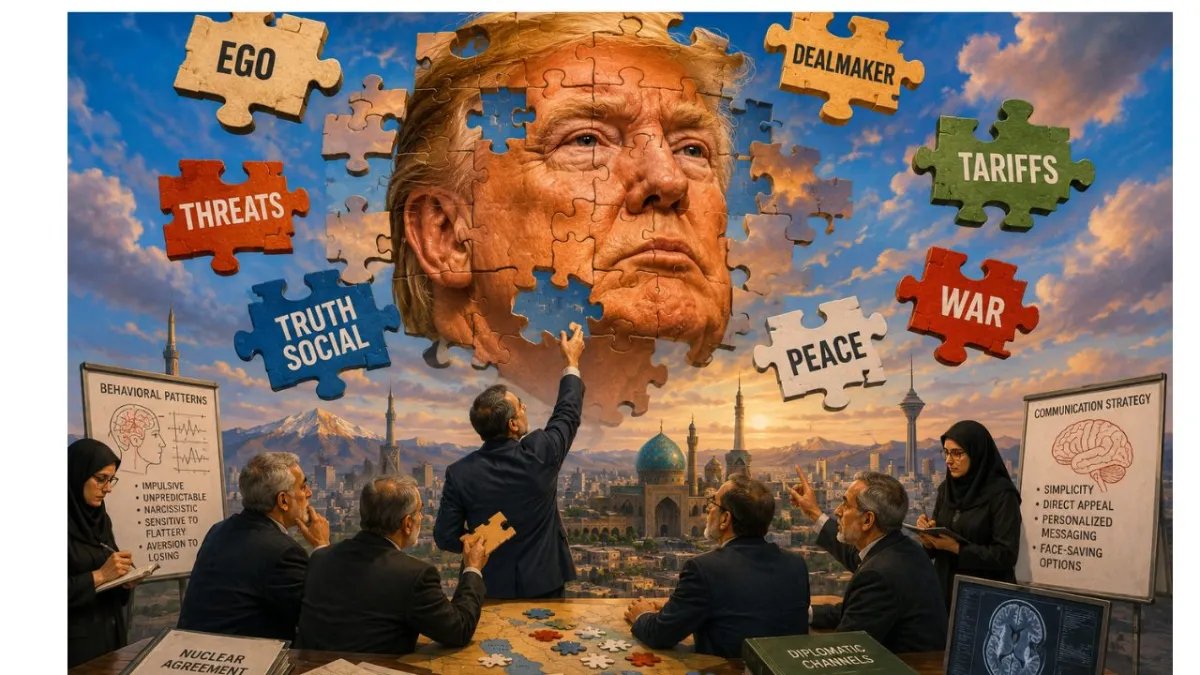
Just a few months ago, investigative journalist Jeremy Scahill was reporting that the Trump administration appeared determined to force Iran into submission through military pressure, economic warfare, and demands that Tehran abandon key elements of its defense and nuclear programs. Iranian officials, meanwhile, insisted they would not capitulate and described Washington’s negotiating strategy as erratic, contradictory, and driven as much by President Donald Trump’s personal impulses as by coherent policy.
Now, in a remarkable new report for Drop Site News, Iranian officials suggest they responded to that challenge in an unconventional way: by bringing psychologists into the negotiating process to help analyze Trump’s behavior and craft messages designed to influence his reactions. The disclosure offers a striking contrast to the atmosphere of confrontation that characterized earlier stages of the crisis and raises new questions about how both sides ultimately arrived at a preliminary agreement after months of war, threats, and diplomatic stalemate.
The following article is based on reporting by Jeremy Scahill for Drop Site News.
As negotiations between Washington and Tehran moved toward what both sides now describe as a preliminary agreement, Iranian officials reportedly turned to an unusual source for strategic advice: psychologists.
According to reporting by Jeremy Scahill at Drop Site News, Iranian negotiators enlisted two senior psychiatric professionals to help assess President Donald Trump’s behavior and shape messages intended to reach him through regional intermediaries during indirect talks aimed at ending the U.S.-Iran conflict.
An Iranian official, speaking anonymously to Drop Site, said the advisers were brought into the process after initial negotiations began in Islamabad earlier this year. Their role, according to the official, was to help Iranian negotiators understand what they viewed as Trump’s highly unpredictable decision-making style and to tailor communications accordingly.
“We added two senior psychologists to the negotiations’ advisory circle so that we can shape messages intended for President Trump from the perspective of managing what we regard as psychopathic behavior pattern,” the official told Drop Site News.
The official further claimed that Trump’s responses appeared to improve after Iranian negotiators began incorporating recommendations from the psychological advisers into written communications and diplomatic messages.
Here is Jeremy discussing his latest on Democracy Now
The revelation offers a remarkable glimpse into how foreign governments may attempt to navigate negotiations with political leaders viewed as unconventional or erratic. While governments routinely employ behavioral analysis, intelligence assessments, and political psychology in diplomatic strategy, it is rare for officials to openly acknowledge the involvement of mental health professionals in ongoing high-level negotiations.
The comments also underscore a broader reality of contemporary diplomacy: international negotiations increasingly involve not only military, economic, and geopolitical calculations but also efforts to understand the personalities of world leaders themselves.
Scahill notes that the timing of the disclosure comes shortly after reports that Trump’s most recent presidential medical evaluation involved an unusually large team of specialists. According to a recent Washington Post report cited by Drop Site, twenty-two medical experts participated in Trump’s latest examination, reportedly more than in any previous presidential assessment.
The disclosure emerged as both Washington and Tehran announced that they had reached a preliminary Memorandum of Understanding, with a formal signing ceremony expected in Geneva later this week.
Whether the Iranian official’s claims can be independently verified remains unclear. Nonetheless, the account provides a striking illustration of how deeply questions of personality and psychology have become intertwined with high-stakes diplomacy in an era marked by personalist politics and increasingly volatile international crises.
The report also raises broader questions about the extent to which foreign governments have adapted their diplomatic strategies around Trump’s governing style during both of his presidencies. Critics and supporters alike have long characterized Trump as an unconventional negotiator whose personal reactions can dramatically shape policy outcomes.
If the Iranian official’s account is accurate, Tehran appears to have concluded that understanding the psychology of the American president was as important as understanding the geopolitical interests of the United States itself.
Read the original reporting by Jeremy Scahill at Drop Site News.
Iran Enlisted “Senior Psychologists” to Help Craft Messages to Trump Ahead of Agreement by Drop Site News
An Iranian official told Drop Site that Trump’s “reactions improved noticeably” after the psychiatric professionals joined the negotiating effort.
Based on these the two Democracy Now! interviews with Jeremy Scahill from earlier this year, the contrast with this latest Drop Site report is striking. In the spring, Scahill’s reporting portrayed a Trump administration openly threatening military escalation and regime change, with Iranian officials warning that Washington was demanding effective capitulation on issues ranging from nuclear enrichment to ballistic missile capabilities. At that time, Scahill described negotiations as little more than a veneer covering preparations for wider conflict, with Iranian officials viewing Trump as obsessed with destroying the Islamic Republic and seeking a historic political victory before the U.S. midterm elections. Iranian leaders repeatedly emphasized that they would not surrender their core deterrent capabilities and were preparing for a prolonged confrontation rather than a diplomatic breakthrough.
The new report suggests a significant shift—not necessarily in the underlying disputes, but in the dynamics of communication. Instead of describing Trump as an adversary determined to impose unconditional terms, Iranian officials now claim they have developed a more sophisticated strategy for dealing with him personally, even bringing psychologists into the negotiating process to help craft messages tailored to his behavior and decision-making style. While earlier reports focused on military pressure, competing red lines, and the possibility of a wider regional war, the latest account implies that Tehran has concluded that understanding Trump’s personality may be as important as understanding U.S. policy. Whether this reflects a genuine moderation of Trump’s position, a growing Iranian confidence after surviving the conflict, or simply a tactical adjustment by negotiators remains unclear. What is clear is that the conversation appears to have shifted from threats of regime change and military escalation toward a tentative diplomatic process in which both sides are searching for a political off-ramp after months of confrontation.
A deeper irony emerges from the comparison. In the earlier interviews, Scahill reported that Iranian officials viewed Trump and his negotiating team as erratic, ideological, and often detached from technical realities surrounding nuclear diplomacy. The latest report suggests Tehran may have decided that rather than trying to change those realities, it would adapt its own messaging to them. If Iranian officials are accurately describing the process, the shift is less about changing policy than changing psychology—moving from a strategy centered on resisting American pressure to one focused on managing the behavior of the man applying it. That evolution may say as much about the state of contemporary diplomacy as it does about the negotiations themselves.
Taken together, the evolution in Jeremy Scahill’s reporting — from springtime warnings of imminent escalation to this latest account of psychological strategizing inside the Iranian negotiating team — underscores how fluid and personality‑driven the U.S.–Iran standoff has become. The story illuminates a broader truth about contemporary diplomacy: in an era when individual leaders can redirect national policy with a single impulse, foreign governments increasingly treat psychological insight as a form of national security intelligence. The reported involvement of senior mental‑health professionals suggests that Tehran concluded it could not navigate the crisis through traditional statecraft alone, but had to understand and manage the behavior of the American president himself. As Washington and Tehran move toward a preliminary agreement, the question is not only what concessions each side has made, but what this episode reveals about the shifting nature of power, perception, and negotiation in a world where the personality of a single leader can shape the trajectory of war and peace.
Editor’s Note:At a moment when the once vaunted model of responsible journalism is overwhelmingly the play thing of self-serving billionaires and their corporate scribes, alternatives of integrity are desperately needed, and ScheerPost is one of them. Please support our independent journalism by contributing to our online donation platform, Network for Good, or send a check to our new PO Box. We can’t thank you enough, and promise to keep bringing you this kind of vital news.
You can also make a donation to our PayPal or subscribe to our Patreon.
Please share this story and help us grow our network!