

[ad_1]
In Iran and Ukraine, what is at stake — what is fought for and against — is a rebalancing of power that will prove of world-historical magnitude when it is at last accomplished.
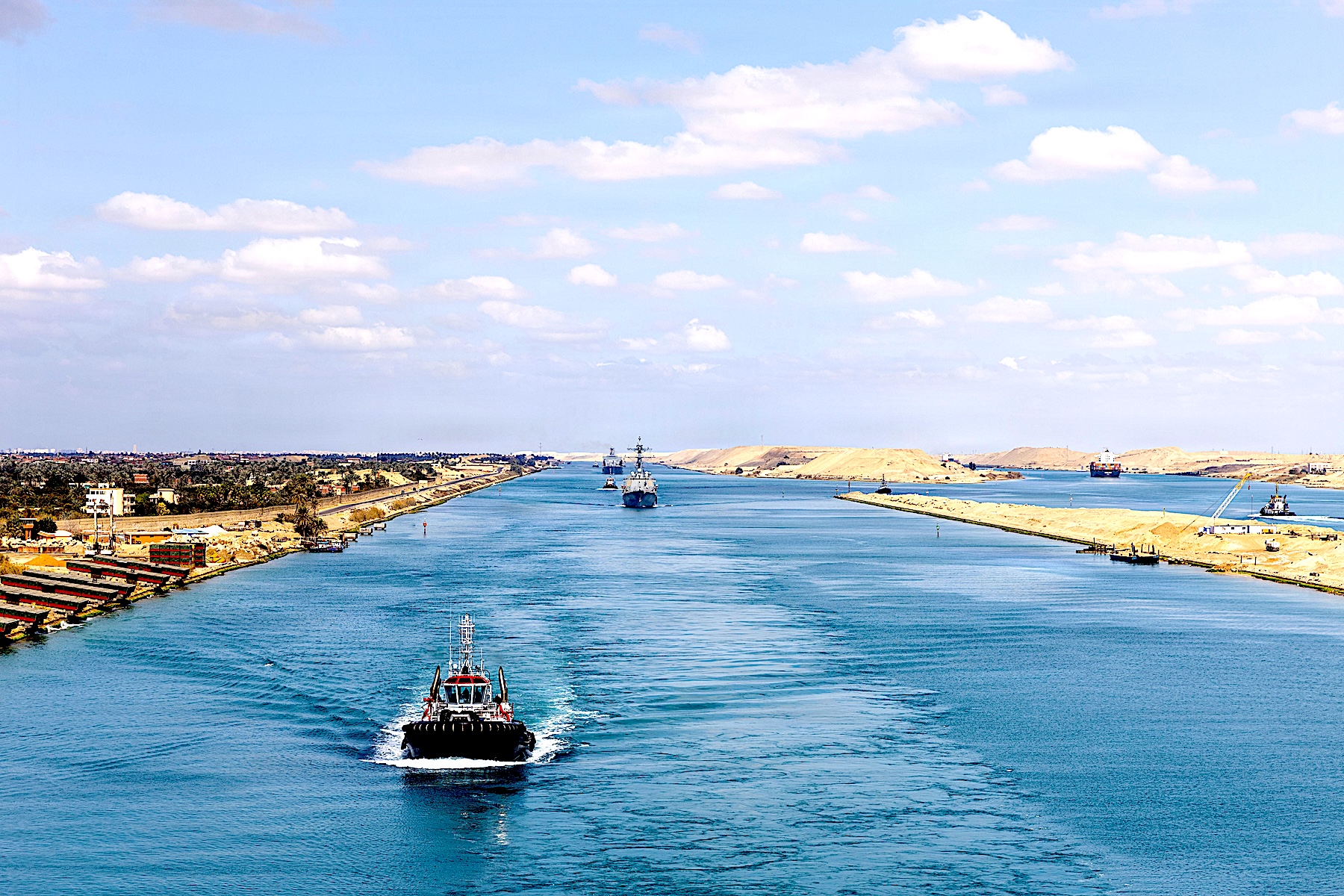
The guided-missile destroyer USS Bainbridge passes through the Suez Canal during the U.S.-Isreal war on Iran on March 5. (DoD/Wikimedia Commons/Public Domain)
By Patrick Lawrence
Special to Consortium News
 First came news that, on April 8, Israeli jets bombed what is known as the China–Iran railway, a key component of Beijing’s ambitious Belt and Road Initiative. Of all the targets the Zionist terror machine might have hit, why a Chinese-sponsored infrastructure project, you had to wonder.
Then on Wednesday came reports that officials from nearly 50 nations — I would love a list of these 50 — met in Berlin to make sure the fires of war against Russia do not flicker out. “We cannot lose sight of Ukraine,” Mark Rutte, NATO’s new secretary-general, declared a little forlornly.
There are other reports such as these of late. Dan Caine, chairman of the Joint Chiefs of Staff, announced Thursday that the Pentagon has authorized the Pacific Fleet to interdict ships in the Indian and Pacific oceans if they are deemed to be carrying Iranian oil to Asian ports or “material support” from Asia — read China — to the Islamic Republic.
It is time for a stock-take.
The war in Ukraine drones (literally) on and on, the West showing no inclination whatsoever to take the Russian position seriously. In West Asia we find a variant: The United States and the rabid dog that Bibi Netanyahu has made of Israel have no intention of considering the 10–point document wherein Iran states its conditions for ending a war it appears perfectly willing to continue waging.
What are we looking at? What animates these two confrontations such that to understand our moment we must see Ukraine and Iran as two theaters of a single war?
I do not care for self-referencing commentators, but an exception to my rule is the swiftest way to my reply to these questions.
I have argued since the turn of the millennium that parity between the West and the non–West is the foundational imperative of the 21st century. Any given nation or bloc may favor or oppose this eventuality, but there will be no stopping the turn of history’s wheel: This was my take at the opening of the era that announced itself with the events of Sept. 11, 2001.
And it is the painful birth of this new time we witness as the wars in Europe and West Asia grind on. In each case what is at stake, what is fought for and against, is a rebalancing of power that will prove of world-historical magnitude when it is at last accomplished.
What have the Russians sought since Donald Trump began his second term and declared his intention to end the war in Ukraine and restore relations with Moscow to some kind of equilibrium?
It is the same thing Moscow hoped for at the Cold War’s end, and the same thing they proposed when, in December 2021, they sent draft treaties, one to Washington and one to NATO headquarters in Brussels, as the basis of negotiations for a comprehensive settlement between the Russian Federation and the West.
Moscow’s Push for Equal Standing

Trump and Putin in Anchorage, Alaska, in August 2025. (DoD /Benjamin Applebaum)
Moscow has been clear on this point the whole of the post–Soviet era: It seeks a security architecture that takes cognizance of its interests and, so, recognizes Russia as an equal partner in its relations with the West.
President Putin and Sergei Lavrov, his able foreign minister, speak of the “root causes” of the war in Ukraine and insist these must be addressed if any kind of enduring settlement between East and West is to be achieved. This is merely another way of saying what the Russians have said for the past 30–odd years. [See: Ukraine Timeline Tells the Tale]
Neither has the West’s reply been any different: It amounts to one long list of refusals, however directly, dishonestly or incompetently these have been conveyed.
Last November the Trump regime issued a 28–point peace plan that was not less than shocking when cast against the past three and some decades of history. It called for a nonaggression pact Russia, Europe and Ukraine were to negotiate and sign. “All ambiguities of the last 30 years will be considered settled,” it read in part.
And further in this line:
“A dialogue will be held between Russia and NATO… to resolve all security issues and create conditions for de-escalation in order to ensure global security…”
These 28 provisions proved too good to be true. The Americans who developed this document, Secretary of State Marco Rubio and Steve Witkoff, the incompetent Trump insists must act as his “peace envoy,” simply did not know where the fence posts lie: While they almost certainly did not understand this, implicit in their 28 points was an East–West relationship based on parity.
Out of the question, as was immediately evident.
The Trump regime quickly abandoned its plan, despite its favorable reception in Moscow, and seems to have dropped all thought of “a deal” with Russia. The Europeans, freaked out at the very thought of a negotiated settlement, now resort to upside-down versions of reality I find it hard to believe they even try on.
At that gathering of European officials in Berlin Wednesday, immediate pledges of new weapons supplies came to $4.7 billion, and there is more, much more, coming as Volodymyr Zelensky, Ukraine’s president, mooches his way around the European capitals.
Boris Pistorius seems to have spoken for the group when the subject of peace talks arose. “The truth is, anyway, Russia has never taken them seriously,” the German defense minister declared. “This is why it is all the more important to support Ukraine.”
Russia has never taken negotiations seriously: Can you imagine how this kind of talk lands in Moscow? Can you imagine how low are the Russians’ expectations that the West will take their legitimate interests seriously until events on the battlefield force them to do so?
Tehran’s Conditions

Jinnah Convention Centre in Islamabad served as media facilitation; the U.S.-Iran talks were held at the Serena Hotel in the background. (Humza Ahmed /Wikimedia Commons/CC BY-SA 3.0)
The Iranians, it seems to me, are in a similar predicament.
Read the text of the 10–point plan wherein Tehran advances its demands for ending the war with the United States and Israel. An end to U.S. and Israeli attacks is merely the Iranians’ opener. The withdrawal of all U.S. forces from the region, a nonaggression pact with the United States, recognition of Iran’s rights on the nuclear side, war reparations: To borrow from the Russians, this is a demand to address root causes, a demand for “a new security architecture,” a demand — returning to my principal point — for parity as a non–Western power.
There is a lot in the press these days about a return to negotiations after Vice–President J.D. Vance’s debacle in Islamabad last weekend. I have no trouble imagining the Iranians are eager to avoid more of the savage, indiscriminate bombing their civilian population suffered prior to the two-week ceasefire that went into effect April 8. But I do not think, at the horizon, they will abandon the 10 demands they have advanced any more than the Russian will abandon theirs.
Both nations appear to have concluded it is time to confront the West in the name of that 21st century imperative I noted earlier. Two reasons. One, Russia and Iran have both gathered strength as non–Western powers in recent years, forged in the heat of incessant confrontations. This, indeed, is what history’s wheel looks like as it turns.
Declining Coherence & Power
Two, it is not difficult to recognize the declining coherence and power — and so the creeping desperation — of the United States and its European allies.
Are the Western powers aware of the magnitude of the moment? I do not see how this can be anything other than so. Setting aside the Zionists’ obsessions and the visceral hatred Ukraine’s neo–Nazi regime nurses toward Russia and Russians, these conflicts are, when viewed broadly, about the defense of Western hegemony in its declining years.
This is how I read that attack on the China–Iran railway. O.K., the Israelis did the wet work, as they say, but the bombing of a significant Chinese asset was not without intent: It reflects the United States’ mounting anxiety as the non–West’s premier power advances an imaginative global agenda that has the policy cliques in Washington, now that they belatedly recognize its significance, quaking.
Look at the map in this link. This rail line is key to China’s long-term plan to build efficient connections through southeastern Europe and on to the European capitals. To date, Beijing has reportedly spent 40 billion yuan, about $6 billion, on the project. This is part of the $400 billion investment agreement Beijing and Tehran signed in June 2020.
A little to my surprise, the Chinese have not reacted since the Israelis bombed their asset. There are several considerations at work here, but the most operative appears to be Beijing’s desire to assist in diplomatic mediations while presenting itself as a responsible world power in the face of the Trump regime’s serial insanities.
China Daily ran an editorial cartoon in its Tuesday editions that sheds useful light on Beijing’s perspective. It shows Uncle Sam profligately scattering money and weapons as he bounds through a field marked “War, Hate, Chaos and Greed.” The headline at the top is “The U.S. Reaps What It Sows.”
It is a darkly humorous reminder that Beijing knows very well what the war against Iran is fundamentally about and what time it is on history’s clock. You can always count on the Chinese to take the long view.
Patrick Lawrence, a correspondent abroad for many years, chiefly for the International Herald Tribune, is a columnist, essayist, lecturer and author, most recently of Journalists and Their Shadows, available from Clarity Press or via Amazon. Other books include Time No Longer: Americans After the American Century. His Twitter account, @thefloutist, has been restored after years of being censored.
TO MY READERS. Independent publications and those who write for them reach a moment that is difficult and full of promise all at once. On one hand, we assume ever greater responsibilities in the face of mainstream media’s mounting derelictions. On the other, we have found no sustaining revenue model and so must turn directly to our readers for support. I am committed to independent journalism for the duration: I see no other future for American media. But the path grows steeper, and as it does I need your help. This grows urgent now. In recognition of the commitment to independent journalism, please subscribe to The Floutist, or via my Patreon account.
The views expressed are solely those of the author and may or may not reflect those of Consortium News.
[ad_2]
Source link
