
[ad_1]
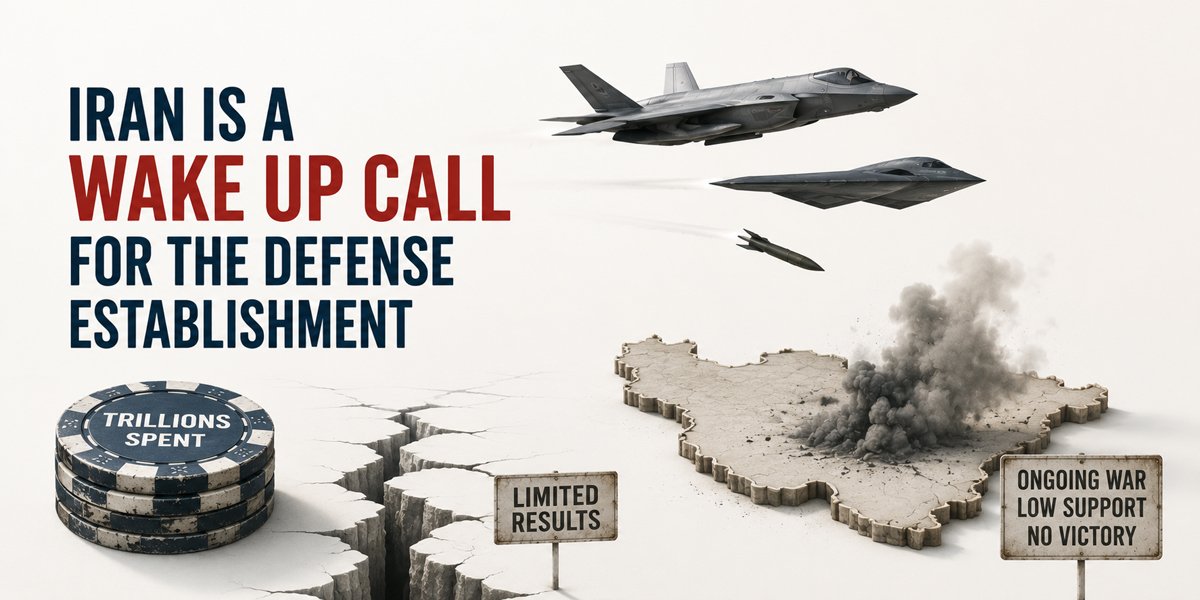
As the war in Iran has reached its fifth month, progress fails to be made and opposition continues to mount. And while President Donald Trump certainly deserves his fair share of the blame, the playbook he’s using is in no way his own.
Since the Cold War, the United States has become the preeminent world power, utilizing its heavily budgeted and expansive military to enforce its hegemony across the globe. During the later years of the 20th century especially, this has primarily taken the form of strategic bombing and overwhelming air power.
From the Gulf War to Iran, US defense leaders have made use of this strategy extensively, and besides serving as a destructive show of force, many claim it is the future of human warfare, and that high tech aircraft and weapons systems can and will be able to secure victory without deploying troops on the ground.
Dan Grazier, who is a Senior Fellow and Director of the National Security Reform Program at the Stimson Center, published a recent report disputing this very notion, claiming the limits of air power – which have been obvious in the current Iran war – are being largely ignored by the defense establishment in favor of plans for an expensive and high tech Air Force.
As such, DoD officials have been pushing extensively for new contracts and programs that aim to create next generation air power, featuring expensive fighters, stealth bombers, and various drone models. President Donald Trump launched the Iran War with this paradigm in mind, demonstrated by the ferocity of strikes carried out in the country by US and Israeli forces.
“But these plans, especially with regard to traditional methods, ignore hard-earned historical lessons. In some cases, proposals are based on historical myths and imagined outcomes,” Grazier said in his report, entitled “The Future of American Airpower.” “The force that will result from the current plans, even if the contractors manage to deliver aircraft that perform as promised, will not meet the nation’s security needs because the assumptions about warfare on which the plans are based are fundamentally wrong.”
The Iran War not only illustrated the defense establishment’s affinity for aerial bombardment, but it also greatly exposed the problematic nature of this framework as official DoD strategy.
Since the end of WW1, military theorists across the world have devised strategies that would supposedly win wars using aircraft alone, with much of the emphasis placed on the role of bomber fleets and the wholesale destruction they wrought. These ideas were put to the test in a slew of conflicts during the 20th century, notably WW2 and the Gulf War, and given its destructive capabilities many began to hold air power as a military priority – which, according to Grazier, is a dangerous fallacy.
“Both of these much-touted examples of airpower failed completely. Allied soldiers stormed the beaches of Normandy on June 6, 1944. General Schwartzkopf resorted to ordering his forces to execute the famous ‘Left Hook’ that ended the Gulf War after 100 hours of fighting on the ground,” Grazier said in his report. “If either of these bombing campaigns worked as their designers intended, the enemy would have surrendered before any ground troops began to move.”
Grazier argues not only that current air power theory is rife with misconceptions, but that it is largely outdated and out of touch with 21st century warfare. “Today, there are many ways to deliver munitions to any point on the globe. With the advent of long-range rocket artillery, cruise and ballistic missiles, and uncrewed aircraft, the centrality and even relevance of manned strike fighters and bombers diminish by the day.”
“In the 21st century, there is no need for fleets of bombers to be escorted by swarms of fighters to fly over the enemy’s capital. Put another way, there is no longer a need to establish general theater air superiority.”
Besides the declining utility of traditional aircraft, Grazier also points out that the long held notions of air power theory touted by the defense establishment are both obsolete and risky. Especially in the past two decades, administrations have been increasingly starting and waging conflicts almost exclusively using airstrikes, which according to Grazier “lowers the threshold for war initiation, but does not deliver war conclusion.”
“This creates a potential dilemma for a politician,” says Grazier. If the airstrikes fail to deliver the promised results, an all-too-common occurrence, the politician then must decide to admit defeat or escalate the situation with other military means. Escalation may include deploying ground troops to achieve a political goal that was not originally deemed worthy of such a sacrifice.”
Grazier argues that the so-called “Normandy Threshold” should be the standard for foreign policy: if the potential conflict is not deemed dire enough to deploy ground forces, then no military action should be taken at all.
While the US military excels in destruction, it erroneously sets it as the metric for strategic success. The belief that simply bombing an enemy nation into oblivion will ensure victory has emboldened the defense establishment to launch and pursue wars with reckless abandon, leaving behind costly and unpopular failures in their wake.
The Iran War has exemplified this problem tremendously. Besides having the lowest popular support of any conflict in American history, over-reliance on air supremacy has achieved none of the war’s stated objectives. Iran continues to successfully withstand Israeli-American strikes while causing significant disruption to regional bases and shipping in the Strait of Hormuz.
“Because the US has no way of controlling outcomes on the ground, the Iranians will continue to put into power the people they want” Grazier tells Antiwar.com in an interview. “When those people realize the Americans aren’t crashing across the shore, the Iranian leaders almost certainly won’t give any significant concessions because they don’t have to. It would seem cowardly for them to do so because the United States isn’t willing to fully commit to the conflict.”
Notwithstanding the dubious motives for entering Iran, like Josef Stalin’s Winter War, the conflict has resulted in viral embarrassment for the United States military and has showcased its glaring weaknesses. Dr. Jennifer Kavanagh, senior fellow and director of military analysis at Defense Priorities, claims that depleted munitions, the vulnerability of forward bases and air defense equipment and the failure to completely eliminate Iranian missile fire has raised serious questions about the state of the US military and its effectiveness in future conflicts, especially one with China.
“The bottom line is that the Iran war has cast a spotlight on the flaws and weaknesses in U.S. military strategy, both in general and specifically as it pertains to contingencies in Asia” Kavanagh said in her article. “The United States has for decades assumed that its forward bases will be defensible and that power projection assets such as bombers, aircraft carriers, and fighter jets will allow the United States to prevail in military contests even far from home.”
“If these things were ever true, they are not anymore” she continues. “Money and time can fix munitions shortages in the medium term, but they cannot solve these more serious and, in many ways, intractable strategic shortcomings. In an increasingly multipolar world where access to military power has been democratized and the United States has a smaller advantage than in the past, what the United States can achieve with military force will be more limited. U.S. strategic aims and ambitions will need to adjust accordingly.”
Grazier plans to publish a report later this year detailing his proposed reforms, which would consist of reverting the military to its pre-1947 organization with the Army and the Navy. As for the Air Force, Grazier says that it “should be broken up into its useful parts by military function”; this essentially means delegating a reduced force of fighters and bombers to the Army Air Defense and Field Artillery branches, respectively. He also proposes integrating fixed-wing cargo aircraft into the Army’s Transportation Corps, whose logistics officers could then “integrate them into a cohesive operational concept.”
America’s military is not weak, but has to this day operated on strategies and ideas that have become ineffectual in modern warfare. Investing in the hottest and priciest tech doesn’t translate into battlefield success. Until it can reform and adapt for national defense, the military establishment may want to rethink waging wars that most Americans never wanted in the first place.
Ioannis Vlahos is an editorial assistant and writer for AntiWar.com. He studies history and journalism at George Mason University. Contact: ivlahos93@gmail.com.
[ad_2]
Source link
