
[ad_1]
By Ashish Malhotra
This article was originally published by Truthout
India’s Gen Z-led movement confronted Modi, but some see it as a missed opportunity for transformational change.
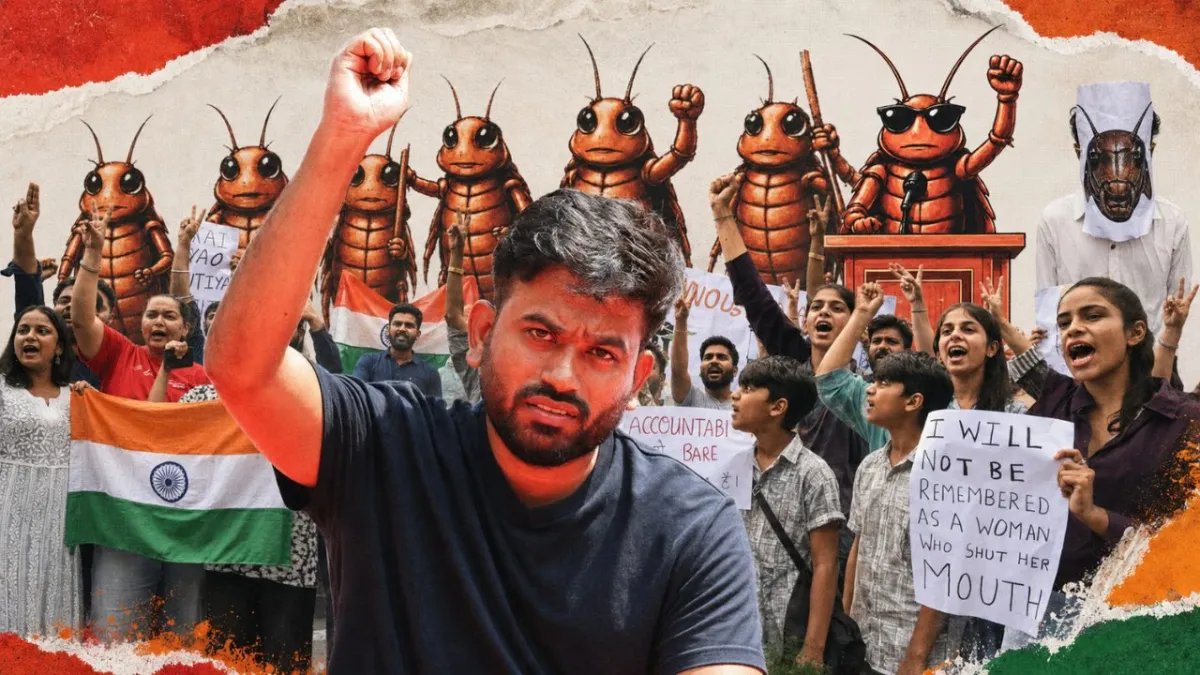
Clad in a black T-shirt and sporting slightly unkempt hair, Abhijeet Dipke conducted the massive crowd in front of him. As they waved a sea of Indian flags to the beat of the music, he stood over them waving one back. The song they were all singing, “Maa Tujhe Salaam,” is one of India’s most patriotic, released by A.R. Rahman in 1997 to mark the country’s 50th year of independence. And when it reached its bridge and chorus, Dipke held up a little red book: the founding document of that independence, the constitution of India.
It was a poignant moment. Not just because the past 12 years of Prime Minister Narendra Modi’s rule has threatened that constitution’s integrity on multiple levels. But also because it constituted an act of resistance against how Modi’s party has pushed a Hindu nationalist project that has marginalized the country’s minorities, as well as its secular fabric.
Rahman is Muslim, and his song “Maa Tujhe Salaam” evokes memories of the pre-Modi years — a more inclusive time, when India’s diversity was celebrated rather than beaten down.
The collective invocation of Rahman’s song became one of the more iconic moments of the largely Gen Z protest movement in India this summer, which has grown into what many feel is the most significant challenge Modi’s government has ever faced.
“I think that was what was so beautiful,” said Aarti Neharsh, a protester who traveled from Mumbai to the capital New Delhi to be a part of the movement. Neharsh told Truthout that it stood out to her how many people were making overt displays of patriotism — something that in recent years has come with connotations of right-wing Hindu nationalism.
“People were not shying away from it,” she said. “It genuinely felt like a reclaiming of these songs and phrases … I think that reminded people [the country] is worth fighting for, and this is what India should be.”
What Started as Satire Grew Into a Movement
But the movement that Dipke has been leading, which over the weekend forced the resignation of India’s education minister, was not sparked by these big-picture battles over what India represents. That story begins with a disparaging remark by Surya Kant, the chief justice of India’s Supreme Court, who in May referred to unemployed youth as parasites and cockroaches.
Kant’s remark led Dipke, who was just a student in the U.S. at the time, to write on X: “What if all cockroaches come together?” The post went viral, and Dipke responded by jokingly creating the Cockroach Janta Party (CJP) — a play on the name of Modi’s ruling Bharatiya Janata Party (BJP). The CJP website said membership was open to the chronically online, lazy and unemployed — as well as those with “the ability to rant professionally.”
But what started as satire then grew into something more because it tapped into genuine frustrations. Modi first won power based on a promise that “acche din” (good days) were coming. Over a decade later, many are still waiting.
And nobody feels more in limbo than India’s 370 million youth, who make up more than a quarter of the country’s population. As more of them have had access to education in recent decades, the job market has not kept up.
According to a recent report, almost 40 percent of graduates between the age of 15 and 25 in India are unemployed. For many, the fact that Kant chose to malign Gen Z with his cockroach comment rather than do anything to fix the problem was emblematic of a government that doesn’t work for them.
“The name cockroach wouldn’t have been there if the CJI (chief justice of India) wouldn’t have compared us with the cockroaches,” Dipke told Reuters in May, pointing out that cockroaches “exist in a place which is rotten,” and reasoning, “So is the system so rotten, that the cockroaches are coming out in such a huge number?”
Mishandling of Medical School Entrance Exam Stokes Despair Among Youth
But what really fueled the movement was news in mid-May that questions on India’s medical school entrance exam had been leaked before students had taken it a few weeks earlier. In response, the government announced that the results would be invalidated, and the more than 2.2 million students who took the test would have to retake it.
In a country with high levels of inequality and poverty, education is seen as many people’s best shot at social mobility. Poor families spend life savings and take out ruinous loans to pay for years’ worth of test preparation for their children, in hope that passing exams like the medical entrance one will give them a better life. For the kids, studying can dominate entire childhoods.
As journalist Manu Joseph wrote in the Indian business newspaper Mint: “For decades, there has been a covenant between India and its young — pass these entrance exams and you are set … In return, the young wasted their youth in the gloom of preparing for life.”
But even at the best of times, the odds are stacked against them. Fewer than 130,000 undergraduate spots existed for the 2.2 million students who took this year’s medical exam.
It’s incredible pressure. And having to go through the process all over again was too much for some to take. In the months since the exam was invalidated, the Cockroach Janta Party said 21 students committed suicide. Their families’ emotional journey has been unbearable.
“She triumphantly told me she had aced her papers,” Jafar Hussain, the father of 19-year-old Sana Shaikh recently told the People’s Archive of Rural India. “I told her to celebrate with her mother or go to a hotel and enjoy a meal.” A few weeks later, after the blow of the results being invalidated, Sana Shaikh hanged herself.
Her mother, Habib-un-Nisaa Sheikh, who traveled roughly 1,000 miles to join the protests, told the People’s Archive of Rural India that she holds those in power responsible: “My daughter died because of their decisions. You are supposed to protect us, not ruin our lives.”
Rana Ayyub, a journalist based in Mumbai, also said she spoke to protesters on the ground there and in Delhi who had traveled from all over the country to voice their pain.
“These are people coming from rural areas — villages where there’s not even electricity, where parents are taking loans on their small piece of land and sending their kids for education because it’s an aspirational country. Everybody wants their children to be an Indian Administrative Service or an Indian Police Service officer,” Ayyub told Truthout, referring to two sought-after government jobs that require competitive placement exams.
Protests Gather Steam in the Face of Brutal Treatment by Police
Dipke was a student at Boston University in the United States when he started the Cockroach Janta Party. But when he returned to India on June 6, 2026, he went straight to Jantar Mantar, New Delhi’s main protest site for the movement’s first street protest. From the outset, he and his fellow protesters demanded the resignation of Dharmendra Pradhan, the country’s education minister.
The movement built over weeks, getting a boost when Sonam Wangchuk, a 59-year-old activist, came to Jantar Mantar in late June to start a hunger strike in solidarity with the Gen Z protesters. Hunger strikes have great resonance in India dating back to its independence struggle. Mahatma Gandhi went on hunger strike 18 times, for as long as 21 days on two occasions, during India’s fight for freedom.
And so when Wangchuk was forcibly removed by police, three weeks into his hunger strike on July 19, it was seen as an attempt to silence his message. What followed was the biggest day of protest the movement had seen until that point, with tens of thousands showing up at Jantar Mantar.
Among them was Neharsh, the protester who flew in from Mumbai. “I was following what was happening,” Neharsh told Truthout, “and I just had this feeling that there is some hope because of the number of people that were standing up for this.”
But protesters were met with extreme force — police using tear gas, batons, and pellet guns, injuring over 100, including one woman who ended up on a ventilator.
“Because the police were using so much force, there were constant stampedes … there was nowhere to move … people were fainting because it was claustrophobic,” said Neharsh, who was tear-gassed.
“We saw a bunch of people coming — one by one injured on their heads and arms.”
Organizing Amid a Climate of Fear
Among the many characteristics that have marked the Modi years is a climate of fear. Dissent is rare, and often punished. In 2021, the Sweden-based V-Dem Institute downgraded its classification of India from an “electoral democracy” to an “electoral autocracy,” highlighting “the diminishing of freedom of expression, the media and civil society.” The few major protest movements that have taken place during Modi’s 12 years in power have generally petered out without achieving much.
A compliant mediascape that has been increasingly bought up by government-friendly businessmen has only added to the sense that Modi is untouchable. And when it came to the protests, that initially seemed to be holding true.
“If we still relied on mainstream media, we wouldn’t have known the kind of police brutality that students faced on July 20, because mainstream media didn’t document it,” said Priyanshi Sharma, a journalist who co-founded Peek TV, a short-form, independent media outlet, last year.
But what the Cockroach Janta Party protests fostered was a groundswell of Gen Z activity on social media expressing solidarity with protesters, documenting police brutality, and taking aim at Education Minister Pradhan and even Modi himself. Their critiques flooded the internet, bypassing traditional media as a main artery of information.
“ Many people thought that this protest will not become big because mainstream media is not covering it. But that wasn’t the case. Mainstream media were not covering it, but this became an ‘Insta’ revolution,” Sharma told Truthout.
Ayyub said that a difference between 2026 and previous years is that the emergence of independent news platforms like Peek TV have also helped push back against mainstream media discourse.
“I think one of the biggest victories of this protest is to show the irrelevance of the mainstream media,” she told Truthout. “They tried really hard to create a narrative that [the protests] were funded by George Soros or outside forces. It didn’t stick.”
As the momentum built, both online and on the streets, the government lost control of the narrative, and Gen Z protesters found a new level of defiance. Crushing dissent didn’t work in the way it usually does.
“The police brutality actually removed whatever bit of fear was still in the minds of people,” Sharma said. “After that they thought, ‘We’ve seen the worst that can happen.’”
Neharsh agrees: “For the first time, a lot of us experienced what living without that fear feels like.”
For the first month or so of the protests, the government had barely paid them any attention. But now they were desperately scrambling to keep up.
“The government realized that this protest is not happening on the horizontal screens of television, but it’s happening on the vertical screens of mobile phones in people’s hands,”said Sharma.
On June 24, the government held a cabinet meeting where it emphasized the need to start connecting with young people more on social media. The night before, Modi had made his own first attempt at this — a selfie video addressed to protesters that was roundly mocked for numerous reasons, including his face being too close to the screen.
The efforts were ineffective and too late. Pradhan resigned on July 25, becoming the first full cabinet member to resign from the Indian government during the Modi years. The Cockroach Janta Party immediately ended its protest movement.
A Missed Opportunity?
One of the most noticeable ways in which fear subsided during the protests was the way people spoke up about how Modi has used religion to divide.
“I never thought I would hear something like … ‘Jab Jab Modi Darta Hai, Hindu Muslim Karta Hai’ (‘Whenever Modi Is Afraid, He Divides Hindus and Muslims’),” Ayyub told Truthout.
“That was heartening [and] a uniting sentiment across the board … it just goes to show that people have seen through Modi’s majoritarianism.”
And though the Cockroach Janta Party’s biggest demand throughout the protests was the resignation of Pradhan, as the movement grew, Gen Z began to take aim at Modi too. And they did it in a way Ayyub said she hasn’t seen before.
“The language used in these protests — there was no fear. The kind of abusive words used for the prime minister himself, the memes, the T-shirts, the merchandise that was selling on the streets.”
The strength of the movement was enough to get the government to agree to a list of demands — not just the resignation of Pradhan. But in the days since that victory, many are questioning whether calling off further protests was the right move.
The Cockroach Janta Party has already threatened to resume protests because the government has not implemented one of its demands: that those involved in the movement would not face retribution. Police cases have been filed against protesters in multiple states led by the ruling party, and the Cockroach Janta Party said more than 100 people have been arrested.
Another action promised by Modi — a fast-track court to investigate the exam leak — has already hit a roadblock after the government’s lawyer failed to show up for the first hearing.
While Ayyub recognizes that forcing the resignation of a cabinet member was a huge achievement, she also said the government acceding to the Cockroach Janta Party’s demands was a “token” gesture to end the protests. As a result, she’s been left feeling disappointed, and wishing the movement had kept its momentum going to achieve more.
“Modi’s myth-making has been shattered. His image has been punctured … [but] I don’t see [Pradhan resigning] as a big victory,” she told Truthout, adding that the Cockroach Janta Party “could have consulted senior lawyers, intellectuals, and people who have seen movements like this, and asked for systemic changes.”
Comparisons have been made between the Cockroach Janta Party and other recent Gen Z–led protests in the region that have led to the total fall of the governments in Sri Lanka, Bangladesh, and Nepal. That outcome was always going to be unlikely in India, which has seen close to 80 years of democratic, peaceful transitions of power as an independent nation.
But what’s interesting to note is that the Cockroach Janta Party itself was quick to distance itself from those movements when it started.
Ayyub was surprised by that.
“I understand there was violence involved [in those other movements] … and violence should never be a part [of a protest]. But I didn’t like that framing, that somehow we are different from them,” Ayyub said. “Gen Z rage is coming from the same space as what’s happening in those countries, so I felt like there were many similarities.”
But given they’ve now ended, Ayyub is not hopeful that the protests in India will create transformational change.
“There’s nothing really that’s going to change,” Ayyubsaid. “The country lost the momentum when it was really going in a direction where we could have sought some accountability.”
This article was originally published by Truthout and is licensed under Creative Commons (CC BY-NC-ND 4.0). Please maintain all links and credits in accordance with our republishing guidelines.
Editor’s Note: At a moment when the once vaunted model of responsible journalism is overwhelmingly the play thing of self-serving billionaires and their corporate scribes, alternatives of integrity are desperately needed, and ScheerPost is one of them. Please support our independent journalism by contributing to our online donation platform, Network for Good, or send a check to our new PO Box. We can’t thank you enough, and promise to keep bringing you this kind of vital news.
You can also make a donation to our PayPal or subscribe to our Patreon.
Please share this story and help us grow our network!
[ad_2]
Source link
