
[ad_1]
I find it curious how in our society we often judge things differently based on context. We think that a person can only call themselves to be ‘a lover of books’ if they go through big piles of them in just a few days. But what would you think of a person who claimed they love good food, if we invited them to a grand dinner only to see them breathlessly gobble up their entire plate in a matter of seconds? People who confuse passion with expediency must all be dreadful in bed…
When it comes to books, the more I’m enjoying it the slower I read it: I want to savor every phrase, ponder upon the thoughts committed to paper, search online to learn more about a given reference, copy memorable quotes into my personal journal, and—when the text really inspires me—I grab my pencil and start doodling.
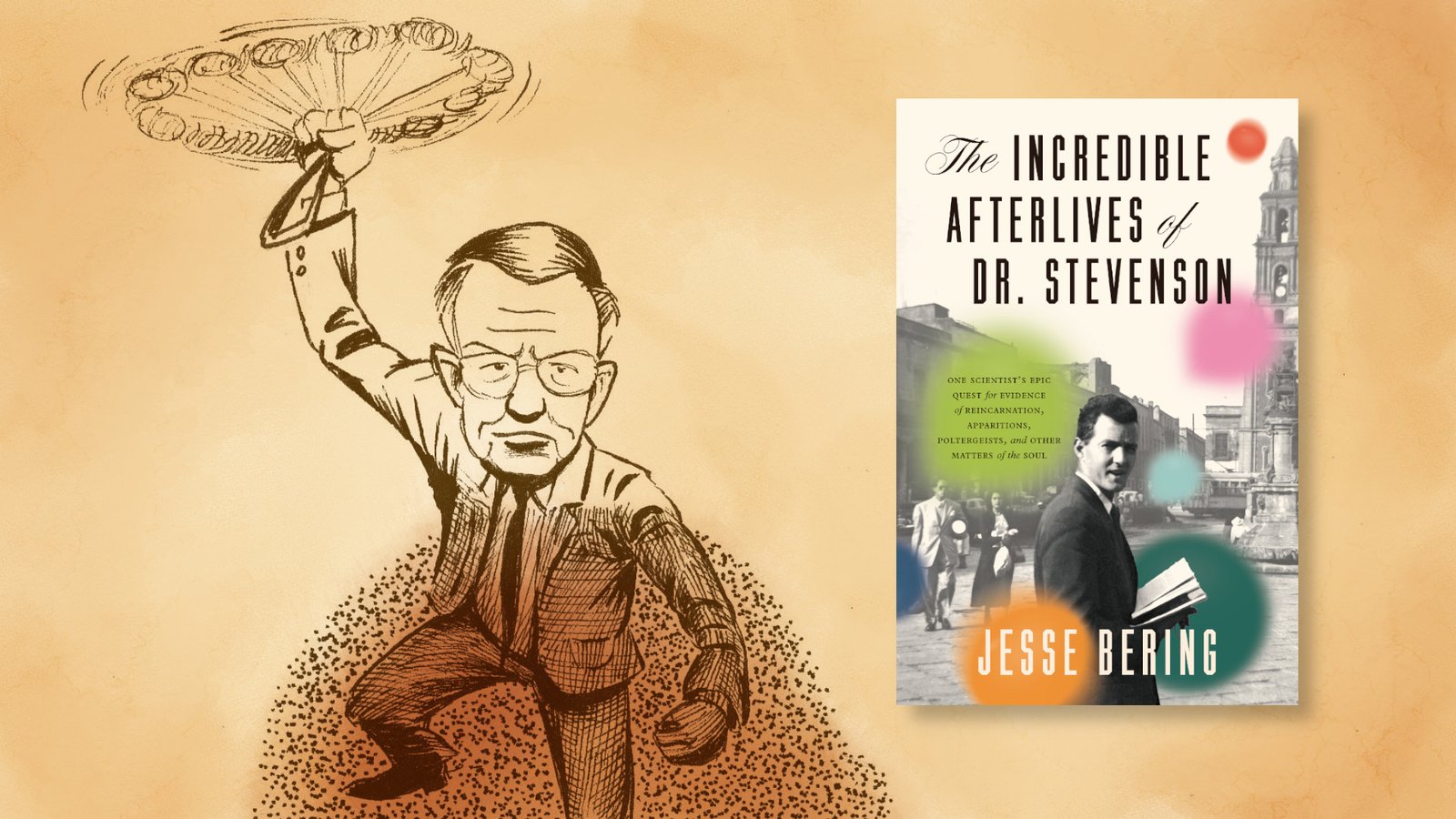
That’s exactly what happened when Greg and I set out to interview Jesse Bering, author of “The Incredible Afterlives of Dr. Stevenson.” As unprofessional as it may be for an interviewer to prepare an interview without having gone through the whole subject matter first, I just couldn’t force myself to rush through the book when I was having such a great time admiring the vistas it painted for me in my mind…with many of them transferred to the pages of my sketchbook, as you will see below.
For anyone who haven’t had the chance to watch the interview yet (please do, it’s one of our best ones to date!) the book is a biography of Dr. Ian Stevenson (1918-2007), a Canadian-born psychiatrist who decided to devote his life in the search for evidence of life after death; particularly, in the form of children who allegedly remembered their previous lives.

Stevenson is a well-known figure in the field of parapsychology, but Jesse’s biography of him gives us a broader scope of why his research was so thorough and meticulous, that only cynic naysayers would have the gall to dismiss it out of hand. Even Jesse (who is also a professor of psychology and is now working as Head of the Science Communication Programme at the University of Otago, New Zealand) found himself impressed by the cumulative effect of Stevenson’s gathered data, as he went through it to prepare his book. And even if it didn’t turn Jesse into a ‘true believer’ in the afterlife by the end of writing the manuscript, it successfully implanted a tiny seed of doubt in his mind —no doubt the good doctor would have been very pleased with that, wherever he may be now…
As Jesse relates in the first chapters of the book, it’s almost as if Stevenson had been predestined to become a challenger of scientific orthodoxy. His thorny relationship with his father—an important lawyer and economy journalist for The Times—gave him a distaste for authority figures from an early age. When he was a student he wrote brilliant essays celebrating scientific iconoclasts like seventeenth-century English physiologist William Harvey—who was ridiculed by his peers for his revolutionary ideas about the circulatory system.
And even after he chose a career in psychiatry and psychoanalysis he didn’t hold much love for Freudianism either, which he judged to be more deserving of the label ‘pseudoscience’ than the parapsychology field he joined later in life.

His iconoclasm—it should go without saying—also extended to religion, which never had much hold in his mentality despite the fact his mother introduced him to Eastern mysticism (even Theosophy) when he was just a young boy. Even so, Ian respected the role of religious ministers as ‘proto-therapists’ before the advent of modern psychiatry.

Another aspect in which Jesse documents Stevenson’s rebellious intellect, is in his portrayal as an unsung pioneer in the field of psychedelic research. This is one facet of Ian’s life that surprised me the most, since not only he became acquainted with Aldous Huxley—author of Brave New World and The Doors of Perception—but he personally experimented with mescaline and LSD in the 1950s.

The role of psychedelics has had so many ups and downs in our society, it’s hard to imagine how in the mid XXth century they were still considered a legitimate tool in psychotherapy. Back in those days scientists first thought (wrongly) how LSD could be a gateway into understanding the mind of psychotic patients. But Stevenson—like many others after him—managed to appreciate the potential of these chemical compounds in expanding the limits of human perception, in ways that are still unknown to this day.

Despite Stevenson’s exceptional interviewing skills, he found out the hard way that trying to interrogate a test subject while they are high on drugs is nil impossible. He later theorized this might be the reason why communication with discarnate entities often ends in failure—the dead might just be having the time of the life (or rather, their afterlife) and have no interest in reaching out to those of us who are trying to learn if they are okay.

Albeit I’m still very much alive (as far as I can tell!) I can certainly relate; my older sister is still angry with me and my nephew, because when we went out to see U2 in concert, she wanted us to call her the moment they would start to sing With or Without You—we were so enthralled by the experience, I simply forgot her request (can you blame me??).
One thing Stevenson made clear in one of his letters, is that thanks to those early ‘trips’ he became open to the possibility of Reincarnation.

One of the many values of Jesse’s book, is that it uses Stevenson’s biography as an excuse to explore a great deal of the history of parapsychology as a fledgling field of study; from its primitive beginnings when early scientists were attending spirit seances and haunted houses, in the hopes of catching a rare glimpse of the supernatural amid a mélange of charlatanry, to its establishment as a (semi) respectable modern scientific practice, with proper protocols and laboratory experiments.
Parapsychology could very well be divided into two large camps, then: on one hand you have the research of ‘spontaneous’ cases—reports of psychic or paranormal occurring under unexpected or uncontrolled circumstances; this is the kind of stuff anyone of us could get to experience at least once in our lives (and many of us often do). One example provided in the book is that of W. T. Stead, an English newspaper editor who was a member of the Society for Psychical Research (SPR) despite the fact of being something of a skeptic. Before he was scheduled to take a cruise trip across the Atlantic, he was warned by a psychic friend of his to not get onboard; for she had had a vision of a great tragedy in which the boat would sink, and many passengers would drown. Stead received the warning with a raised eyebrow and paid no heed to it—he was later among the many who died when the Titanic sank.

Spontaneous cases are as dramatic as they are hard to verify. Which is why in the second half of the XXth century the second camp of parapsychology appeared: the experimentalists. These are the folks who prefer to stay in the comfort of their labs, instead of wandering around decrepit haunted houses.
Rather than trying to get bits and pieces of gossip about the afterlife from chatty spirits, they are more interested in testing the latent psychic abilities in everyday people with properly monitored instrumentation. One of the most famous experimentalists was J.B. Rhine, whom we get to know a lot about in the book—and much of it not good!

Experimental parapsychology is a double-edged sword: what you gain in control over the conditions of the test, you lose in the potency of the results you obtain. Replicability is also an issue skeptics like to point out a lot, while at the same time omitting how many experiments in psychology we now take for granted have also been difficult to replicate (e.g. the famous Stanford prison experiment).
Instead of playing around with Zener cards and throwing dice, our man Stevenson focused his investigation into the ‘spontaneous’ cases. He found great value in retracing the steps of those founding fathers of the field, who among other things documented reports of what is now commonly referred to as ‘crisis apparitions’: when a person has a vivid experience (a waking dream, auditory hallucination, etc.) directly connected to the death of a person close to them. One example included in the book, is of a woman named Agnes Paquet, who in 1889 had a terrifying vision of his brother as he was drowning in the Chicago Harbor.

Another case Ian investigated that I found very interesting, was that of Georgina Feakes, who had a vision of his cousin Owen Howison, who had been recently killed in the Italian front during WW2. The apparition, surrounded by a golden mist, instructed the woman (apparently, using his voice instead of ‘telepathically’) that he wanted her to tell his mom his spirit was still alive. What made this case exceptional to Stevenson, is that when the woman demanded some proof, so she would be believed by her relatives, the apparition produced a strange blue flower from inside his uniform shirt.

This was all the proof Howison’s mother needed, since it referred to an event no one outside she and her husband ever knew, when their son had picked a rare blue orchid from a mountain near their home in Cape Town; a flower which is so rare that being caught with one of them constituted a serious offense—hence why the act remained a secret. To Ian, this constituted a solid evidence of afterlife survival.
Another spontaneous case collected in the book that I found particularly amusing, was an account of an elderly man who claimed he was able to ‘astrally project’ himself into the bedroom of two sisters who lived three miles away from him. The sisters signed affidavits in which they swore they saw the pijama-clad aparition of their pervy neighbor standing near their bed. Which probably goes to show that psychic abilities are not necessarily indicative of a good moral character —*cough* Uri Geller *cough*

But perhaps the spontaneous case that stands out from the rest in Jesse’s book, is one he himself investigated when he was researching his book about suicide. It involved a woman, Linda Collins, living with her family in Singapore in 2017, who had a powerfully vivid dream about her young daughter, Vic, whom she visualized euphorically flying upward while shouting “I’m free! I’m free! And you’re free, too!”.

While the dream had left her with a feeling of joy, Linda woke up in the early morning with a sense of dread, which caused her to get up and walk up to her daughter’s bedroom, which was empty. Not long after, the building’s concierge rang the door and gave her and her husband the news no parent ever wants to hear: Vic had climbed to the roof of the building and jumped to her death. Based on Linda’s testimony, Jesse assessed, it is quite likely the hour of the tragedy coincided with Linda’s dream.
It is precisely because of this personal experience, and others Jesse gallantly shares with his readers throughout the pages, that he was open in the first place to assess Ian’s body of evidence despite his initial skeptical misgivings; further reinforced by his professional training as a psychologist and cognitive scientist.
One of those early pioneers Ian held in high regard was Frederick Myers, who elaborated a sophisticated theory about the afterlife (inferred by the paranormal phenomena he personally witnessed) which many modern parapsychologists—including Stevenson himself—still adhere to. To Myers, humans were ‘multi-dimensional’ beings dividing their existence between what he called the ‘Metetherial’ world (where our higher Self resides) and the everyday world experienced by the senses of our physical self.

In Myers’ worldview, our physical selves evolved to experience just a tiny sliver of all there is—a practical necessity wittingly acknowledged by modern parapsychologists like Dean Radin, who is fond of writing how it is best to be aware of the tiger hiding in the bushes in front of you, instead of the tiger living in the planet Pluto ten thousand years ago. Meanwhile our larger Self (with a capital “S”) has an all-encompassing, privileged perception of Reality.

But there are occasions in which our limited physical perceptions are momentarily expanded, Myers and his colleagues at the Society for Psychical Research (SPR) posited. Sometimes the person is naturally sensitive to information coming from the metheterial domain—we call those people ‘psychics’.
Other times strong emotions and trauma play a role in ‘thinning the veil’ between worlds. And this is another instance in which Stevenson’s early medical background had made him uniquely qualified to leave his future mark in parapsychology. As related by Jesse, Ian began his career as lab assistant for Harold Wolff at Cornell University, where they studied the psychosomatic effects of emotions in the health of patients—like how anger can literally change the color of your stomach tissue.

Even Ian himself became a study subject a couple of times, noting how criticism on the part of his boss elicited a rather disgusting discharge of mucus in him (perhaps these bitter experiences at the lab were the reason why he chose to be a field researcher instead of a parapsychology experimenter later in life?).

Jesse writes on how Stevenson’s intellectual rebelliousness made him lock horns more than once with Wolff, because they disagreed on the effect positive emotions can have on the body. Counterintuitively, Ian suspected that sometimes sudden bursts of joy could have a negative effect in humans—imagine, for example, a scene in which a middle-aged man which high blood pressure suddenly realizes he’s won the lottery and is now a millionaire: that moment of ecstasy could easily cause him to die of a heart attack, before he could even cash in the check.

Strong emotions, Stevenson theorized, especially associated with violent deaths, seemed to have an influence somehow in the reincarnation process, leaving a kind of ‘psychic impression’ from the dying incarnation onto the next one. While most Eastern religions involve the concept of karma as the regulatory factor which would determine the manner in which the ‘soul’ would incarnate, Ian didn’t subscribe to any moral interpretation: Punished by our sins, not for our sins, as he put it.

But we are actually getting ahead of ourselves! Before Stevenson could even begin to study cases suggestive of reincarnation, he needed to overcome one major problem in this and any other incarnation: Money.
Travelling to places like India to verify claims of children who remember their previous lives is expensive, and despite having obtained tenure as the chair of Psychiatry at the prestigious University in Virginia, Ian wouldn’t be able to justify those traveling expenses to the school board. That is why Jesse introduces his readers to two major figures in the life of Dr. Stevenson: Eileen Garrett and Chester Carlson.
Jesse does a fine job of painting Eileen Garrett as this wonderfully eccentric woman who became a celebrated trance medium in the Edwardian era under the most unlikely of circumstances, which allowed him to mingle with celebrities like Sir Arthur Conan Doyle; who, unlike his world-famous detective character, was all-too eager to believe in whatever evidence of the afterlife and the paranormal he came across.

What makes Eileen exceptional, is that despite his natural talent to dissociate and purportedly ‘channel’ discarnate intelligences, she herself was skeptic of her own psychic abilities! Being an intelligent woman, she managed to use those abilities to escape poverty and eventually become a major influence in the nascent field of parapsychology; thanks in no small part to her life-long friendship with Frances Bolton, a wealthy US Senator who helped her finance the efforts of many luminaries in the field, like William McDougall, J.B. Rhine, and also Ian Stevenson himself.

(All you TV producers who like to read The Daily Grail: I want a movie or series about Eileen’s life starring Olivia Colman, stat!)
One of those ‘silver age’ parapsychologists Eileen took under her wing was Gardner Murphy, who eventually became the head of the SPR. Gardner, among many other things, was one of the researchers who looked into the abilities of the famous medium Leonora Piper, whom Greg here has devoted many gallons of ink and neurons writing about.

It was Eileen, then, who help finance Ian’s first trip to India. A curious decision, since—as Jesse points out—she remained skeptical about the possibility of reincarnation; whereas ‘Abdul Latif’ (one of the discarnate personalities she regularly channeled) was very much in favor of. I guess you could say she was of two (or more) minds on the matter!

The other great ally in Ian’s work—and parapsychology in general—was Chester Carlson, the inventor of ‘xerography’ (photocopy) and founder of the Xerox company.

Younger generations might not be aware of how humongously HUGE the Xerox company was during the XXth century, when before PDFs and scanners every office had to have at least one photocopying machine just to get by—I still remember how when I went to college, many teachers assigned their class to get copies of the assignments on the various copy centers throughout the campus.
Suffice it to say, Carlson was as rich as Midas before an age of techbro billionaires. And, unlike said billionaires, he was very generous with his wealth; he financed many philanthropic initiatives, including the work of many parapsychological institutions and researchers. To the point that, after reading Jesse’s book, I feel as if every parapsychology department today should still keep an old Xerox machine—not because they would still use them, but as an altar to show their gratitude!

Carlson became Ian’s major patron. And with that funding, he was able to travel to remote villages across the whole wide world, gathering evidence suggestive of reincarnation (that caveat—‘suggestive’ instead of ‘conclusive’—shows Stevenson’s scientific integrity, and is one of the reasons he managed to slowly gain Jesse’s respect as he went through his papers and writings in preparation for this book).
Because countries in Southeast Asia have a cultural acquaintance with the concept of reincarnation, finding good cases there was easier than in Western countries; even though memories of past lives seem to be pretty much universal. In fact, one of the things that surprised me the most when learning about Ian’s research, was how the Tlingit tribe in Alaska also hold a belief in reincarnation. But, unlike most cases in which the ‘transmigration’ from body to body seems like a random process, the Tlingit seem to have a way to control the circumstances by which they will reincarnate.
One case mentioned in the book, for example, involved a Tlingit old man who apparently was successful into returning to life as the child of his favorite son. Not only did the child exhibit birthmarks strikingly similar to those the old man had when he was alive, but he purportedly was very attached to a watch that had once belonged to him.

Remembering past memories is one thing, but the thing that made Stevenson’s research stand up to the scrutiny of skeptics were those accompanying birthmarks, that closely resembled the death wounds or malformations suffered by the previous incarnation. Ian let the weight of his gathered evidence speak for itself—and this is where Jesse as an author deserves much accolades, since he did a yeoman’s work perusing over the highly detailed (and highly DRY) content in Stevenson’s papers.
Later in life, Ian would allow himself to speculate about the possible mechanisms that would produce the physical features he observed in his case studies, along with the storing and transmission of memories from one incarnation onto the next one. He proposed the idea of the ‘Psychophore’ as a sort of template or repository of psychic impressions, that become an intermediate vessel between incarnations.

While most psychophores would just jump at any opportunity they could find to incarnate as quickly as possible, Ian speculated that some might be much more picky, and maybe would be even able to interfere (to an extent) with both the circumstances of the birth (i.e. when and where they would be born) but also with the biological development of the zygote within the womb. Thus, his ideas attempted to explain some the physical and behavioral differences of members of the same family, as a result of an influence of their past lives.

If this sounds rather controversial to you, you’re not alone. There are actually other ideas Stevenson cultivated throughout his long career, with regards to the role reincarnation may have in explaining the behavior and morphology of individuals, which even open-minded readers of The Daily Grail would find too out-there to entertain. Leaving aside the minefield issues of sexual preferences and gender identity, Ian thought the proliferation of albino children in Africa were the result of too many American and European pilots dying over that region during the second world war (!).
He also thought the spike in male births during and immediately after the war might have been the result of the spirits of dead soldiers seeking to ‘come home’. Jesse counters these speculations with other alternatives, such as the theories of Satoshi Kanazawa, an American psychologist who attempted to explain the spike as a result of taller-than-average American soldiers visiting home during shore-leave, and how taller men tend to have more male offspring. Even though Jesse doesn’t mention it, Wikipedia has labeled Kanazawa’s ideas as ‘pseudoscientific’ so make of that what you will…

“Infants later identified as autistic frequently had not reached out toward their parents when the parents went to pick them up. I suggest that such alienation may derive from unhappy experiences in a previous life, even when the child has no imaged memories of one. This conjecture obviously opposes the view that infantile autism derives exclusively from biological, principally genetic, factors.”
Ian Stevenson

Yikes! And yet, many ideas we now hold as self evident began as being considered ridiculous—or even scandalous— at one point. What’s important here to remember, is that Ian never misled his readers and was clear in pointing out to them when he was reporting on factual data, and when he was indulging in informed speculation.
Not that I made any difference in dissuading skeptics like philosopher Leonard Angel from trying to debunk his work, often without even bothering to carefully read the evidence before pronouncing it as nonsense—the usual “it can’t be therefore it isn’t” attitude.


What about reincarnation between different species? Here I was surprised to learn about Ian’s skepticism on the issue, even though he wouldn’t discount it entirely. In fact, he actually managed to find one case of a young boy in India who claimed he had been one of the monkeys living near the property of his (new) family.

Even though Jesse omitted mentioning in his book the work of Jim Tucker—who is the current successor of Ian’s reincarnation research,—I believe Tucker managed to find a case of another kid in India, who claimed to have been a snake in a previous life. The kid displayed a strong resentment toward a villager that allegedly had killed the snake—talk about being Team Slytherin.
When we had Jesse on our YouTube channel, I asked him what he would’ve done if he had been one of Ian’s assistants in his reincarnation research, in order to improve the data or prevent him from making possible cognitive bias mistakes. While you can watch his response in the interview, my own personal critique of Stevenson’s approach towards reincarnation is that—to paraphrase my favorite fictional scientist—he was not thinking fourth-dimensionally about it!

In other words, while it is common to assume the past is behind us and the future hasn’t already happened, modern physics tells us this is just an incomplete perception of Time imposed by our brains. In fact, modern parapsychology experiments conducted by Dean Radin and others have been able to show the future can influence the past (although in a small measure).
So if we are willing to entertain the possibility of ‘previous lives’, then what about our ‘next lives? From that perspective, couldn’t we interpret things like ‘clairvoyance’ and ‘prophetic visions’ as the memories from our future selves? The movie Cloud Atlas remains, in my opinion, one of the best ways to conceive the notion of human existence moving simultaneously across all axes of time and space. Too bad Stevenson didn’t live enough to watch it (or maybe he will, in a next incarnation?)
While reincarnation research is where Stevenson left his deeper mark—and even skeptics like Carl Sagan reluctantly admitted his work deserved further study—as we’ve already stated it wasn’t the full scope of his long, fruitful career in pursuit of evidence of survival after death. He was among the first Western scientists to analyze the cultural differences between NDEs across geographical regions. Whereas the ‘Western NDE’ has become the stereotypical form of the phenomenon— observing your body while medics are trying to resuscitate you > tunnel of light > encounter with dead loved ones > encounter with ‘being of pure love/light’ > life review > voluntary or involuntary return to life— the NDEs reported in India,. Ian found out, are more like a ‘cosmic SNAFU’ in which the accountant god Chitragupta realizes there’s been some kind of mistake, and that soul of the person has been ‘snatched’ ahead of schedule.

This part of the book reminded me of how, when it comes to reincarnation, Hollywood also likes to favor the idea of the ‘cosmic SNAFU’ (e.g. the 1989 movie Chances Are with Cybill Shepherd and a young Marvel-less Robert Downey Jr.). Stevenson’s own ideas about reincarnation also seemed to align with the notion that remembering past lives was a sort of ‘glitch in the Matrix’ which often brought negative consequences on the person, and the people around them.

Other cultural differences Stevenson documented dealt with the phenomenon known as ‘spirit possession’. Whereas movies like The Exorcist have made us assume one can only get rid of uninvited spirits through the sprinkling of holy water, and copious repetitions of “THE SPIRIT OF CHRIST COMPELS YOU!”, in India they tend to solve such matters in a gentler, more diplomatic approach: a priest would make an arrangement with a spirit wishing to possess a living body for a brief chance to re-experience earthly delights, in exchange of certain spiritual favors.

Ian Stevenson was definitely a globe-trotter, and another country he visited in search of parapsychological evidence was Iceland, where he reviewed the work of renowned medium Hafsteinn Björnson.

Among the cases of alleged afterlife communication Björnson was involved in, the one I found the funniest was that of a grumpy spirit that would barge into his group’s regular sessions over the years, and slowly provided enough information that helped to identify him as a drunken sailor who had died decades ago, and whose corpse had washed ashore after the tide went down, missing one of its legs. The supposed spirit gave more details that eventually resulted in the discovery of the missing leg, for which a proper burial was arranged. This made the spirit very grateful.

The person who introduced Björnson to Stevenson was Icelandic parapsychologist Erlendur Haraldsson, who became a close friend of Ian for the remainder of his life.

Despite having been luckier than most with regards of securing the support of wealthy patrons, and the respect of his peers—or if not respect, at least not open mockery!—Stevenson’s work was not impervious to obstacles. For instance, the publication of his first book on reincarnation went through a looong peer-review process, which became even more complicated when Hemendra Banerjee—the parapsychologist who first invited him to visit India—was accused of forging test results by some of Ian’s competitors.

This put Stevenson in a tough spot, since most of his best Indian cases have been first obtained through Banerjee, even though he hadn’t been involved in the actual research process. Jesse points out in the book how Eileen Garrett—Ian’s friend and former patron—had warned him beforehand of Banerjee’s sketchy reputation,

Here, Jesse shows how Stevenson’s integrity was so great, that instead of discarding those cases altogether he decided to travel back to India just to re-examine them a second time, to ensure Banerjee’s original translations hadn’t been misleading or inaccurate.
Back home, Stevenson enjoyed tenure, but that doesn’t mean he also enjoyed total immunity or had carte blanche to do anything he wanted—especially since what he really wanted, was to devote more of his time doing parapsychology, instead of being caught with the bureaucratic duties his position demanded. Page after page, Jesse leads his readership through the travails of tribulations Ian endured, and the allies he secured. Like Dr. Thomas Harrison Hunter, the dean of the UVA medical school when he started to work there, who was more sympathetic about his fringe research than his replacement, Dr. Kenneth Crispell.

But more than specific individuals, Stevenson found himself facing an entire scientific paradigm, still hooked (to this day) on materialism, that simply could not see the merit in what he was trying to accomplish. It was the 1960s, and there was a widespread fear in the academic circles of Psychology, that if the ‘woo-woo’ of parapsychologists was allowed a foothold into their field, the reputation of the entire discipline would suffer an irreparable damage.


When Stevenson finally managed to convince UVA to have a Parapsychology Division attached to the Department of Psychology, he actually wanted it to have a different name other than the already-stigmatized ‘P’ word. The school board would have none of that—he wanted to quit his chair in pursuit of woo-woo? He had to accept the full baggage… including the label.

The resistance to own the title of parapsychologist might seem strange to outsiders, but Jesse helps us to understand how Ian was concerned on how his high standards for scientific research, were not shared by the majority of the people in the field whose validity he tried so hard to defend.

There’s also his natural distaste for sensationalistic publicity. He did not look kindly on newcomers riding on coattails of pioneers like himself, who wrote best-selling books about reincarnation. I even think Stevenson avoided the chance of writing the kind of mass paperback book that would be sold in airport bookstores.

By the 1980s, TV shows and movies have further given Parapsychology a bad rep. Something I didn’t understand when I watched Peter Venkman (Bill Murray) fudge with his Zener cards experiment just to flirt with a hot college student; but I can certainly understand it now.

And on top of all that, Jesse provides excellent context to better understand the internal fights between the field. Part of the reason for those fights was the end result of having too few sources of funding for research; so instead of colleagues, it seems as parapsychologists saw themselves as competitors for the attention of the few wealthy patrons willing to support their efforts.


The situation probably got a little more personal, when Joseph Gaither Pratt ended up quitting Rhine’s lab at Duke university, and Stevenson took the opportunity to offer him a position with him at UVA. Pratt was an excellent scientist who improved the methodology of parapsychology by introducing ‘double-blind’ protocols into the experiments.

Going through Jesse’s excellent biography of Stevenson, I kept thinking about the many parallels between his career and that of another maverick scientist, who also paid a hefty price for his interest in controversial topics: the late John Mack, who jumped into pop culture celebrity due to his research into the so-called alien abduction phenomenon.

After reading Ralph Blumenthal’s book ‘The Believer’ (his biography of Mack, also highly recommended) it’s clear John went through a rougher time at Harvard than Ian at UVA (the latter never suffered the threat of being removed of his tenure!). Still, I see in both of them kindred spirits and I wonder if they ever crossed paths during the 1990s—perhaps I’ll ask Karin Austin (Mack’s friend and confidant) next time we get the chance to speak to her.
The thing that I loved the most about biographies of scientific figures like Jesse’s book, is when they manage to get the perfect balance between going through the gist of that person’s professional work—in an approachable way for a layman like myself— without forgetting to include the details of their personal life; which not only helps you to understand the circumstances of their journey that shaped their decisions and career path, but also makes you look at them as tridimensional beings, instead of just idealized characters you admire only for the things they accomplished.
Even though The Incredible Afterlives of Dr. Stevenson portrays him as an indefatigable researcher, an impeccable scientist and a man of great integrity, he was not without human defects like the rest of us. All that ceaseless traveling must have put a heavy strain on his marital life, leaving his devoted wife Octavia alone for too-long periods of time while he was chasing the elusive proof of the afterlife—while neglecting the herelife, as it often happens.
Ian’s life was also full of trials and tribulations. From his early years when he suffered from serious health issues, to the loss of his sponsor Chester Carlson, whom had become his dearest friend.

Harold Lief, one of his contemporaries, said of him: “Either he is making a colossal mistake, or he will be known as the Galileo of the 20th century.” Perhaps the comparison, as flattering as it may be, is not entirely adequate; since Ian never suffered the censure of his work (nor he was sentenced to house arrest either). By the end of the book, Jesse himself compares him to the biblical David, standing up against the “Goliath of scientific conformism.”

Equally evocative allegory (heck, that is why I drew it!) but seeing how we’re still living under a materialistic paradigm, I’m not sure it is fitting either—the Goliath remains standing.
The thing is, our old myths are filled with heroes that single-handedly defeat the giant of slay the dragon, because that’s more convenient for narrative purposes (and political manipulation). I prefer modern myths, like Lord of the Rings, which show that in every tale there are many heroes, whose collective actions are equally necessary to fulfill the quest.
From that perspective, I’m not even sure Ian would be the ‘Frodo’ of the story either. Rather, what I hope is that books like Jesse’s inspire future generations into taking the Ring from where Ian and the other pioneers in the field of parapsychology left it.
“As a psychologist who studies how our species’ theory of mind spills over into places where other minds don’t exist […] I’m inclined to argue that reflecting about the minds of the dead is just another example of misplaced social cognition. But that inclination is also tempered by at least some of Ian’s research. his findings rarely speak for themselves, as we’ve seen, but neither can they all be so easily brushed off as a simple cognitive illusion.”
Jesse Bering, ‘The Incredible Afterlives of Dr. Stevenson’
What say you? Will you join the Fellowship?
The Incredible Afterlives of Dr. Stevenson was published in 2026 by the University of Chicago Press.
[ad_2]
Source link
