
[ad_1]
In one of the scariest moments in modern history, we're doing our best at ScheerPost to pierce the fog of lies that conceal it but we need some help to pay our writers and staff. Please consider a tax-deductible donation.
Zero-click phone hacking tools once used abroad are now confirmed inside the United States — raising urgent civil liberties concerns.
ScheerPsot Staff
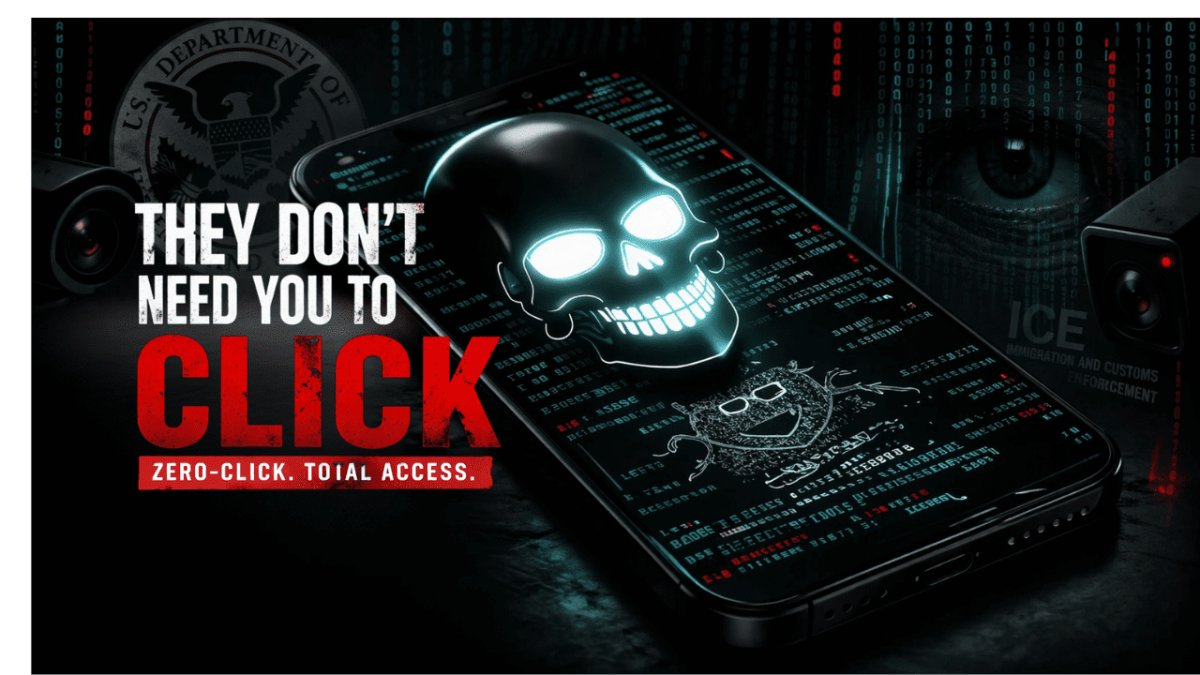
In a quiet but deeply consequential admission, U.S. Immigration and Customs Enforcement (ICE) has confirmed it is deploying powerful spyware capable of infiltrating phones, intercepting encrypted messages, and surveilling targets without any user interaction. The revelation, buried in an agency letter to lawmakers, signals not just a technological escalation—but a political one.
At the center of the controversy is a tool known as Graphite, a form of “zero-click” spyware developed by Israeli firm Paragon Solutions. Unlike traditional surveillance methods, this technology requires no action from its target. A phone can be compromised without a click, a download, or even awareness. Once inside, it can access private messages, calls, and sensitive personal data—effectively turning a device into a live wiretap.
ICE claims the deployment is part of its mission to combat fentanyl trafficking and dismantle transnational criminal organizations. But critics warn that justification has become a familiar gateway for expanding surveillance powers far beyond their stated purpose.
Civil liberties advocates and lawmakers are sounding the alarm. Representative Summer Lee, one of the officials who pressed ICE for answers, made clear the danger: the agency has not defined who can be targeted, nor provided a transparent legal framework for how such invasive tools are used within U.S. borders.
This ambiguity is not theoretical—it is historical.
Surveillance programs in the United States have repeatedly expanded beyond their original scope, often targeting marginalized communities, activists, and political dissenters. ICE itself has already built what critics describe as a “massive surveillance web,” utilizing data brokers, facial recognition, and location tracking to monitor millions—including U.S. citizens.
Now, with spyware capable of penetrating encrypted apps like WhatsApp—tools relied upon by journalists, organizers, and ordinary people alike—the stakes are even higher.
What makes Graphite especially alarming is its track record. Reports have already linked the technology to the targeting of journalists and civil society actors abroad. Researchers identified cases where individuals were hacked through messaging platforms, raising serious questions about how such tools are wielded—and against whom.
This is from yesterday—someone asked a Palantir employee a question: What went wrong with your life? A good question for those who decide to spend their lives invading privacy and risking people’s lives, careers, hopes, goals, and everything.
It used to be that a peeping Tom would climb a tree and could be arrested. Now, these digital peeping Toms are doing it for our “safety.” What a joke.
Had to share this in a larger article about surveillance and the limits—which we know they have none.
We need to ask the question: do they have morals? Do they have souls?
A Palantir employee was confronted on a public sidewalk
“What went wrong in your life that you work for a company that enables ICE, the IDF, and mass surveillance?” pic.twitter.com/kgdzgcporh
— Ounka (@OunkaOnX) April 7, 2026
The concern is not just abuse. It is normalization.
ICE insists its use of spyware complies with constitutional standards. But experts argue that current U.S. law has not kept pace with surveillance capabilities. There are few clear guardrails preventing agencies from stretching authority, especially when tools are deployed under administrative processes rather than judicial oversight.
In other words: the technology is advancing faster than the law—and far faster than public awareness.
This revelation comes at a critical moment. Congress is preparing to debate surveillance authorities and whether to close loopholes that allow the government to purchase vast amounts of personal data without a warrant. The confirmation that ICE is already using military-grade spyware only intensifies the urgency.
Because once such tools are normalized, they rarely disappear.
They expand.
What begins as a tool against “foreign threats” can and will be quickly be turned inward—against protesters, journalists, immigrants, and anyone deemed inconvenient to power. That is not speculation. That is precedent.
And now, it is policy.
And as we see from this latest article about the New Red Scare from Zateo news with them reporting “FBI emails obtained by Zeteo show that the Trump administration is pushing state and local police to target Americans with left-wing views, emails show. As Donald Trump’s hot war in Iran enters its second month with no end in sight, a quieter, colder war is simmering on the home front.”
THE CRACKDOWN EXPANDS: FROM SURVEILLANCE TO THOUGHT POLICING
If the expansion of spyware marks a technological escalation, new reporting suggests the political framework for its use is already being built.
A report from Zeteo reveals that internal FBI communications show the Trump administration is actively pushing state and local law enforcement to monitor and potentially target Americans for their political views—specifically those aligned with left-wing dissent.
At the center of this effort is a sweeping directive known as NSPM-7, a national security presidential memorandum that dramatically expands the scope of what can be treated as a domestic threat. Unlike traditional directives, which shape internal federal policy, NSPM-7 reaches across the entire intelligence and law enforcement apparatus—federal, state, and local.
In practice, the implications are chilling.
Criticizing corporations online.
Holding a protest sign calling for ICE to leave your city.
Posting a meme.
Speaking out against war.
Under this framework, these actions risk being cataloged, shared, and escalated through law enforcement channels as potential indicators of extremism.
The result is a system where surveillance is no longer just about what you do—but what you think, what you say, and what you believe.
This is not happening in isolation. It is unfolding alongside the expansion of invasive tools like zero-click spyware—technologies capable of penetrating the very devices people use to express those views.
Together, they form a feedback loop of control:
Surveillance identifies dissent.
Policy redefines dissent as threat.
Technology enforces that definition.
What emerges is something far more dangerous than any single tool or directive—a convergence of power that collapses the line between national security and political suppression.
The last time the United States undertook a transformation of this scale in domestic surveillance was in the wake of 9/11, with the passage of the Patriot Act.
This time, the official target is not just terrorism.
It is dissent itself.
Editor’s Note: At a moment when the once vaunted model of responsible journalism is overwhelmingly the play thing of self-serving billionaires and their corporate scribes, alternatives of integrity are desperately needed, and ScheerPost is one of them. Please support our independent journalism by contributing to our online donation platform, Network for Good, or send a check to our new PO Box. We can’t thank you enough, and promise to keep bringing you this kind of vital news.
You can also make a donation to our PayPal or subscribe to our Patreon.
Please share this story and help us grow our network!
[ad_2]
Source link
