
[ad_1]
Medea Benjamin warns that a decades-long economic war against Cuba has escalated into what she calls a “medieval siege,” as fuel shortages cripple hospitals, food systems and daily life while U.S. officials openly discuss military options.
Joshua Scheer
For more than six decades, Washington has tried to force Cuba to its knees. Today, according to peace activist Medea Benjamin, that campaign has reached a new and dangerous stage. Fuel shipments have been blocked, foreign companies threatened, humanitarian aid obstructed and military rhetoric intensified, creating what Benjamin describes as a modern-day siege designed to break the Cuban economy and the Cuban people alike.
In this wide-ranging conversation with Dr. Margaret Flowers, Benjamin argues that the crisis unfolding on the island is not the result of natural disaster or governmental incompetence, but of deliberate U.S. policy. She details how shortages of fuel have crippled transportation, disrupted hospitals, spoiled food supplies and contributed to worsening public health conditions. The goal, she says, remains largely unchanged from the earliest days of the Cold War: create enough hardship that Cubans turn against their government.
But the discussion goes beyond Cuba. Benjamin places the escalating pressure on Havana within a broader pattern of U.S. foreign policy — one that relies on sanctions, coercion and military power to maintain global influence even as that influence declines. From Venezuela and Iran to Palestine and beyond, she argues that economic warfare has become a preferred tool of empire, inflicting immense humanitarian costs while remaining largely invisible to the American public.
At a moment when reports of possible military action against Cuba are once again circulating, Benjamin issues a stark warning: what is happening in Cuba today is not simply a foreign policy dispute. It is a test of whether the United States will continue down a path of punishment, intervention and regime change, or whether ordinary people can build enough pressure to choose diplomacy, solidarity and peace instead.
For more than sixty years, the United States has sought to isolate, punish and ultimately reshape Cuba through economic warfare. Yet according to longtime peace activist and CODEPINK co-founder Medea Benjamin, what is happening today goes far beyond the familiar story of sanctions and diplomatic hostility. Speaking with Margaret Flowers on Clearing the FOG, Benjamin described a rapidly escalating campaign that she says has pushed Cuba into a humanitarian emergency while raising fears that Washington could be laying the groundwork for direct military intervention.
Benjamin did not mince words when describing current U.S. policy.
“I struggle to find the correct adjective,” she said. “It is so horrific that there’s almost no words.” What began decades ago as an attempt to create economic pressure on Cuba has, in her view, evolved into something far more extreme: a policy designed to systematically cut off every possible source of fuel, trade, investment and survival.
The consequences are visible throughout Cuban society.
According to Benjamin, the island is facing severe fuel shortages that have crippled transportation, disrupted industrial production and created rolling blackouts that affect nearly every aspect of daily life. Hospitals struggle to maintain services. Refrigerators stop working, causing food to spoil. Public transportation becomes unreliable or nonexistent. Families living in apartment buildings face interruptions in water supplies because pumps cannot operate consistently without electricity.
Perhaps most alarming, Benjamin pointed to rising infant mortality rates as evidence of a public health crisis that she believes is directly connected to the tightening blockade. Cuba once boasted one of the lowest infant mortality rates in the Western Hemisphere, often outperforming wealthier nations including the United States. That achievement, she warned, is now being undermined by shortages of medicine, medical equipment and basic necessities.
What makes the situation particularly tragic, Benjamin argued, is Cuba’s long history of providing medical assistance to the world. She recalled being treated by Cuban doctors while working in Africa and noted that Cuba has trained physicians and deployed medical missions across dozens of countries. Even under severe economic constraints, Cuba has maintained a reputation for international medical solidarity that far exceeds what might be expected from a small island nation.
Yet today, she says, the country that has helped save lives around the globe is struggling to obtain the fuel and medical supplies needed to care for its own people.
At the center of the crisis is oil.
Benjamin explained that the Trump administration has effectively declared that “not one drop of oil” should reach Cuba. Since January, she said, only a single Russian tanker has successfully delivered oil to the island, while other shipments have reportedly been pressured, delayed or canceled. Countries that might normally assist Cuba have faced threats of sanctions, tariffs or other forms of retaliation from Washington.
The blockade’s reach extends beyond governments. New sanctions target foreign companies operating in key Cuban sectors such as energy and mining. Benjamin cited the example of a Canadian company that had worked in Cuba for decades but is now severing ties under mounting U.S. pressure. The strategy, she argued, is designed not merely to isolate Cuba economically but to make normal commerce virtually impossible.
China has attempted to provide assistance, sending rice and helping construct solar energy projects, while solidarity groups continue delivering humanitarian aid. But Benjamin stressed that food aid alone cannot solve the crisis. Without sufficient fuel, transportation networks collapse, power grids remain unstable and basic economic activity becomes impossible.
The contradiction at the heart of U.S. policy became especially clear when Flowers asked about Washington’s proposal to provide roughly $100 million in assistance to Cuba through selected organizations.
Benjamin called the offer deeply hypocritical.
The economic damage caused by sanctions, she argued, amounts to billions of dollars annually. Offering a fraction of that amount while continuing the policies responsible for the suffering is akin to creating a crisis and then presenting oneself as the rescuer. She noted that Cuban officials estimated the proposed aid represented only a tiny portion of what sanctions cost the country.
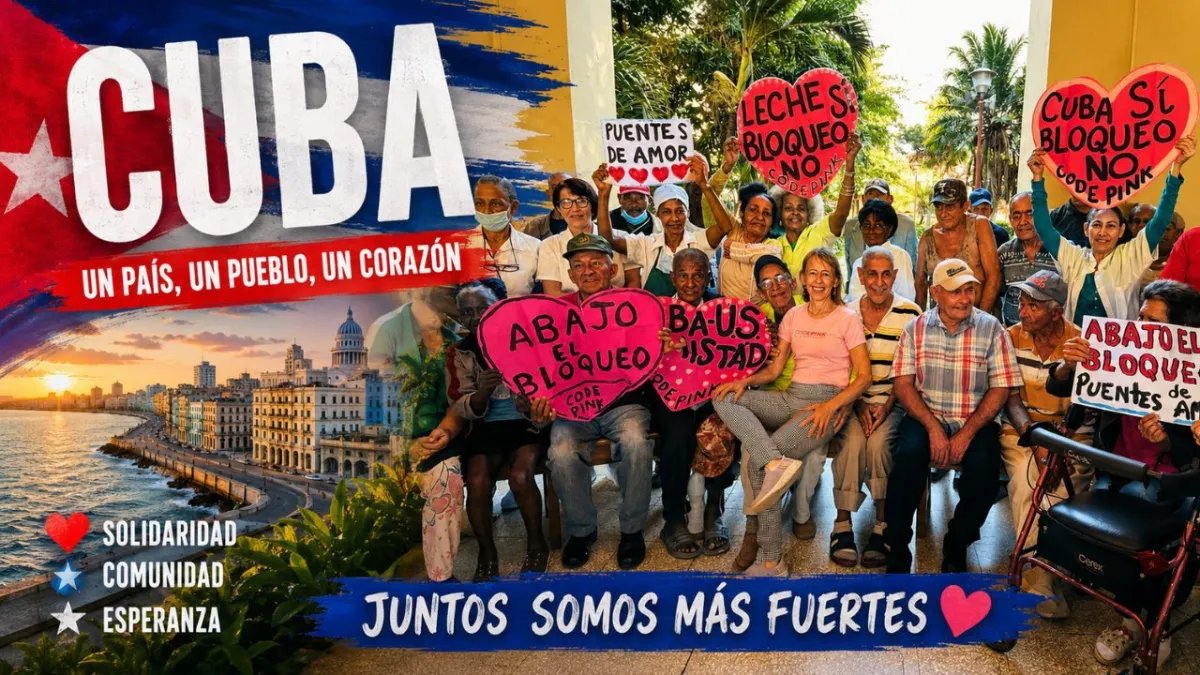
While humanitarian groups continue delivering food and medicine under limited exemptions to U.S. sanctions, Benjamin warned that aid alone cannot address the scale of the crisis. Organizations including CODEPINK, Global Exchange, Global Health Partners and others have mobilized delegations and donations, but they are attempting to fill a gap created by a policy that deliberately restricts Cuba’s access to international trade and finance.
More troubling still is the growing discussion of military action.
Benjamin pointed to reports that U.S. military assets have been repositioned in the Caribbean and that officials connected to Southern Command have indicated preparations exist for a possible operation against Cuba. While she acknowledged uncertainty about whether Washington intends a full-scale invasion, targeted regime-change operation or continued economic strangulation, she argued that the rhetoric itself creates instability and fear.
She believes advocates of regime change are hoping that worsening conditions will eventually provoke unrest and political upheaval on the island.
The recent U.S. indictment of Raul Castro, now 94 years old, further fuels those concerns. Benjamin argued that reviving a decades-old case involving the “Brothers to the Rescue” aircraft serves less as a legal action than as a political pretext. She compared it to earlier efforts to criminalize leaders in other targeted countries before pursuing broader interventionist objectives.
The larger issue, however, extends far beyond Cuba.
Throughout the interview, Benjamin repeatedly returned to a theme that has defined much of her activism: the connection between U.S. foreign policy and domestic inequality.
America’s military spending, she argued, continues to grow even as political leaders claim there is insufficient money for healthcare, affordable housing, education and other public needs. She pointed to a Pentagon budget that now exceeds one trillion dollars annually and questioned why basic social investments remain politically impossible while military expenditures expand almost without debate.
Benjamin also linked foreign intervention to migration, surveillance, policing and the erosion of civil liberties at home. The consequences of empire, she suggested, do not remain overseas. They eventually return to shape life inside the United States itself.
Yet despite her grim assessment of current events, Benjamin ended on a note of cautious optimism.
She argued that the global balance of power is shifting. Countries across the Global South are developing alternatives to U.S. dominance through new economic partnerships and institutions. China, BRICS nations and other emerging centers of influence are creating a world that is increasingly multipolar, reducing Washington’s ability to dictate outcomes unilaterally.
At home, Benjamin believes ordinary people must build new forms of solidarity and political engagement. She highlighted the “Summer of Peace and Love” initiative, which seeks to create community spaces for organizing, education, mutual aid and antiwar activism. Drawing inspiration from movements such as Occupy Wall Street, she argued that people need opportunities not only to protest existing systems but to model alternatives rooted in cooperation and democracy.
As the interview concluded, Benjamin delivered a straightforward message: Americans who oppose military escalation should pressure Congress to support measures that would block any invasion of Cuba and reject another chapter of interventionist foreign policy.
Whether one agrees with her analysis or not, the warning she offers is unmistakable. Cuba is not simply facing another round of sanctions. According to Benjamin, the island is confronting a coordinated campaign of economic suffocation whose human costs are already being measured in shortages, blackouts, deteriorating health conditions and growing uncertainty about what comes next. In a world already scarred by war and confrontation, she argues that the last thing the Caribbean needs is another conflict manufactured in Washington.
Editor’s Note: At a moment when the once vaunted model of responsible journalism is overwhelmingly the play thing of self-serving billionaires and their corporate scribes, alternatives of integrity are desperately needed, and ScheerPost is one of them. Please support our independent journalism by contributing to our online donation platform, Network for Good, or send a check to our new PO Box. We can’t thank you enough, and promise to keep bringing you this kind of vital news.
You can also make a donation to our PayPal or subscribe to our Patreon.
Please share this story and help us grow our network!
[ad_2]
Source link
