

[ad_1]
Massachusetts has a long and storied history of prohibition. The Puritans banned dice, cards, and gaming tables. The state was one of the first to ban alcohol and marijuana. Missing from this murderer’s row of vices is tobacco—for now.
Local boards of health are banning nicotine in their towns and cities by imposing “Nicotine-Free Generation” (NFG) policies. These forbid anyone born after a specific date from buying any kind of tobacco in their lifetime, ever. In Massachusetts, the specific date is typically either January 1, 2004, or January 1, 2005. The bans usually cover not just cigarettes but all nicotine products, regardless of their level of health risk, including cigars, nicotine pouches, vapes, hookah, and pipe tobacco.
The boards of health responsible for these rules are municipal bodies. They’re empowered to adopt and enforce “reasonable health regulations.” Their work typically focuses on sanitary code enforcement, restaurant inspections, housing conditions, and communicable disease control.
Board members are elected in some towns and appointed in others. The elections typically have a low profile and a low turnout, and they’re often uncontested. Most residents are unaware that a tobacco regulation is being considered until it has already been adopted.
Public records from 13 Massachusetts municipalities reveal that the adoption of NFG policies is not the result of popular demand. It is the result of a coordinated, state-funded campaign of a dedicated network of activists, collaborating with health board members and a melange of tobacco control programs, pursuing predetermined outcomes with little regard for public opinion.
The Massachusetts Tobacco Cessation and Prevention Program (MTCP), for example, is a taxpayer-funded public health program whose goal is to prevent young people from using nicotine, help current users quit, protect nonsmokers from secondhand smoke, and eliminate tobacco-related disparities. Nowhere in its legal mandate is there a duty to lobby localities to ensure adults never have the choice to use nicotine.
But local tobacco control programs, funded through MTCP, use tobacco control program managers and coordinators to scout potential cities to target for a generational ban. MTCP tracks each new effort and includes NFG adoption among its tracked goals.
The dual role of government employee and prohibition activist is evident in an email chain from March 2025. Maureen Buzby, a tobacco inspection coordinator employed by the city of Melrose, wrote to the town of Hopkinton’s health director, Shaun McAuliffe, after learning of the town’s interest in a generational ban at an MTCP meeting. Using her government email account, Buzby offered to deploy “an amazing group of volunteers” who would “answer questions, attend a meeting, testify at a hearing, whatever.”
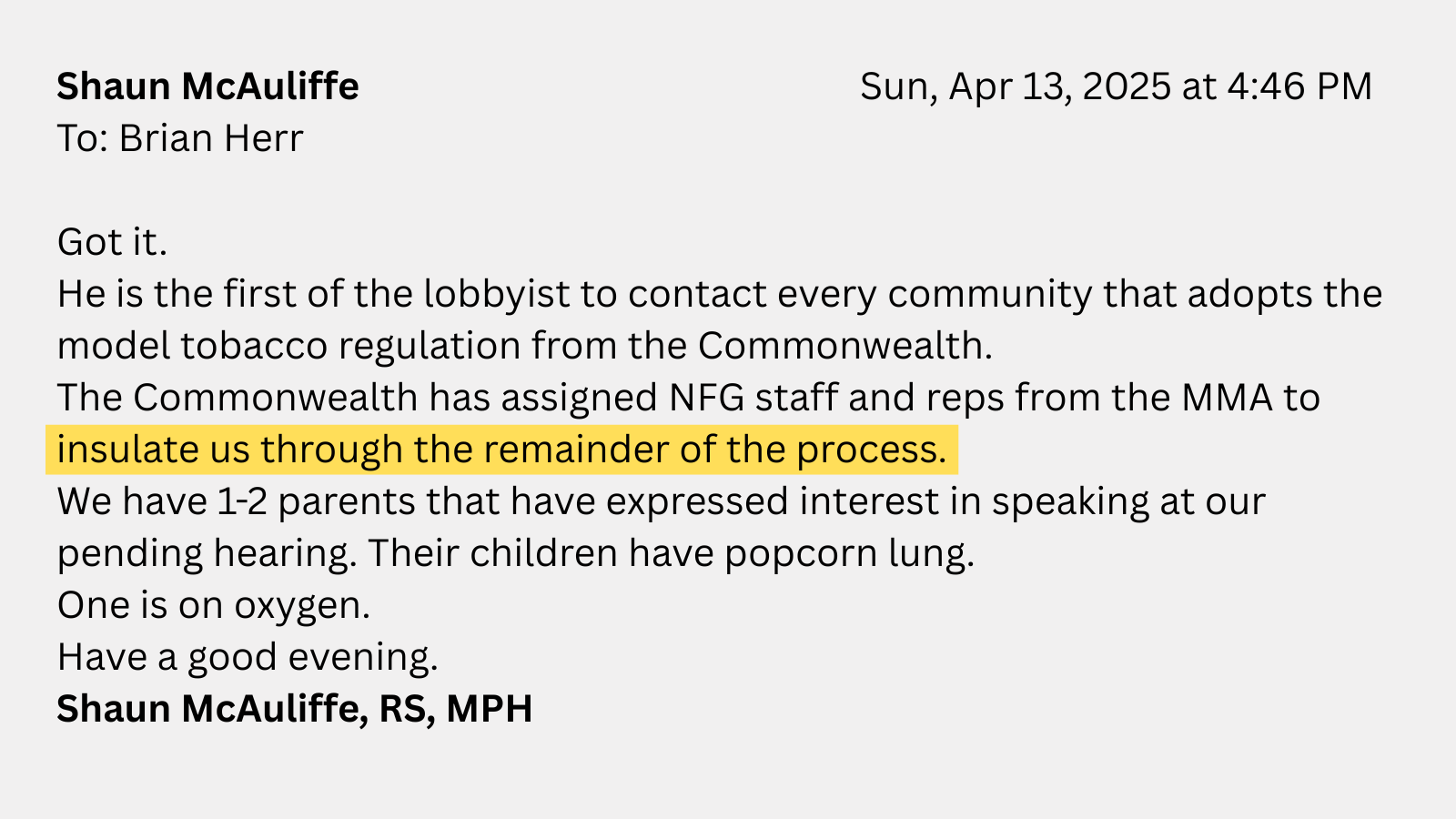
McAuliffe described the arrangement in an email to the town’s Select Board chair: “The Commonwealth has assigned NFG staff and reps from the [Massachusetts Municipal Association] to insulate us through the remainder of the process.”
Buzby was explicit about MTCP’s interest in NFG, writing to the town of Mansfield’s health director: “MTCP has asked all of us Tobacco Program Managers to let them know when new tobacco policies get passed.”
The grant report for the Six City Tobacco Initiative, which is entirely funded by the Massachusetts Department of Health, recorded Somerville’s adoption of NFG in March 2025 as “another win.” The use of such language in a grant report to a state health department suggests that this is an active policy being pursued with no public mandate.
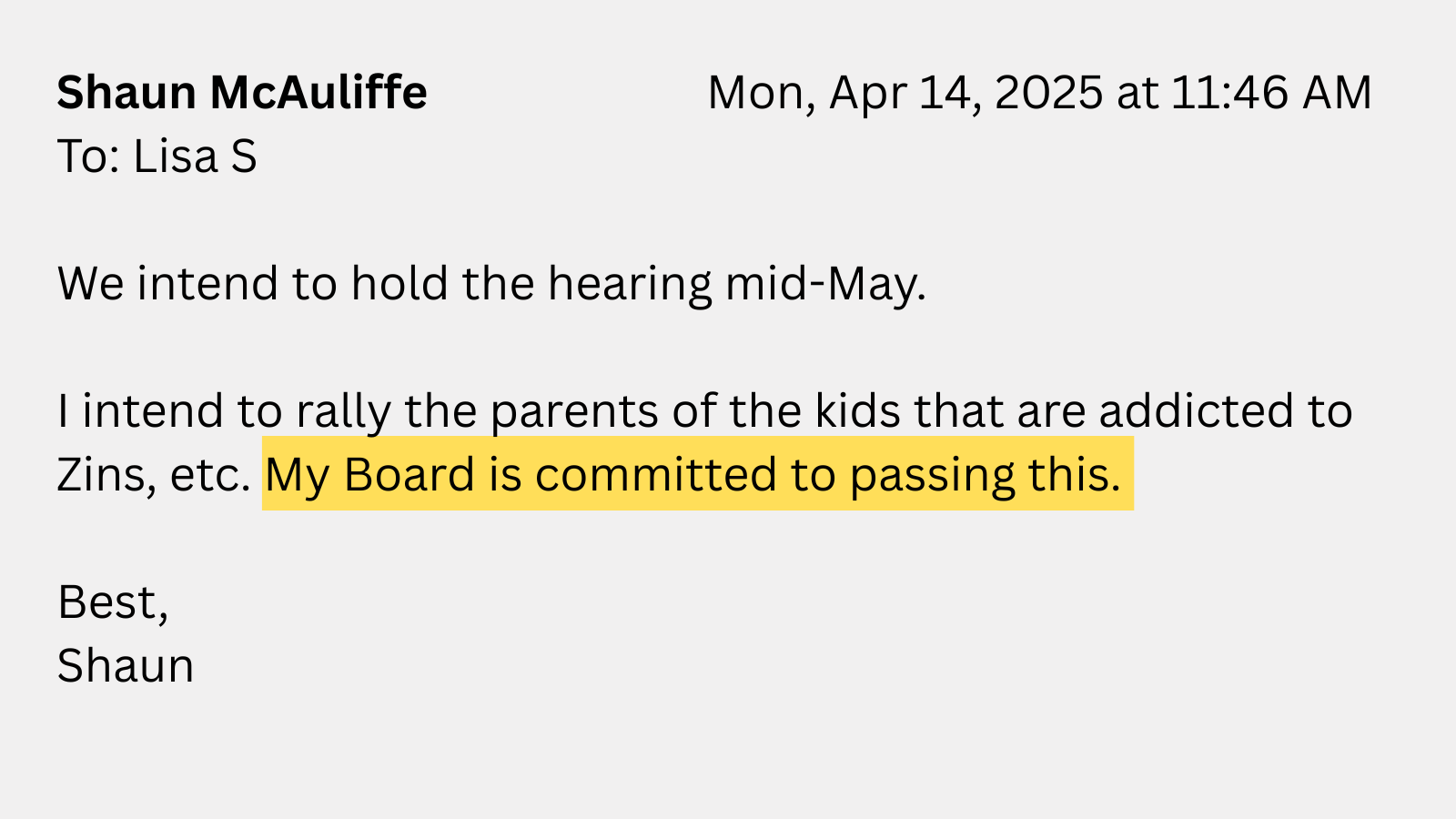
On April 14, 2025, McAuliffe wrote to Lisa Stevens-Goodnight of the Massachusetts Municipal Association: “We intend to hold the hearing mid-May. I intend to rally the parents of the kids that are addicted to Zins [sic], etc. My Board is committed to passing this.”
In Milton, the health director urged the board to adopt the ban before a single resident had spoken. The hearing was gavelled in and out in 14 minutes. Three witnesses who testified were pro-NFG campaigners who had appeared at hearings in other towns. No opposition testimony was recorded. The board voted unanimously.
Somerville’s board passed a ban a month before the public hearing. A pre-written hearing script used in Amherst said: “Board members only need to listen to the public testimony. No [Board of Health] member will comment or ask any questions.”
In Belchertown, Public Health Director Andrea Crete initiated contact with advocacy organizations, solicited template letters of support, and coordinated external experts. Letters sent to the board were drafted by outside parties, vetted by Crete, and then put before the board as if they were spontaneous expressions of local support. One federally funded Drug-Free Communities program director asked Crete to review her draft letter: “Let me know if there is anything specific you would like me to add.”
There were about 1,000 emails in opposition. Yet the Belchertown Board voted 4-0-1 in favor of NFG.
One member who voted in favor, Ken Elstein, had spent the preceding weeks helping the outside advocates shape the regulation he would approve. In an email chain that October and November, under the subject line “Belchertown TFG comments,” Elstein traded edits on the draft language with the Public Health Advocacy Institute‘s Mark Gottlieb, Kate Silbaugh of Boston University’s law school, and Anthony Ishak of Massachusetts General Hospital, with Gottlieb supplying a detailed legal analysis in return. Elstein relayed another member’s private doubts about the measure to the same advocates, and he took in the Public Health Advocacy Institute’s legal read on it before a single resident had the chance to see it, let alone object.
Six weeks later, Elstein made each of the three motions to adopt the regulation. By 1:40 a.m., not seven hours after the gavel, a finished press release was already going around to Elstein and his collaborators, with instructions to “get ahead of the story.”
The emails reveal how officials understood their own role. When an opponent emailed the Hopkinton Board of Health, McAuliffe forwarded the message not to the board members he is supposed to serve but to Buzby. His response: “I’m going to line up as many parents that have addicted kids that I can. Game on.” Buzby coached him on credibility: “Youth are the most important voices. As well as local residents. We get chastised regularly for being ‘outsiders.'”
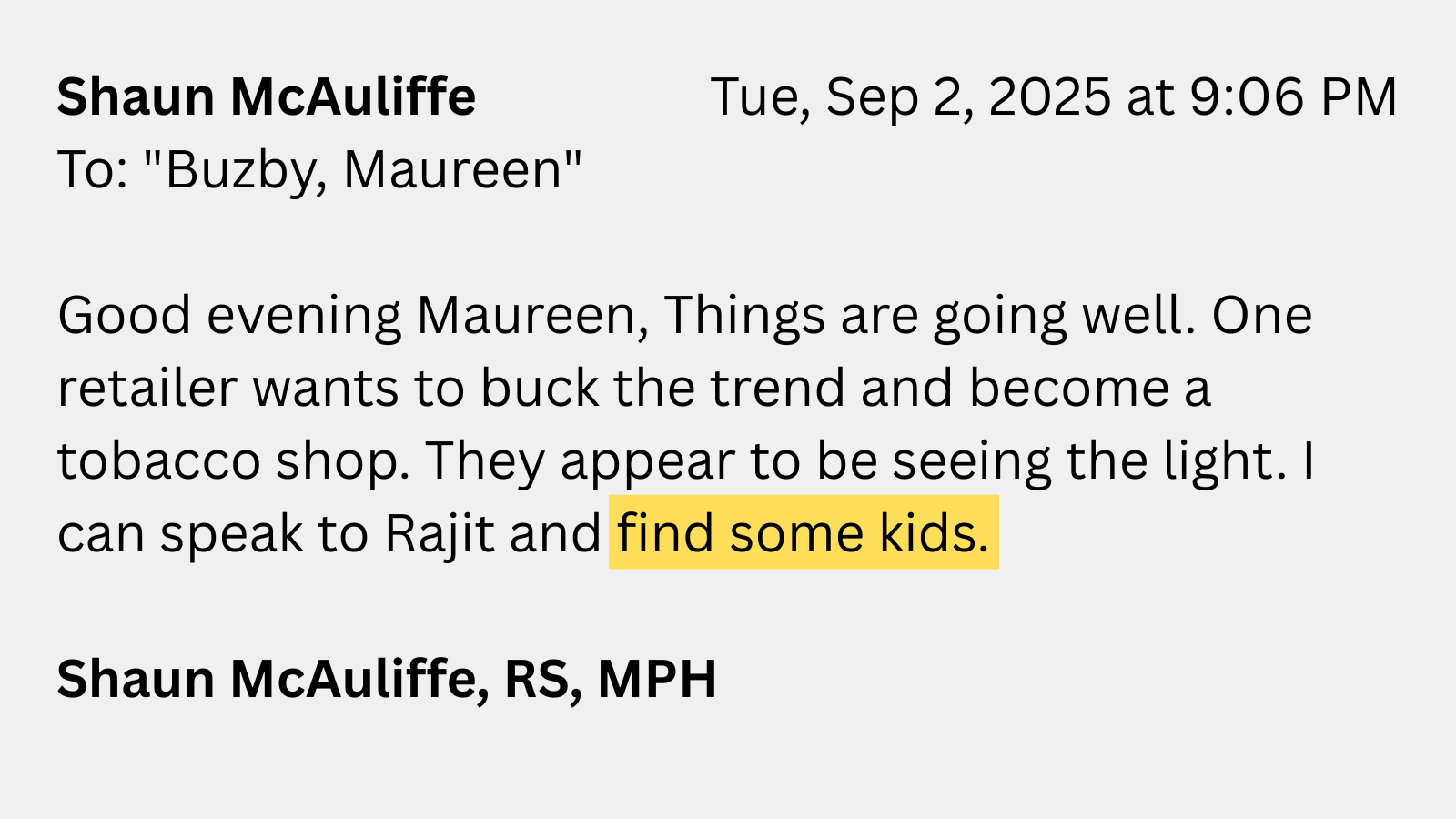
Town employee Erin Bartolini, a Drug-Free Communities coalition coordinator who used her government email, maintained a catalog of template testimony for different audiences and distributed it to young people, encouraging them to recruit friends and parents. After Hopkinton adopted a generational tobacco ban, the apparatus was redeployed to the neighboring town of Ashland. McAuliffe emailed Buzby: “I can speak to Rajit and find some kids.” He then contacted other town departments: “Do we still have a joint program with Ashland where we could recruit from?” A colleague asked: “For what?” McAuliffe replied: “Support NFG for Ashland.”
The director of Hopkinton Youth & Family Services suggested sending “Emily our young intern” who “wanted to speak at Hopkinton and lost out on time.”
To be clear, it is already illegal for children to buy any kind of tobacco product in Massachusetts. And if they don’t want to use nicotine after they turn 21, they do, in fact, have the option not to use it. Instead, they are dragooned into supporting legislation to ban their future selves and peers from having the choice in the first place.
In Manchester-by-the-Sea, after the health board adopted a generational tobacco ban by a 3–1 vote in October 2024, residents successfully petitioned for a nonbinding warrant article to be placed before a town meeting. Opponents of the tobacco ban won the vote, 81–76, at the April 2025 town meeting. The board’s response was to keep their NFG policy anyway. Health Director Wendy Hansbury reframed the loss, arguing the vote was “so close” that the board was “justified saying that you side with the ½ that want to protect youth.”
In Ashland, the Health Board resisted. Chair Ed Burman said, “the Board discussed at length and felt 5 Board Members shouldn’t make this decision for the whole Town.” According to the minutes of a November 2025 meeting, board member David Kinsman said, “He would like to live in a world where nobody uses tobacco products. However, there are a lot of things in the world that he wishes didn’t exist and believes that NFG goes too far…mentioned Covid and the public belief that government went too far during the pandemic. Doesn’t want to erode that trust any further and tell adults what they can and can’t do.”
These responses appear to have baffled NFG campaigners. Stephanie Patton, a prevention coordinator in Stoughton, emailed Buzby: “Do you have any intel into why the [Board of Health] in Ashland went the way that they did?”
The Public Health Advocacy Institute is the leading pressure group pushing generational tobacco bans. The institute reported total revenue of $741,000 in fiscal year 2022; the following year, that figure soared to $21.2 million. Whatever the source of that sudden increase, public or private, it’s an eye-popping amount of money for a small policy shop offering free legal defense to municipalities that adopt NFG.
The Massachusetts Health Officers Association and the Massachusetts Association of Health Boards together reported millions more in government grants, with the latter group’s senior staff attorney supplying draft NFG regulations to towns. These taxpayer-funded associations turned into distribution channels for a campaign nobody voted for.
Why do NFG advocates target boards of health rather than the state legislature or Congress? It’s because local health boards have a low profile and are rarely scrutinized. They consist of three to five members who, by self-selection and the very nature of the office they hold, are more likely to prize longevity above all other values. More strategically, littering the state with localities that have NFG policies gives advocates ammunition to demand that the legislature adopt tobacco bans statewide.
Elstein, the same Belchertown board member, said as much at a Northampton presentation: “The more localities that pass this policy, the pressure it puts on the state to pass a statewide NFG bill.”
This reveals an irony. For decades, tobacco control organizations have opposed measures that would give state legislatures exclusive power to regulate tobacco, arguing that local action serves as a laboratory for policy innovation. But the FOIA record shows the commitment to local democracy is threadbare. When enough municipalities adopt the same regulation, the advocates pivot to the state legislature and argue for statewide adoption, citing regulatory coherence. This is precisely the argument for preemption that the tobacco control movement has spent decades opposing.
The process is already in motion. Emily Reynolds, at the time a staffer in Massachusetts state Sen. Jason Lewis’s office, kept Buzby and the Public Health Advocacy Institute abreast of developments regarding state-level NFG legislative hearings. “I am forwarding the public hearing notice for the tobacco free generation legislation….Please forward this on to any advocates that you think would be interested,” Reynolds wrote in an email in July 2025.
Youth nicotine use is at a 25-year low, and fewer than 2 percent of kids smoke cigarettes. The war on youth nicotine use has been fought and won. Nicotine-free generation bans are about restricting tomorrow’s adults, not today’s kids. It’s not unreasonable to imagine that if NFG advocates get their way, age-graded prohibition could be applied to a host of other products and activities that adults enjoy but run afoul of the preferences of public health officials.
[ad_2]
Source link
