
[ad_1]
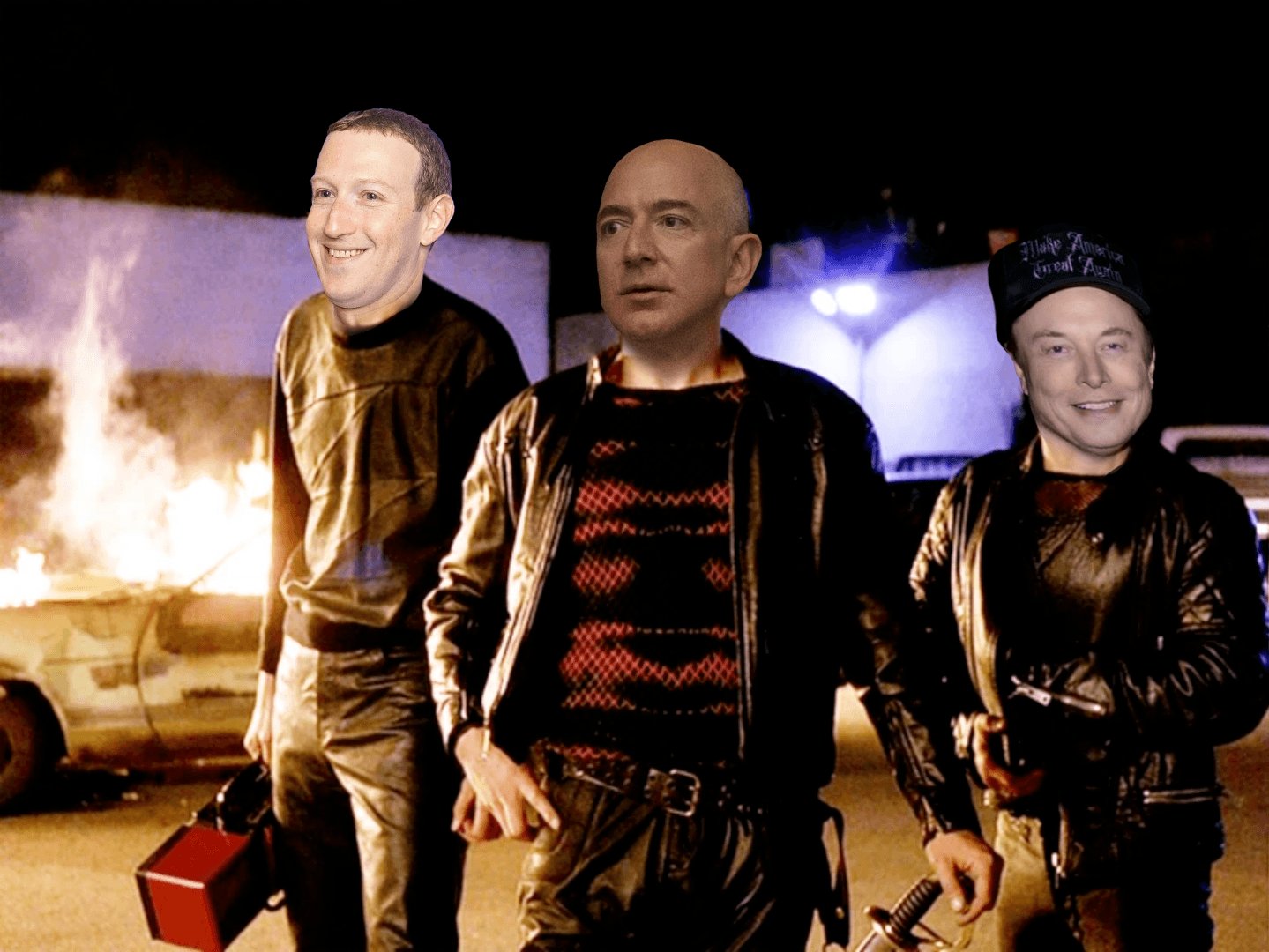
Crude photoshop work done by Nathaniel St. Clair. Image Sources: Screenshot from The Big Lebowski. Photograph of Zuckerberg by Xavier Lejeune. Photograph of Bezos by Senior Master Sgt. Adrian Cadiz. Photograph of Musk from Office of Speaker Mike Johnson.
Life is strange.
If you’d told me fifteen years ago that, as part of covering DC politics, I’d be reading books about space, I’d have told you to take a hike. But when Jeff Bezos bought the Washington Post, he set a chain of events in motion.
I remember the day the Washington Post’s sale was announced. It was August 2013 and I was with my friend Tony Norman at our regular falafel haunt on U Street when I got an alert on my phone saying Bezos had just bought the Post for $250 million. “What?” Tony said when I broke the news to him. I read it again, not believing the words either. The Graham family, which had owned the Post for decades, wasn’t known to be looking to sell its prized possession. But now they had.
And in that instant, Bezos was transformed from the billionaire founder of Amazon, into the savior of the Post, if not the entire failing media industry. I read these hot takes with steam coming out of my ears. As the child of parents who owned our local newspaper, I was keenly aware of Amazon’s role in destroying newspapers across the country — namely by bankrupting local business, which are the lifeblood of any local paper (and community). The man who may be responsible for destroying more newspapers than anyone on earth was definitely not a savior of the free press.
That much I knew. But there was a lot about Bezos that I didn’t know. And now that he owned the Post, then the all-important newspaper for local DC politics, it was time to start reading up on the man.
The first book I cracked was The Everything Store, Brad Stone’s revelatory 2013 biography of Bezos. Eight years later, Stone followed that up with Amazon Unbound, another invaluable work. More recently, I devoured Wall Street Journal reporter Dana Mattioli’s excellent 2024 book The Everything War. These books laid bare Bezos’ business practices, a good number of which are illegal, or would be if we enforced antitrust laws in this country.
But there’s another aspect to Bezos that these books didn’t quite capture — namely how he’s lost touch with reality.
Bezos truly believes that he’s going to save humanity via an intergalactic bank shot. He’s perfectly open about this, and always has been. As I wrote in a story at Truthdig last year:
Jeff Bezos has long believed that he can save humanity, but only by placing earth’s heavy industries on the moon, then shipping manufactured products back to earth, and leaving the pollution behind.
“The earth is finite,” a teenaged Bezos told his local newspaper, “and if the world economy and population is to keep expanding, space is the only way to go.”
“I still believe that,” Bezos said four decades later, while doing his best Steve Jobs impersonation on a darkened stage at the DC Convention Center, with a captive audience of students looking on.
With population and energy use growing exponentially, we’re on a “bad path” that leads to “rationing,” Bezos explained. But not to worry! With all the fervor of a snake oil salesman, Bezos continued: “The good news is that if we move out into the solar system, for all practical purposes we have unlimited resources. So we get to choose: do we want stasis and rationing? Or do we want dynamism and growth? This is an easy choice.”
“We can have a trillion humans in the solar system,” Bezos said in his 2019 presentation. “Which means we’d have a thousand Mozarts and a thousand Einsteins. This would be an incredible civilization.”
I don’t begrudge Bezos a rich fantasy life. But this isn’t fantasy for him, it’s very real. It’s also very convenient.
Bezos’ curious beliefs happen to align perfectly with his business interests (like AI), which trash the planet. (Job well done on that front; as I write these words, Canada’s forests are burning with such ferocity that it’s unpleasant to breathe a thousand miles away in the DC region.) By pretending we’re oh-so close to finding a miracle space solution for our ills, it obviates the need to rein in polluters like Amazon, or address other earthly injustices — it gives tech bros a free pass for their earthly sins.
“This is painfully apparent in the way Jeff Bezos talks about geniuses of the future,” science journalist Adam Becker wrote in his incisive 2025 book More Everything Forever.
He dreams of one thousand Mozarts and one thousand Einsteins among his trillion humans living in space. But he’s neglecting the potential Einsteins and Mozarts that are living and dying in poverty right now. If Bezos really wants a dynamic civilization, he could invest in solving the problems that we actually face. He could tackle the enormous levels of wealth inequality in the world today. He could put all his resources into fighting global warming, which will also have unequal impacts around the world. Instead, he’s going to space — and he thinks that’s the best and most important thing he can do with his money.
This worldview comes down to “Don’t look at the horrifying labor conditions at the local Amazon fulfillment center,” writes Becker. “Look at the shiny rocket instead. Ignore the problems of this world. Everything will be better in space.”
This belief system — let’s call it “the grass is always greener on the other side of the galaxy” — not only benefits Bezos, but other tech oligarchs, too. So it should come as no surprise that they’re also hopped up on some variation of this self-serving ideology.
One central aspect of this thinking is something ironically called “effective altruism.” One might look at those two words and wonder what exactly the problem is. Altruism is a good thing. And if it’s effective all the better. But somehow the resulting worldview embodies the opposite of these words’ meaning.
I grew up in the “greed is good” eighties and nineties in Westchester County, New York. While I found that worldview debased, at least it acknowledged its unbridled selfishness. What effective altruism manages to do — all under the guise of selflessness — is elevate greed from good to practically godly.
Under this ethical rubric, particularly the “longtermism” strain of it, tech bros needn’t fret over aiding the needy of today, because their brilliance will do infinitely more good by elevating the lives of billions or even trillions of future humans.
“Future people count. There could be a lot of them. We can make their lives go better,” William MacAskill, co-founder of the effective altruism movement, wrote in his 2022 book What We Owe the Future. “Distance in time is like distance in space. People matter even if they live thousands of miles away. Likewise, they matter even if they live thousands of years hence.” (MacAskill’s book was awkwardly published just as the leading proponent of effective altruism, MacAskill’s friend and patron Sam Bankman-Fried, was charged with running a crypto Ponzi scheme; he’s now serving a 25-year prison sentence.)
It’s easy to see why tech billionaires love effective altruism. They’re ignoring today’s downtrodden not out of sinful greed, but to heed a higher, god-like calling. And devoting their unprecedented wealth to whatever strikes their fancy — often shooting phallic rockets into space — only demonstrates their munificence to future generations.
“These ideas offer transcendence,” writes Becker, “allowing adherents to feel they can safely ignore all limitations. Go to space, and you can ignore scarcity of resources, not to mention legal restrictions.”
When Bezos bought the Post in 2013, I suspected things would change, and not for the better. But I had no idea the journey would veer into space, where tech billionaires go to make greed godly.
Reading Becker’s book, a quote from the late inimitable Texas columnist Molly Ivins came to mind. After dining with her state’s oil tycoons at the Midland Petroleum Club, she came away thinking, “Goddamn, those are nice people. I’m sure glad they’re not running the world.”
Today’s tech billionaires are running the world, and increasingly space too. And they’re using promises of the latter to strengthen their grip on the former, all in the name of serving humanity.
[ad_2]
Source link
