
[ad_1]
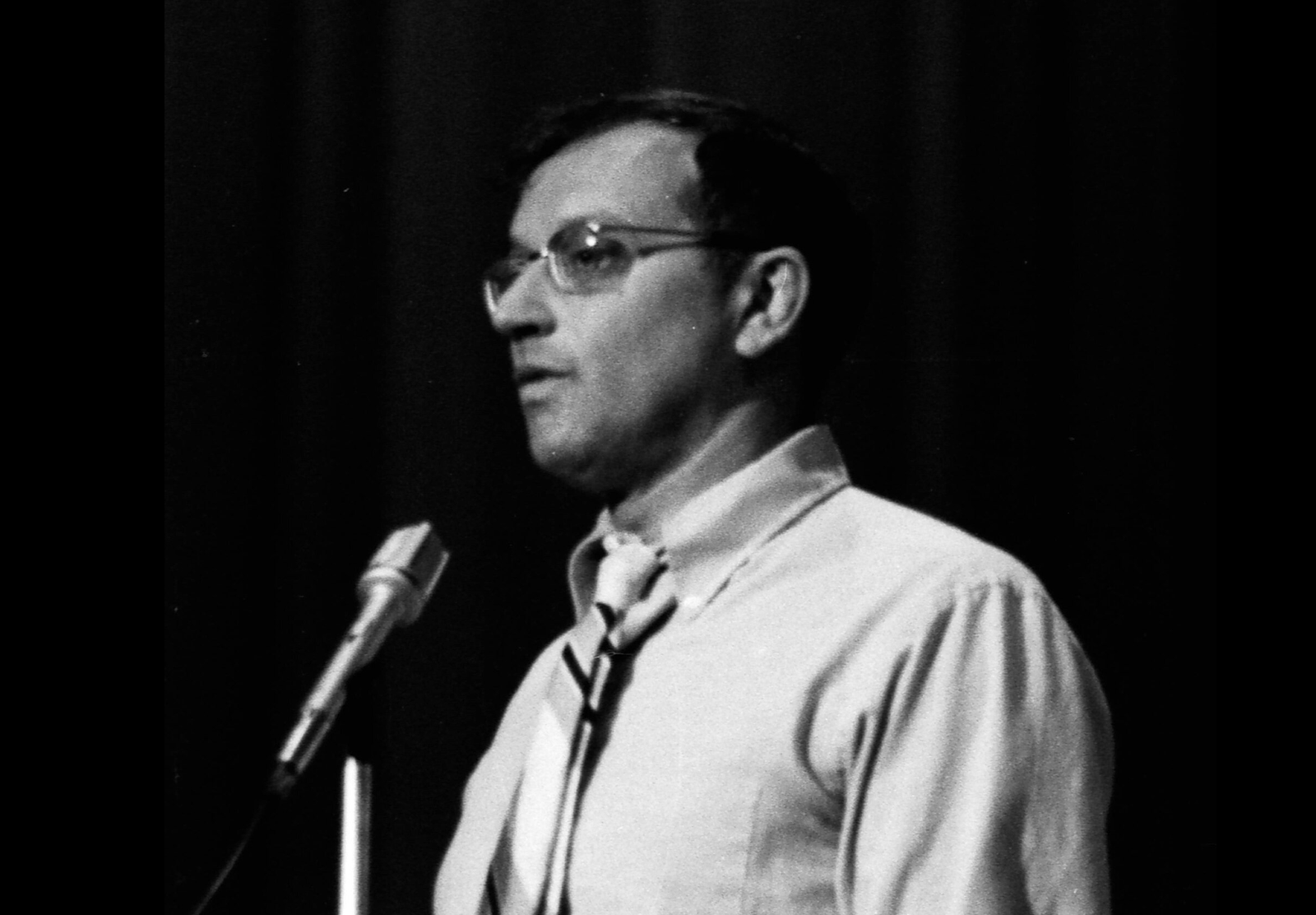
Allard Lowenstein at congressional race fundraiser, August 29, 1976 – Public Domain
Few people would associate Allard Lowenstein with Roy Cohn. Lowenstein tried to influence politics while avoiding the problems of dirty hands. Cohn was the ultimate insider, one who gloried in all the underhanded tricks that soil politics, “the master of situational immorality,” and the man who taught Donald Trump how braggadocio and underhandedness were the secrets to success. And yet they both had something in common: they both attended the Horace Mann School in New York City, my alma mater.
I have often thought of them as two sides of the American coin. Lowenstein represented one tradition: public service and a belief that politics could be used in the service of a larger common good. Cohn represented self-interest, power, and the conviction that politics was ultimately a struggle in which winning mattered more than the rules by which one played.
Roy Cohn graduated from Horace Mann in 1944, Lowenstein in 1945. The Class of 1944 had only 78 students, about the same number as the Class of 1945. For at least a brief period, they were walking the same corridors, taught by many of the same teachers, and shaped by the same intellectual world.
That coincidence has always fascinated me. How could the two have emerged from the same milieu to represent such different visions of America?
Lowenstein and Cohn weren’t just two distinct personalities; they were products of different currents in postwar America. Lowenstein belonged to the world of civil rights, liberal internationalism, antiwar politics, and reform. Cohn belonged to the world of anti-Communism, McCarthyism, New York City power politics, the man-about-town of the gossip columns, and eventually the politics of personal influence.
Lowenstein and Cohn can be seen as opposing poles of the American character: the aspiration toward something larger than oneself versus the relentless pursuit of the self; the belief in politics as a means of serving others as opposed to the belief in politics as a means of acquiring and exercising power.
Lowenstein’s life was firmly grounded in the liberal politics of his time. “In a sense, the theme of his [Al’s] life was, Let Right be Done,” wrote Douglas Hunt after his death. President of the National Student Association, aide to Hubert Humphrey and Robert Kennedy, participant in the Mississippi Freedom Summer, leader of the “Dump Johnson” movement, briefly a member of Congress, and later a leader of the anti-Vietnam War “Dump Nixon” movement, Lowenstein repeatedly put his political talents at the service of causes larger than himself. Jimmy Carter appointed him to the United Nations Commission on Human Rights.
Cohn was the other side of the coin, the underside of the postwar euphoria. He has recently become a figure of renewed interest as journalists continue to investigate Trump’s rise and his early mentors. (See “How Roy Cohn taught Donald Trump everything” by Kai Bird and Susan Goldmark in the August 3, 2026, New Yorker as well as their book about Cohn, American Scoundrel.)
There are three parts to Cohn’s career: Cohn the anti-Communist prosecutor; Cohn the power broker and fixer; and Cohn as a precursor to the world of Trump’s politics. In the first phase of his career, he was involved in the prosecution of Julius and Ethel Rosenberg in 1951 as part of the anti-Communist Red Scare after World War II. He was chief prosecutor in the Army-McCarthy hearings, working closely with F.B.I. Director J. Edgar Hoover in investigating supposed Communist influence in the U.S. Army. (Joseph Welch’s famous “Have you no shame, sir,” to Senator McCarthy might well have been directed at Roy Cohn.)
During much of his later career, Cohn was known as a fixer for people like Donald Trump. “Cohn taught him [Trump] that the pyrotechnics of publicity were more important than the law. What counted was controlling the narrative,” Bird and Goldmark wrote in The New Yorker. Cohn was disbarred by a New York appellate court in 1986 for professional misconduct involving dishonesty, fraud, deceit, and misrepresentation.
What survives as Cohn’s legacy is his mentoring of people like Trump. Sam Roberts, quoted in The New Yorker article, called Cohn “a master of situational immorality.” “He had rules about how to exercise power. . . . You would always try to goad your enemies into being the worst they possibly could be and then turn that against them, so that Roy Cohn would actually look like the good guy, which he virtually never was.”
Despite the differences, there were similarities between the two men. Both were ambitious. Both were highly intelligent. Both understood institutions. Both were convinced that individuals could alter history. Both were willing to fight. Both had strong egos. Each was, in his own way, intensely political; each believed in the power of individuals to shape events.
The difference between them may have been what they believed those qualities could be used for. Lowenstein was no naïve idealist. He understood politics, worked within institutions, organized campaigns, challenged powerful men, and served in Congress. But for him power was a means: a way of advancing causes and ideals beyond himself. Cohn understood political reality equally well, perhaps better. But his concept of power was very different. For Cohn, power was not restrained by an overriding conception of the common good. It was something to acquire, exercise, and use to win.
In that sense, the contrast between them was not simply idealism versus realism. Both were political realists in the sense that they understood how power worked. The deeper difference was what that power was for.
Are there really two poles in America’s character? Neither Lowenstein nor Cohn was as absolute as I have portrayed them, although I do believe Cohn was much more than just a “scoundrel.” What is noteworthy is how Lowenstein’s idealistic liberalism has faded from the current radar screen while Cohn’s version of realism has burst front and center.
What happens to a political culture when power increasingly becomes an end in itself rather than a means to some conception of the common good? The motto of the Horace Mann School is “Magna est veritas et prævalet,” “Great is the truth, and it prevails.” The same school whose motto invokes truth produced two men whose approaches to truth, power, and political life could hardly have been more different.
[ad_2]
Source link
