
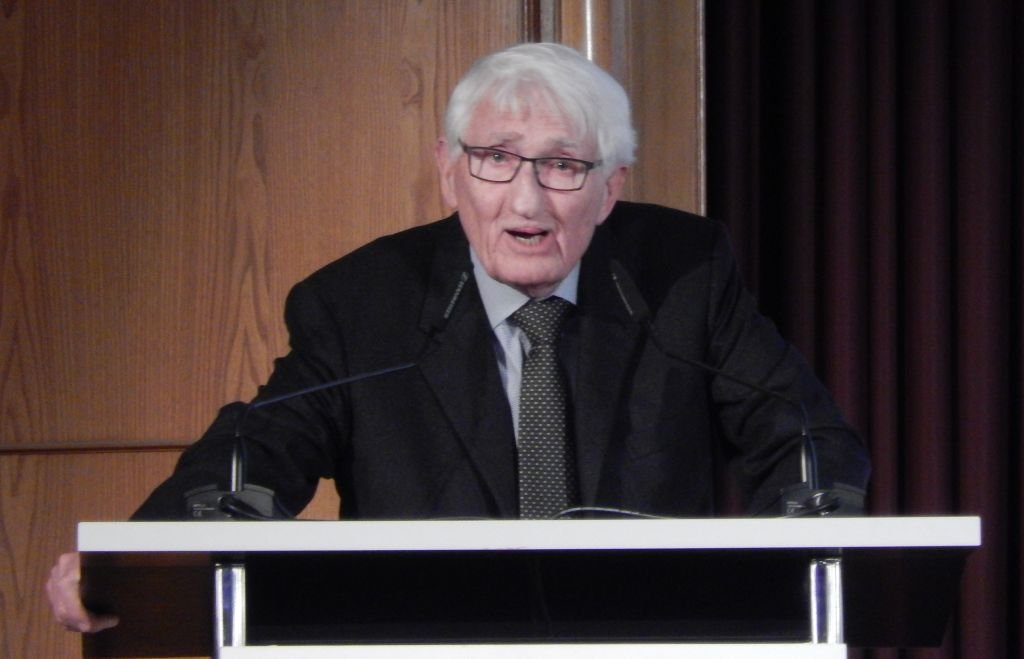
The German social philosopher Jürgen Habemas, who AI assures us is “one of the most significant thinkers of the 20th and 21st centuries,” died in Starnberg in southern Germany on March 14, 2026, at the age of 96. Habermas’s working life spanned more than seventy years and from 1956, when he became the assistant of Theodor Adorno at the University of Frankfurt through his academic career at Frankfurt and Heidelberg, Habermas was closely associated with the Frankfurt School for Social Research. Indeed, this prolific social critic stood out as the most famous representative of that movement’s second generation.
Given Habermas’s remarkably long life, it may be fitting to separate stages in his life and career, from his birth in Düsseldorf through his brief membership in the Hitlerjugend to his academic studies in Göttingen, Bonn, and Zürich, to the construction of his theories of communicative action, the “public sphere, and “domination-free discourse,” and finally, to his later years as a public intellectual and vigorous defender of “militant democracy” (Streitbare Demokratie).
It’s not at all clear that the Habermas who spent the last 30 years of his life as a harsh critic of the German past and as a leading antifascist publicist planned this career from the outset. The dissertation he submitted at Bonn in 1954, on the dialectic of freedom and necessity in the historical thought of the German philosopher F.W.J. Schelling, pointed in other directions. There was nothing in this work (having read it, I can speak with authority) that gives signs of Habermas’s later social radicalism and revulsion for a German nation. Moreover, the evidence in his earliest writing on the existential thought of Martin Heidegger suggests that Habermas was still willing to borrow phrases and concepts from a thinker clearly associated with the right.
But by the time Habermas submitted his Habilitationsschrift (a second dissertation permitting a German graduate student to assume a professorship) at Marburg in 1961, his commitments had changed. His second dissertation was a plea for German “social democratization” and an undeniable nod toward the social engineering left. In Structural Transformation of the Public Sphere, which was directed by his Marxist Doktorvater, Wolfgang Abendroth, Habermas advocates further government efforts at shaping or reshaping German public consciousness. This famous dissertation, which was later turned into a book and translated into many languages, marks Habermas’s entry as an advocate of massive social engineering for his countrymen.
Although Habermas acknowledged the “transformation” of an overseen democratized Germany, beginning with postwar attempts to “reeducate” his still-reactionary countrymen, he believed this transformative work had not gone far enough. Even more government intervention, he explained, was needed to safeguard democracy in a society that had long suffered under authoritarian rule.
Curiously, Habermas’s earlier attempt at carrying out his academic work under the Frankfurt School cofounder Max Horkheimer failed for an obvious reason. Horkheimer had become critical of the reeducation program (Umerziehung) begun by the occupying powers after the Second World War and accused Habermas of excessive sympathy for the East German communist regime and its “vulgar Marxist” indoctrination. The Frankfurt School was itself split, and, unlike his colleague Theodor Adorno, Horkheimer would take a stand against both the rising German New Left and the force-feeding of a manufactured “democratic ideology.” Habermas would conditionally reject the former but became Germany’s most celebrated proponent of the latter.
The German philosopher Till Kinzel reads a great deal of the future Habermas into Structural Transformation. That work includes evidence of Habermas’s later argument that, if we wish to “dissolve human domination,” then we must devise forms of communication and discussion that will advance that goal. Those who guide our democracy must provide “gentle nudges” that push public opinion in the desired ideological direction.
Although Habermas later became identified with the concept of “herrschaftsfreier Diskurs,” that is, a form of communication in which only rationality apparently counts, one may question how consistently he ever took that position. His model for structuring permissible communications (das kommunikatives Handeln) operated as a supposedly culturally neutral framework, but acceptable discourse for Habermas depended not only on what he regarded as rational, but also on what he thought was compatible with his concept of democracy.
Habermas’s proceduralism, understood as requiring rules for “rational” communication in which all participants can seek consensus, was presented as a substitute for the religious or metaphysical framework characteristic of pre-democratic discourse. It’s easy to see how proceduralist communication was elevated in his thought to an anti-metaphysical metaphysics. His proceduralist approach to “open discussion” was presented as a precondition for politically and morally true communicative exchanges and was supposed to help advance democratic communal life.
In 1986 Habermas recharged his career as a public intellectual by leading the assault on those who were trying to “recontextualize” and thereby “trivialize” the Nazi catastrophe. In what came to be called the “Historikerstreit” (conflict among historians) but which was popularly known as the “Habermas-Kontroverse,” the then-famous social thinker fired verbal cannonades against distinguished professional historians Ernst Nolte, Michael Stürmer, and Andres Hillgruber for allegedly undermining German democracy.
These historians, not all of whom were on the right, examined the accession to power by the Nazis and subsequent Nazi crimes by examining political affairs in a wider European context. They focused on the prolonged interwar struggle between fascism and communism and the historical antagonism between Germany and Soviet Russia in trying to understand the Nazis’ animus toward those they perceived as enemies. Although this “revisionist” history did not in any way deny Nazi crimes, for Habermas and the leftist German weekly Spiegel, these “pro-Nazi” historians were doing something morally unthinkable, that is, denying the special onus of guilt attached to all future German generations for the crimes of the Third Reich.
As part of his role as the stirrer of Germany’s guilty conscience, Habermas also accompanied the Germany tour of the American historian Daniel Goldhagen in 1996. At that time, Habermas loudly seconded Goldhagen’s dubious thesis that most Germans suffered from “eliminationist antisemitism” and enthusiastically joined in Hitler’s extermination of German Jewry.
Upon returning home Goldhagen would expand his recriminations with a book on the Catholic Church’s complicity in the Holocaust and the emergence of Christian antisemitism in the New Testament. But Habermas by then had launched new crusades against his countrymen’s real and imaginary misdeeds. He took on German historians who argued that Germany and Austria were not entirely responsible for the outbreak of the First World War. Germany’s most celebrated moralist weighed into that discussion but certainly not as a trained historian.
Subscribe Today
Get daily emails in your inbox
It is also noteworthy that Habermas took critical positions against both German “neoconservatism,” by which he meant the indifference of some Germans to his calls for fighting the right, and French postmodernism. Each of these targets was accused of avoiding the kind of moral discourse that Habermas thought appropriate for what he defined as “our democracy.” As Kinzel observes in a detailed obituary in the conservative German weekly Junge Freiheit, Habermas was notably silent when a leftist, antifascist regime stripped Germans of their civil rights during the Covid lockdowns. In this respect, however, he was no different from progressive intellectuals elsewhere in the West, many of whom are now celebrating Habermas’s achievements.
Given my critical comments, it might seem surprising that I agree with AI’s heady praise of Habermas. He was indeed one of the major thinkers of the last 120 years if we view him as somebody who perfectly embodied and promoted the spirit of his times. He was the philosopher of the therapeutic managerial state, about which I have written widely, just as Hegel became the court philosopher of the 19th-century Prussian monarchy, or Aquinas the authoritative medieval philosopher. Although Habermas may not have been so deep a thinker as Aquinas or Hegel, he was as important a figure for our time as earlier thinkers were for theirs. Early in his career he made a fateful, advantageous turn toward the left, and specifically toward what became the successful antifascist left that is still in vogue.
Habermas declined to cheer on the Red Brigades and other violent insurrectionists of the left when Adorno was still feeding their egos. He also didn’t throw in his lot with the principled defender of freedom Horkheimer, who, as it turned out, was not holding a winning hand. Finally, Habermas decided against becoming a conventional intellectual historian, which judging by his dissertation on Schelling he might have done with distinction. Instead, he picked what became the eventually triumphant court party, the left, and won fame as its authorized philosopher. The fulsome tributes that his death evoked testify to the fact that we are still living in Habermas’s age.
