
[ad_1]
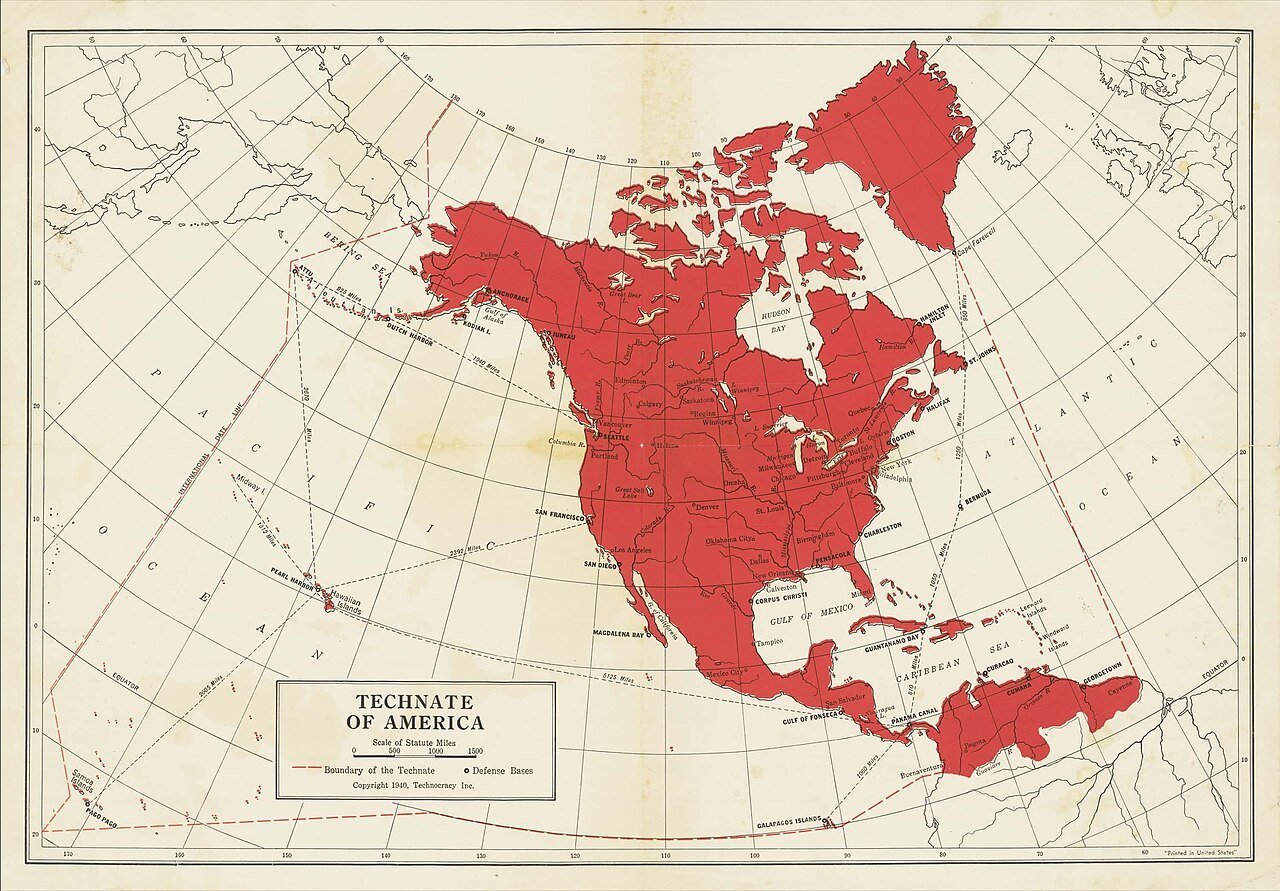
Image Source: Technocracy, Inc. – Public Domain
Just over a month has passed since the first missiles of Operation Epic Fury killed, on the very first day, Supreme Leader Ali Khamenei, 150 schoolgirls and school staff, and most of Iran’s military (40) and political leadership and days since a precarious ceasefire went into effect. The attacks have not only destroyed vital infrastructure in the Middle East, particularly in Iran, but have also completely shattered hopes for coordination and the common defense of sovereignty in Latin America and the Caribbean.
What until just over a decade ago was envisioned as a group of nations capable of defining or negotiating minimum parameters to preserve autonomy in their international relations policy is now in shambles. The guiding principles that successfully steered regional cooperation in South America, within the framework of UNASUR, and at the regional level in The Community of Latin American and Caribbean States (CELAC), have fallen by the wayside. The region has fractured, and now part of Latin America and the Caribbean have been slated to converge in the formation of a “Greater North America.”
This new Trump administration initiative, framed within the US hemispheric security strategy, stretches from Ecuador to Greenland and encompasses the Caribbean, all of Central America, Mexico, Colombia, Venezuela, and Guyana. It seeks to strengthen Washington’s influence and control over the continent, viewing the Latin American and Caribbean countries it encompasses as key partners.
The Greater North America initiative was announced by Secretary of War Pete Hegseth on the eve of President Trump’s address to the nation in which he stated that they would strike Iran extremely hard over the next two or three weeks until they were driven “back to the Stone Age—where they belong”. Trump claimed the United States had “decimated” the Iranian navy, air force, and communications. In the face of instability in the Middle East, the United States is rapidly seeking to consolidate a continental economic and energy bloc that does not depend on supply chains from other regions.
Goodbye, Global South
The new Greater North America posits that all nations north of the equator are no longer part of the so-called Global South, and that they fall within the zone of direct U.S. defense interest. The aim is to ensure the security of critical resources, maritime routes, and the Panama Canal, with the stated goal of strengthening defense cooperation and controlling drug trafficking routes that directly impact U.S. security.
The Global South is a geopolitical and socioeconomic term, not purely geographical, that encompasses countries in Africa, Latin America, the Caribbean, most of Asia, and Oceania. It represents historically marginalized nations with a colonial past that seek to reform the unequal world order and accounts for nearly 85% of the world’s population. Although most “Global South” nations are in the Southern Hemisphere, the designation also includes Northern countries such as China and India. The term has evolved from signifying “underdevelopment” to representing a multipolar force seeking autonomy and equity in the global economy. It serves as a counterweight to the Global North, which typically refers to developed countries (Europe, the United States, Japan, Canada, Australia). With the Greater North America initiative, the United States has decided that more than a dozen Latin American and Caribbean countries should no longer be part of this forum.
What have the presidents of Mexico, Colombia, and Venezuela said now that the United States has told them they are part of Greater North America? The three governments have opted for strategic silence, without issuing statements to reject or validate Pete Hegseth’s new map. They prefer to ignore a geographical and geopolitical decision that was not consulted on or agreed upon, and that is therefore not worth taking seriously. Brazilian president Lula da Silva, despite being a constant critic of U.S. foreign policy toward the region and a defender of sovereignty and the pursuit of minimal common interests to defend against hegemonic conflicts, has maintained the same position.
The day after Hegseth’s announcement, Venezuela’s interim President, Delcy Rodríguez, expressed her gratitucde and approval of the Trump administration’s decision to remove her from the Office of Foreign Assets Control (OFAC) sanctions list. This removal from the “Clinton List” lifted the financial and trade restrictions that had been in place since 2018, now allowing her to interact freely with U.S. companies and investors. Delcy Rodríguez described the measure as a “step toward the normalization and strengthening of relations” between Venezuela and the United States.
With the Greater North America, Hegseth defines a space he can control effectively and quickly, leaving the Southern Cone as a friendly zone of influence, but outside the core of national security. The governments of Argentina, Brazil, Chile, Paraguay, Peru, Uruguay, and Bolivia, which, due to their geographic location, continue to belong to the Global South, are considered strategic rear-guard partners focused primarily on securing the supply of natural resources. Washington demands that they assume greater responsibility for their own defense so that it can concentrate its resources on the new core of Greater North America and on the conflict in the Middle East. In this way, the United States avoids the responsibility of defending such distant territories, while leaders including the presidents of Argentina, Chile, Paraguay, and Bolivia, operate as external allies under the framework of the Shield of the Americas.
Symphony in three acts
The rollout of the Greater North America plan marks the culmination of a policy of regional domination that began to take shape with the publication of the National Security Strategy on December 4, 2025. This document formalized the so-called “Donroe Doctrine,” which reestablishes Washington’s absolute control over the Western Hemisphere to secure critical resources and curb the influence of rival powers. As a result of this strategy, three major initiatives have taken place:
+ The Conference of the Americas Against Cartels. On March 5, Secretary of War Pete Hegseth hosted the defense ministers of 17 countries at the Southern Command headquarters in Doral. At this meeting, attended by Secretary of State Marco Rubio and advisor Stephen Miller, the groundwork was laid to justify direct military strikes against narco-terrorism on regional soil.
+ The Shield of the Americas Summit. Two days later, on March 7, at the meeting in Doral, Miami, the presidents signed the Doral Charter, which sealed an alliance institutionalizing military cooperation and intelligence sharing.
+ The March 31 Directive. Finally, the formalization of Greater North America closed the circle, fragmenting the continent and burying, for now, the aspirations for autonomy of UNASUR and CELAC. In effect, Greater North America defines a zone of influence in which everything that happens from Greenland to Ecuador is a matter of U.S. internal security. Thus, voluntary cooperation is replaced by the establishment of an integrated security bloc where local sovereignty is subordinated to U.S. security.
Nothing new under the sun
The United States’ insatiable appetite for access to the region’s natural resources is nothing new, and military interventions in the region and around the world have always been driven by oil or some other natural resource. The objectives have never been democracy, freedom, respect for institutions, or any of those values that have served as pretexts.
Recall that U.S. General Laura Richardson, former head of the Southern Command, didn’t mince words, when she referred in January 2023 to the region’s wealth of natural resources and how these constitute a matter of national security for her country in the face of its adversaries, China and Russia. She noted then that “the region was important for all its rich resources and rare earth elements, the lithium triangle in Argentina, Bolivia, and Chile, where 60% of the world’s lithium is concentrated—so necessary for technology.” Shee also said that “we have 31% of the world’s fresh water in this region and the Amazon as the lungs of the world (…) With that inventory, the United States has much left to do.” For this reason, Richardson noted at a conference at the Atlantic Council think tank, the United States must “control the region” at any cost.
What the Trump administration has done is simply speed up the timeline. It will press forward relentlessly amid the scant resistance offered by a largely subdued region, and faced with the resounding failure of its joint warmongering adventure with Israel in Iran, despite the triumphalist rhetoric.
Conclusion
“Greater North America” seeks to name the new playing field where sovereignty is no longer negotiated in diplomatic forums but administered in war rooms. In exchange for a supposed, supervised peace, the region is asked to hand over natural resources and border security. The announcement of this new designation is not a proposal for cooperation, but an order to partition the region.
With the world’s focus on a war that Trump claims to have won, after having a catastrophic global economic impact, the announcement of the new partition of Latin America and the Caribbean has gone largely unnoticed.
Unlike the African Union–which despite differences in language, creeds, history, and origins of its 55 members has managed to establish common positions on climate change, global trade, or a seat in the Group of 20,–the Latin American and Caribbean region has cemented the collapse of CELAC and, with it, its dignity and sovereignty as a region. We have once again become an archipelago of nations competing with one another to see who best pleases the Pentagon.
[ad_2]
Source link
