
[ad_1]
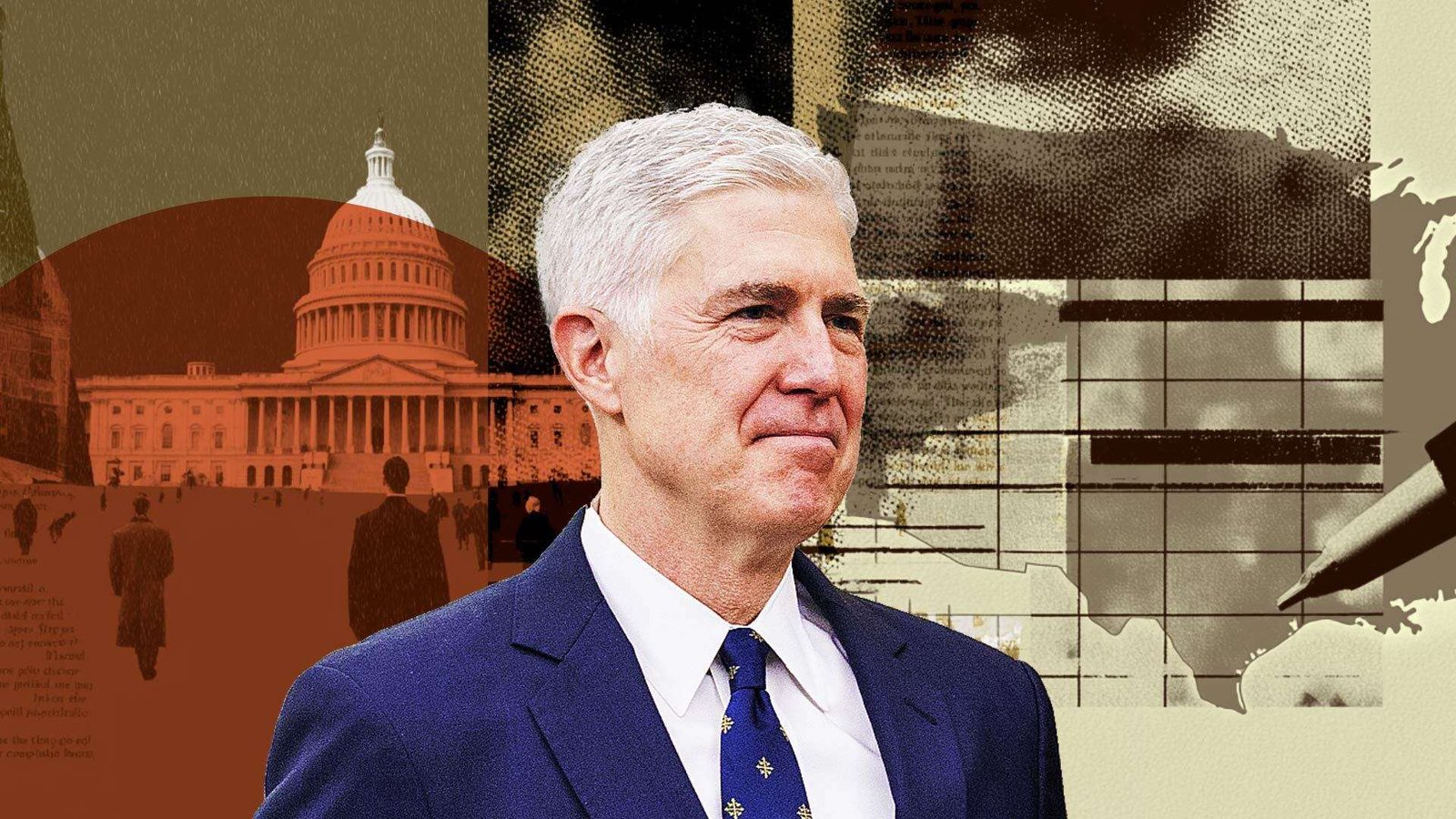
My Reason colleague Nick Gillespie recently sat down with U.S. Supreme Court Justice Neil Gorsuch for a conversation about Gorsuch’s new children’s book, Heroes of 1776: The Story of the Declaration of Independence, coauthored with Janie Nitze, plus other topics more directly tied to Gorsuch’s day job. The whole interview is well worth watching, but I wanted to focus today’s Injustice System newsletter on two points that particularly caught my attention.
You’re reading Injustice System from Damon Root and Reason. Get more of Damon’s commentary on constitutional law and American history.
Americans are increasingly unhappy with the actions of the federal government, including the actions of the Supreme Court, whose own approval ratings have reached a new low.
Is Gorsuch worried about that? He told Gillespie that the Supreme Court is doing exactly what it’s supposed to be doing. He also said that the Court is serving as a kind of role model of respectful and principled adjudication while doing it.
“I think we do pretty darn well,” Gorsuch said, arguing that the Court takes on “the 70 hardest cases in the country” and “we’re unanimous, the nine of us, about 40 percent of the time.” As for the split decisions, he added, “only about half of those are the five-fours or six-threes you’re thinking about,” meaning the cases in which there was a clear divide between conservatives and liberals. “The others are scrambled every which way.”
Gorsuch’s own record helps to illustrate the point. On criminal justice matters, he is often “scrambled” in alliance with liberal Justice Sonia Sotomayor while he regularly butts heads with conservative Justice Samuel Alito. The usual ideological labels are not necessarily so helpful in such cases.
This point from Gorsuch is a good reminder that if you are thinking about the Supreme Court only in terms of right-left divides, you run the risk of misunderstanding, or even missing, a non-negligible part of what is really going on.
The U.S. Constitution famously lists a number of individual rights, such as freedom of speech or the right to keep and bear arms, that the government may not infringe. But the document also refers to rights that aren’t spelled out in it. In fact, according to the 9th Amendment, “the enumeration in the Constitution of certain rights shall not be construed to deny or disparage others retained by the people.” Does this mean that at least some unenumerated rights are entitled to the same legal respect as enumerated rights?
I have always found Gorsuch to be frustratingly hard to pin down on the important question of unenumerated rights and, alas, his answers in this latest interview did not provide any greater clarity.
For example, in response to Gillespie’s question about whether the United States should be seen as “a libertarian project more than a conservative or liberal project,” Gorsuch replied that America should be understood as “a very tolerant project…It’s an idea that you have a right to make your way and your life and pursue happiness and so do I. And we can do that together.”
But what about the proper role of the government in all of that?
Here’s what Gorsuch told Reason:
When I’m asking, “Hey, what rights can government not touch?” The Bill of Rights is your starting place. That’s absolutely your starting place. And most of the things we care about are there. I mean, look at what the First Amendment covers. The press, the right to petition your government for grievances, the right to assemble.
The Bill of Rights is certainly a fine “starting place” because it lists a number of essential liberties. But what about the liberties that are not spelled out in the Bill of Rights?
Throughout its history, the Supreme Court has sometimes recognized and protected unwritten rights. For example, in Pierce v. Society of Sisters (1925), the Court confronted Oregon’s Compulsory Education Act, which outlawed private schools and forced all children to attend only public schools. The Court overruled that law on the grounds that it violated the unenumerated “liberty of parents and guardians to direct the upbringing and education of children under their control.” Such liberty is surely among “the things we care about,” yet it is not a liberty that you will find spelled out anywhere in the Constitution. Indeed, it is an unenumerated right. So what then?
Some legal conservatives oppose all such judicial recognition of unenumerated rights, so their answer would be that if it’s not expressly listed in the Constitution, it’s not a constitutional right at all, regardless of what the 9th Amendment (or anything else) might say. They would tell you that the Court got it wrong in Pierce.
As for Gorsuch, we unfortunately still don’t know exactly how he would factor unenumerated rights into the equation. Hopefully, he will someday say more.
[ad_2]
Source link
