
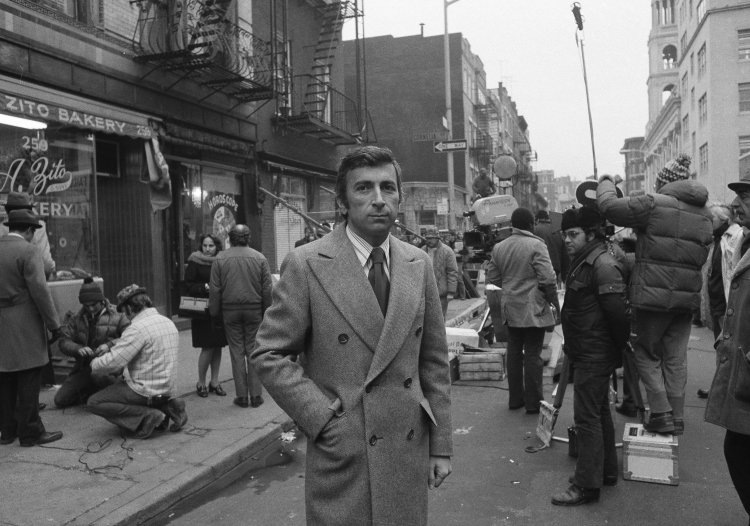
An unrelenting winter and circumstance dictated a most uncustomary form of interview with Gay Talese: a phone call. Another ice storm in New York kept Talese in his Upper East Side townhouse, where he first occupied a bachelor pad as a New York Times reporter at 26 and then bought the whole property with his wife, Nan, by 1973, when he was a writer – and subject – at Esquire. On a January late afternoon, when the call arrived, Talese was pushing 95, and I was in Pennsylvania, laid up on crutches and recovering from a knee injury. There was no time for a serendipiter’s journey.
“When I was younger and working in the field, I always felt you have to be there in person,” said Talese, who in 1999, following a post-anniversary European sojourn with Nan, and in a fit of inspiration and determination, suspended his plans to return home and instead flew to China to pursue a story about the soccer player whose kick cost her team the World Cup. He didn’t return to New York for five months. “You observe so much in person that you don’t get over the phone,” said Talese. “But that’s what the limitations are like today. I can’t meet you. I’m 94, and I can’t go outside. It’s snowing outside.”
In his writing life, Talese has accumulated untold flyer miles, sources, and carefully cut shirt boards – his preference for notetaking, as the son of a Calabrese tailor. There was never a smartphone or recorder, nor even email, until The New Yorker requested that he start submitting his stories online. Today, “people have a narcissistic relationship with their phone,” said Talese. “I never had a phone.”
Indeed, Talese is among the last writers to have lived a life free of pixels, texts, and scrolls. Instead, he pursued his subjects, either befriending them or observing them if they were averse, and then wrote about them with detachment, fairness, and meticulous care. Stories germinated from chance encounters, late-night dinner conversations, and periods of waiting. Drafts and rewrites were composed on yellow legal pads and the typewriter.
It was how Talese could produce his most famous profile, “Frank Sinatra Has a Cold,” published 60 years ago this month in Esquire, and write how “New York Is a City of Things Unnoticed,” at 28 for the magazine. “The problem in New York today: most people don’t see anything. They’re looking down in their fucking phones,” said Talese. “They’re walking the streets and everybody’s looking down, not up. I was always looking up … wondering what goes on up there.” But now the influencers abound. “No one gives a shit about what’s going on anywhere except in their fucking phone.”
In the 1960s, when Talese was in his 30s, television was the “cool medium,” as communications theorist Marshall McLuhan termed it, entrancing the masses while magazines like Look and Life slowly faded. But it was then, writing at Esquire, when Talese ascended as a magazine writer. “My basis as a journalist, as a writer, was to write like fiction writers without writing fiction,” said Talese.
Talese’s formative years, during the Depression and the Second World War, coincided with the ascent of literary lions who wrote short stories for mass-circulation magazines, including The New Yorker. But that was long before Talese wrote for the magazine or had his brush with the writers who later inspired him. A young and ever-sartorial Talese grew up in an Italian household – his father working as a tailor while his mother ran the family’s dress shop – in New Jersey’s Ocean City, then a staunchly Methodist island where the only fellow Catholics were Irish. It was a devoutly Catholic home, where Talese’s father would whisper prayers to a portrait of Saint Francis di Paola, pleading with the monk to protect his Italian infantrymen brothers during the war. Talese, an altar boy, was a daydreamer who enjoyed listening to Sinatra and following Joe DiMaggio, whom he saw in his soldier, rather than baseball, uniform while eating a Sunday meal with his family at an Atlantic City Italian restaurant.
In his early youth, when Talese was a journalism student at the University of Alabama, he began reading short-story writers. “I was a short story lover, and my articles in magazines are always based on short stories,” said Talese. “I was really writing short stories with real names, always.” Among those literary influences were those lions at The New Yorker, like John O’Hara, the belligerent Pennsylvanian whose most famous short story, “A Doctor’s Son,” was submitted to a Scribner’s writing contest just weeks before Talese’s birth in 1932. “I was inspired by the dialogue of John O’Hara and the kind of storytelling technique of Irwin Shaw,” said Talese. Then there was Ernest Hemingway, a literary star by Talese’s childhood, and F. Scott Fitzgerald, whose novels and short stories he described as “beautiful.”
Talese’s favorite writer was Shaw, at one time a celebrity literary figure whose stories, such as “The Girls in Their Summer Dresses,” filled The New Yorker and novels, like “The Young Lions,” became film adaptations. In time, Talese met Shaw in Paris when he was stationed in the Army in mid-1950s Germany. Then, in an ultimate moment of serendipity, Shaw served as Talese’s best man. It happened in June 1959 in Rome, when Talese was working on a story about the Via Veneto for the New York Times Magazine. There, he planned a vacation with Nan, a Random House editor and his then-girlfriend, whose intentions abroad were more matrimonial than leisure.
On the eve of their wedding, a civil rather than Catholic ceremony, Talese spotted Shaw at a restaurant where they had ordered a bottle of champagne. Talese shared with Shaw, whose new novel was set in Rome and optioned by Hollywood, that he was marrying Nan, who worked for Shaw’s publisher. “I’m nervous,” Talese recounted telling Shaw. But Shaw, legendarily warm and charitable, insisted on a party – and on being Talese’s best man. And so, following a civil ceremony overseen by an Italian Communist magistrate, the newlywed Taleses had a party thrown by Shaw at a ballroom that counted attendees involved in the then-active filming of “La Dolce Vita.” It was a “wonderful party and he was a great friend … He was my favorite person—a generous, wonderful person,” he said of Shaw, who died in 1984.
Talese has profiled the faded, the forlorn, and the forgotten – names that were once big or were looking for a comeback. Though algorithms sanction viral X or YouTube clips of the likes of Christopher Hitchens or Gore Vidal, for example, they do not lead younger writers to find inspiration in the literature of the past. Talese lamented how once-giant names – O’Hara, Shaw, and William Styron, who sublet an apartment at his home – had faded into obsolescence. “I think the challenge for modern writers: they don’t read fiction,” said Talese. “They do not know the writers that we’re talking about.” But at one time, Talese knew them all: Norman Mailer, John Fowles, Philip Roth, and Joan Didion, perhaps the exception in recent years among all the young performative male readers in Village cafes. But then there’s John Updike, not dead even 20 years. “You never hear his name anymore,” said Talese. “It’s surprising that people in my generation who are now dead are always dead in literature,” he observed. “Your readership dies pretty much when you die.”
Talese counts Donna Tart as a last contemporary writer whose work he connected with, and he also notes Jay McInerney, who has a newly released novel, as “a sweet guy and he’s a good writer, too. He had a very interesting life.” “I don’t read very much of current fiction,” said Talese. “The younger writers, I just don’t connect to them. Of course, they don’t connect to me either. So it makes it even.”
These days, at his home, Talese carefully reads the New York Times, averaging a daily two-hour regimen, along with the New York Post and The New Yorker. He skips The Atlantic and Harper’s, believing they have become too political, and he is dismayed by the Times’ modern reportorial approach. Talese worked at the Times from 1956 to 1965, having written a sweeping history of the newspaper, “The Kingdom and the Power,” in 1969, and describing the institution as a “fact factory.” But today, Talese believes the Times “only sees one side.” He is no fan of Trump, and he’s a registered Democrat, but still, he views the one-sided approach to the president as “boring.” “They never give both sides of the story,” said Talese.
Talese was born when Jimmy Walker, the petite and debonair Irish mayor of New York, was months away from resignation, and besides Walker, Fiorello LaGuardia – the polyglot progressive of the New Deal era, and Zohran Mamdani, sworn in earlier this year – he has met every occupant of Gracie Mansion. Mamdani was born in 1991, when Talese had written “Unto the Sons,” the story of his family’s Calabrese origins and their immigration to America. “I’m very impressed. He speaks the language beautifully,” Talese says of Mamdani. “I wish him well.” Talese has lived in the city for more than 70 years.
Talese acknowledges the modern constraints of journalism. “It’s a tough time to make a living as a journalist,” he noted. The expense accounts and limitless travel have gone out with the celebrity writers and doorstopper magazines. But Talese believes this should not stop writers from pursuing the craft, one in which he would write stories as if they were movie scenes. “A lot of stories are always across the street,” said Talese. “It’s there, but you have to know it.” A writer, he advised, must “be sure that every sentence is the best sentence you can form.” Talese has made a lifetime of the pursuit. Young writers risk malpractice – and a diminished reading life – if they have not yet studied his beautiful, declarative sentences.
