
[ad_1]
Neil Thompson Informed Comment
US President Donald Trump startled shipping companies and foreign governments earlier this week by announcing that the US would be charging a 20% toll for passage through the Strait of Hormuz. Trump publicly embraced the idea of a tolled future for the Strait, a proposal he had sought China’s help in preventing during at a bilateral summit in Beijing just two months earlier, when it was Iran pushing it.
However, the president ultimately withdrew the toll proposal after emergency talks with Gulf states, instead announcing unspecified trade and investment deals that would finance new jobs, factories and equipment for the benefit of ordinary Americans. The brief saga has added to global confusion about what the status of the waterway will be once the war between the US and Iran eventually ends.
Gulf States Raced to Nix Toll Idea
Governments in the Gulf States of Saudi Arabia, the United Arab Emirates, Bahrain, and Qatar responded rapidly to lobby the White House against the idea of a US toll, which would weigh heavily upon countries which are heavily import-dependent. Gulf Cooperation Council (GCC) states import 85% of their food, for example. Moreover, a toll — whether US or Iranian — would also significantly raise the cost of exporting the oil and gas cargoes upon which regional government revenues still often depend.
Since the start of the war in the Strait, Saudi Arabia and other energy exporters have shifted some hydrocarbon exports to Red Sea ports. However, expanding pipelines and other infrastructure needed to bypass Hormuz entirely would take years and cost billions. Only prolonged conflict and legal uncertainty in the Strait would make doing so worth it.
Yemeni Instability
That appears unlikely, as the Red Sea route is as potentially unstable for commercial shipping to risk navigating, as the Strait of Hormuz currently is. Saudi Arabia and the Houthis, the armed group that controls a significant percentage of neighbouring Yemen, have been in an uneasy truce since 2022, despite the latter’s ties to Iran. However, planes from Yemen’s internationally recognised government, backed by Saudi Arabia, bombed the Houthi-controlled Sana’a airport to prevent an Iranian plane landing there earlier this week. The Houthis fired missiles at Saudi Arabia in response.
On Monday (Jul 13), a Houthi military spokesman said: “In response to this criminal Saudi aggression, the Yemeni Armed Forces carried out a military operation targeting Abha International Airport, using a number of ballistic missiles and unmanned aerial vehicles.” The group also warned airlines to avoid traveling over Saudi airspace until Saana airport was allowed to reopen.
The clashes have died down for now, but tensions remain, with sources telling Reuters this week that Iran has asked the Houthis to attack Red Sea targets if the US attacks Iran’s power infrastructure.
Strait’s Status Remains Contested
Rather than risk the Red Sea repeating their Strait of Hormuz experience, GCC states want the latter to return to its pre-war status as an international maritime trade route. Their rush to persuade Trump to announce new-if-opaque investment deals instead has held off a US guardianship over the Strait for now. They are also vehemently against an Iranian toll regime.
Tolls are an idea that President Trump has floated before, however, including in April. He initially floated the idea of the US charging a toll for controlling the Strait as a “winner” and then considered a joint toll operation with Iran. Confusion over the Strait’s ultimate status is therefore likely to continue in the second half of 2026, especially given the current lack of a clear US military objective.

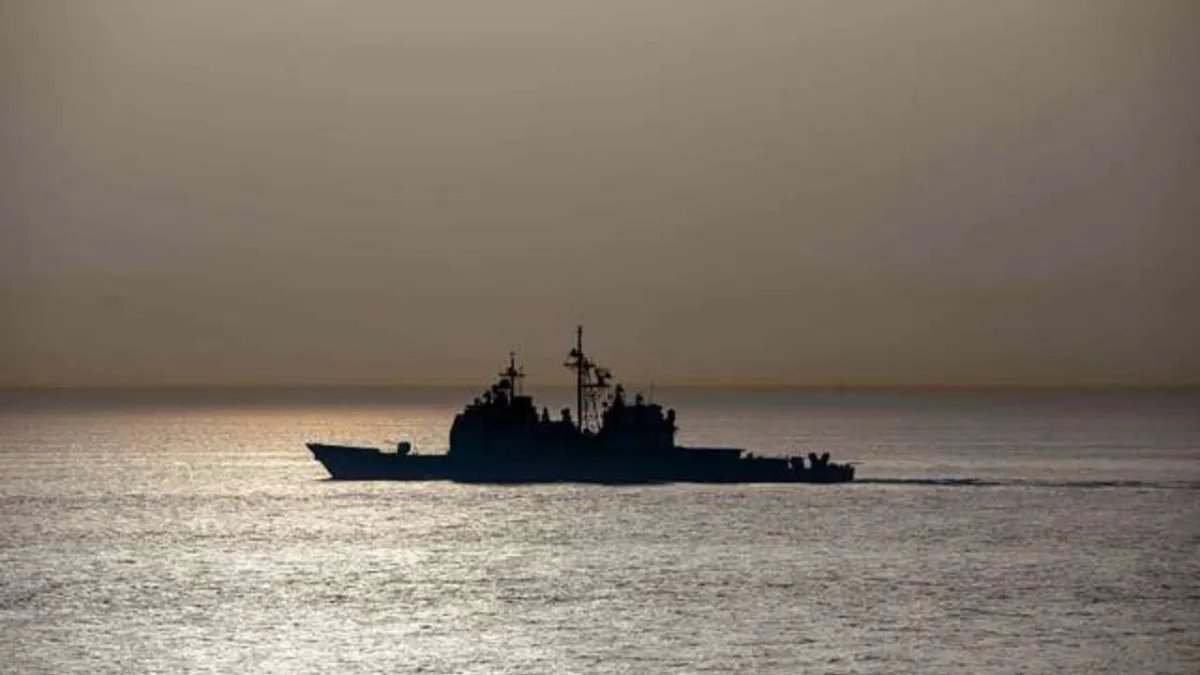
Hormuz. (U.S. Navy photo by Mass Communication Specialist 2nd Class Lyle Wilkie).
Conclusion: A Divided Strait?
Though the White House appears to have abandoned its earlier plans to topple the Iranian regime, the US and Iran returned to conflict over control of the Strait. Iran is keen to turn its leverage over commercial traffic there into funding to rebuild itself. The Trump administration appears willing to be allow its Gulf partners to talk it out of imposing its own toll regime. But it is unwilling to allow Iran to take its place as guardian of the waterway. This has created a new impasse separate from the first round of the war. Iran’s parliament have introduced a bill to manage the Strait, the Strategic Action for the Security and Sustainable Progress of the Strait of Hormuz and the Persian Gulf, which shows a return to the passageway’s pre-war status quo is unlikely.
Littoral states at other global chokepoints, like the Strait of Malacca or the Bosphorus and Dardanelles, offer alternatives to the current instability. But Iran and the US likely lack the trust required to construct such an elaborate policy framework at present. The result is likely to be a frozen maritime conflict similar to the one between North and South Korea in the Yellow Sea, with periodic skirmishes along a boundary that divides the Strait; with an Iranian zone in the north and a one in Omani waters in the south that the US tolerates or even endorses to spite Iran. What there is unlikely to be is a US role as controller of the Strait, charging commercial shipping a fee to enter and exit.
Neil Thompson is a geopolitical risk professional publishing here in his own capacity. The author’s views are his own and not affiliated with any other party.
Editor’s Note: At a moment when the once vaunted model of responsible journalism is overwhelmingly the play thing of self-serving billionaires and their corporate scribes, alternatives of integrity are desperately needed, and ScheerPost is one of them. Please support our independent journalism by contributing to our online donation platform, Network for Good, or send a check to our new PO Box. We can’t thank you enough, and promise to keep bringing you this kind of vital news.
You can also make a donation to our PayPal or subscribe to our Patreon.
Please share this story and help us grow our network!
[ad_2]
Source link
