
[ad_1]
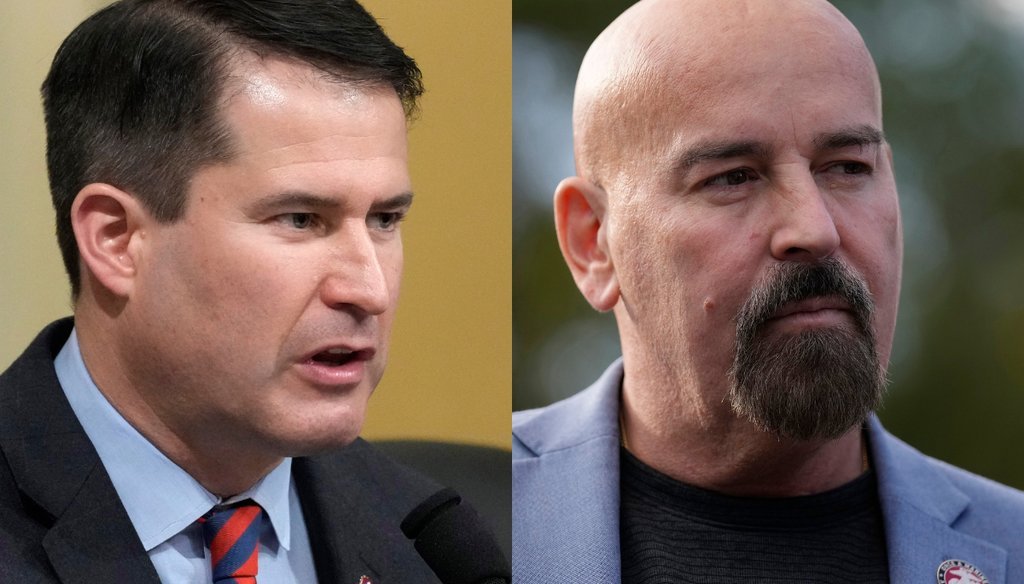
A rare cross-party, pre-primary U.S. Senate debate unfolded June 16 in Massachusetts, with Democratic U.S. Rep. Seth Moulton and Republican trial attorney John Deaton making their case to voters as they try to unseat frontrunner Democratic Sen. Ed Markey in November.
Markey did not participate but agreed to meet Moulton in an Aug. 3 debate and an Aug. 20 debate, the latter co-hosted by PolitiFact partner WCVB Channel 5. Massachusetts’ primary is Sept. 1.
Both Moulton and Deaton are U.S. Marine Corps veterans, with Moulton serving four tours in Iraq and retiring as a captain, and Deaton serving domestically as an officer and judge advocate. Moulton was elected to Congress in 2014. Deaton has not held public office but challenged Democratic U.S. Sen. Elizabeth Warren in the general election in 2024 and lost by 20 points.
Although he wasn’t there, Markey — who is 79 and has held elected office for over 53 years — was a common target, with the debate’s first question centered on him.
Moulton has targeted Markey’s age, saying the incumbent has been in office longer than Moulton has been alive, and “it’s time for a new generation of leadership.” (Moulton is 47). Deaton made similar comments during the debate.
The debate heavily focused on topics related to immigration, energy and President Donald Trump’s policies. Here, we fact-check some of the candidates’ statements.
Deaton: Moulton “thanked ICE in 2025 but now he wants to abolish them.”
That’s missing context.
Moulton voted for a 2025 resolution that included one sentence expressing gratitude for U.S. Immigration and Customs Enforcement. But the resolution’s main purpose was to condemn a violent antisemitic attack in Colorado.
In a January Instagram video, Moulton said,”ICE is beyond repair. It obviously needs to be abolished.”
The 2025 resolution came one month after a Brazilian woman was taken into ICE custody in Worcester, Massachusetts, but before federal immigration agents publicly killed two U.S. citizens — Renee Good and Alex Pretti — in Minnesota in 2026.
Moulton: “I was the first in this race to say that ICE not only needs to be abolished — they need to be prosecuted.”
That’s accurate as it pertains to the 2026 campaign, but omits that Markey called for abolishing ICE in 2020 and also two days after Moulton did.
Calls to abolish ICE increased in January after federal immigration agents fatally shot Good and Pretti in Minnesota. In a Jan. 26 video, Moulton said ICE “obviously needs to be abolished, but even more urgently, its gang of criminal enforcers needs to be prosecuted.”
Two days later, CNN host Brianna Keilar asked Markey if he wanted ICE “abolished or reformed.” Markey replied: “I want ICE to be made accountable.”
Keilar asked Markey repeatedly if he wanted to abolish the agency. He did not answer yes or no; he said he was voting “no” on the ICE budget. Later that night Markey said in a video, “Right now Democrats have the power to defund and abolish ICE. We should do it. This is about right and wrong. … Anyone who supports funding DHS and ICE is supporting the murder of Americans.”
That wasn’t the first time Markey called to abolish ICE. In 2020, he said in an X post, “ICE has become a ruthless deportation force that terrorizes our immigrant communities. We cannot allow this to continue. It’s time to stand up to protect the rights and dignity of our immigrant neighbors and abolish ICE.”
Deaton: Markey pays 16 cents for electricity per kilowatt hour in Maryland, “because Maryland is not subject to your policies. Here in Massachusetts, we pay 33 cents per kilowatt hour.”
Criticisms about Markey’s time at his house in Chevy Chase, Maryland, have dogged the senator for years.
Deaton was in the ballpark for Massachusetts, but he was underselling Maryland’s energy prices.
Massachusetts’ residential electricity cost was about 30 cents per kilowatt hour in March 2026, according to the U.S. Energy Information Administration, and it has not exceeded 31 cents in the last 12 months. Since that’s the average, some Massachusetts residents are probably paying 33 cents, as Deaton said.
Maryland’s residential energy prices are lower, sitting at 22 cents per kilowatt hour in March 2026. The average over the last 12 months was about 20 cents.
Maryland’s electricity prices have risen sharply in recent years, but there was a time when Deaton’s comparison was close to accurate: In March 2023, Maryland’s average electricity prices were around 16 cents a kilowatt hour, while Massachusetts’ average rate was nearly 33 cents.
Moulton: “We had an environmentally-friendly, good plan to do environmentally-approved wind power, and what has Trump done? Yanked it away from us.”
It’s accurate that Trump tried to stop an offshore wind farm in Massachusetts, but after legal setbacks, the project resumed and finished construction.
On his first day back in office in 2025, Trump signed an executive order to temporarily suspend offshore wind leasing on the Outer Continental Shelf, but a federal judge blocked that policy in December 2025. Trump’s administration initially appealed, but dropped the appeal in June.
In late 2025, the Trump administration paused leases for five offshore wind projects, including Vineyard Wind in Massachusetts, citing national security concerns. But a federal judge allowed the companies to resume operations in February, and the Vineyard Wind project finished construction in March.
PolitiFact staff writers Gracey Abernathy, Alex Min and Carsten Oyer contributed to this story.
[ad_2]
Source link
