

[ad_1]
The Enhanced Games, in which elite athletes were allowed under medical supervision to use various pills and injections to boost their performance, took place in Las Vegas over Memorial Day weekend. The Games were hyped by organizers as “the future of sport – where science, athleticism, and progress inspire superhuman achievement.” Not surprisingly, the Luddites at the U.S. Anti-Doping Agency dismissed the event as a “dangerous clown show that puts profits over principle.”
With respect to superhuman achievements, the Games were, to be honest, something of a dud. On the other hand, many of the enhanced older competitors did better than their younger selves.
So what enhancements did the competitors use? Organizers did not release individual athletes’ regimens but did, prior to the Games, reveal that 91 percent used testosterone, 79 percent used human growth hormone, 62 percent used stimulants such as Adderall, 50 percent used metabolic modulators, 41 percent used erythropoietin (EPO), and 29 percent used an anabolic steroid agent such as Deca-Durabolin. The athletes who chose enhancements were on a shortened protocol of nine weeks instead of 20 weeks as initially designed by the organizers. To be eligible, all of the enhancing compounds must have been approved by the Food and Drug Administration. (Worth noting: A 2017 World Anti-Doping Agency study found that nearly 44 percent of elite athletes had surreptitiously used performance enhancements in the past year.)
So why was it a “dud”? The organizers had hyped the Games, suggesting that some of their roster of enhanced athletes would break world records in swimming, track, and weightlifting. In fact, Greek swimmer Kristian Gkolomeev, age 32, was the only competing athlete who beat the world record in his sport, the 50-meter freestyle swim. His time of 20.81 seconds beat Australian Cameron McEvoy’s record time of 20.88 seconds set in March this year at the age of 31. Gkolomeev’s official personal best is 21.44 seconds, set back in 2018 when he was 25 years old. Since he was openly taking various pharmaceuticals aiming to improve his performance, his record swim will not be recorded in the official records.
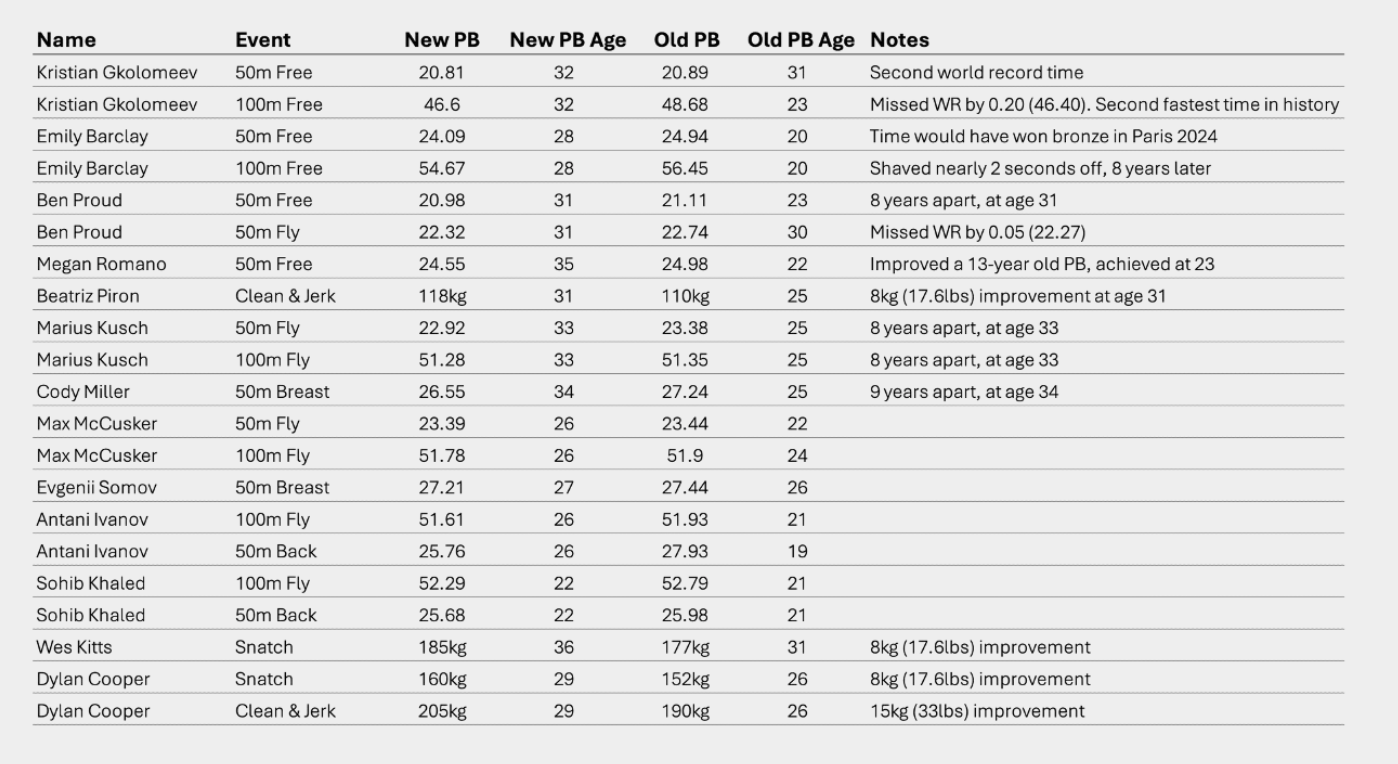
The organizers of the Enhanced Games also highlighted that 21 personal-best results were broken by 13 of the participating athletes. The average gap between an athlete’s previous personal best and their new one set at the Games was 6.4 years. Enhancements, as expected, significantly boost athletic performance.
Notably, three winners at the Enhanced Games were “clean,” that is, they used no World Anti-Doping Agency–banned enhancements to improve their performances. The biggest factor in their victories was their youth compared to most of their competitors. For example, swimmer Hunter Armstrong and sprinters Tristan Evelyn and Fred Kerley are respectively 25, 28, and 31 years old.
Recent research reports that the average age for Olympic medalists in sprint swimming competitions for men and women is, respectively, 27 and 26 years old. Armstrong’s time at the Enhanced Games for the 50-meter backstroke was 24.21 seconds while his personal best time was 23.71 seconds in 2022 when he was 21 years old. Armstrong’s competitors were Shane Ryan (32), Antani Ivanov (26), and Sohib Khaled (22). Competing without enhancements, Khaled’s new personal bests at the Games suggest that he is not yet at his peak as a swimmer.
A 2024 study reported that the “median peak age is 27 years old” for Olympic track and field athletes. Evelyn’s time for the 100-meter dash at the Enhanced Games was 11.25 seconds while her personal best was 11.14 seconds back in 2021. At the Enhanced Games, Evelyn (age 28) competed against Shania Collins (29), Taylor Anderson (31), Jasmine Abrams (32), Shockoria Wallace (32), and Denae McFarlane (25).
Fred Kerley’s time of 9.97 seconds in the 100-meter dash at the Enhanced Games was impressive, especially considering that he is 31 years old. However, that time did not beat his personal best of 9.76 seconds set back in 2022, nor Usain Bolt’s world record time of 9.58 seconds in 2009 when he was 22 years old. Kerley’s competitors were Emmanuel Matadi (age 35), Marvin Bracey-Williams (32), Mouhamadou Fall (34), Reece Prescod (30), and Mike Bryan (33).
At the first Extended Games, older age and enhanced treachery were no guarantee of victory over youth and exuberance.
[ad_2]
Source link
