
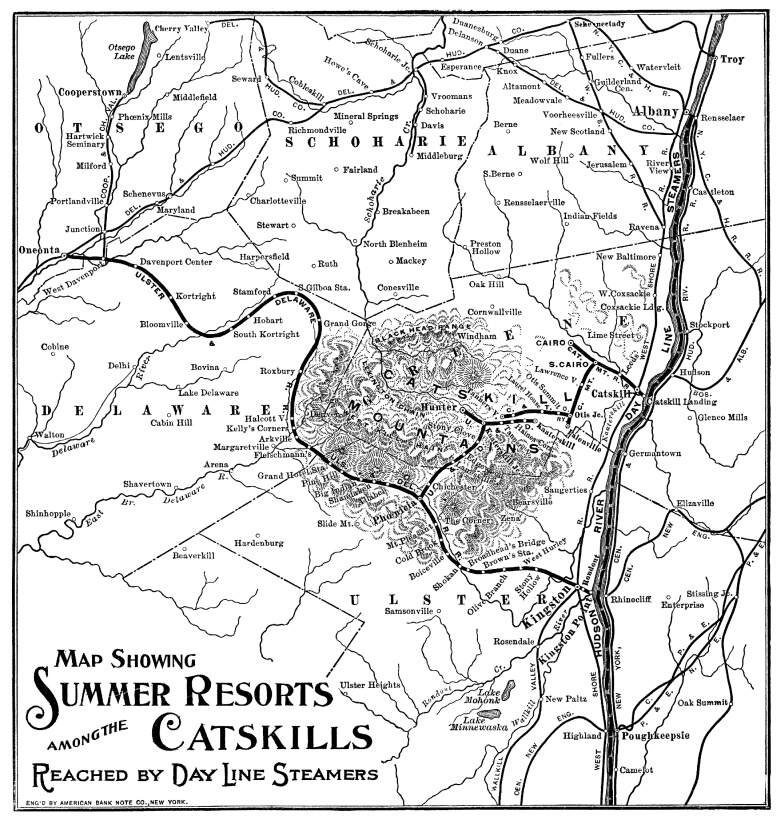
The rail network in the Catskills with summer resorts, ca. 1901 – Public Domain
Several weeks after the White House Correspondents’ Dinner, I finally sat down to watch Trump’s performance. The Dinner is one occasion when the President is expected to be entertaining as well as presidential. What I saw was a very poor imitation of Borscht Belt comic performers like Sid Caesar, Rodney Dangerfield and Henny Youngman. While many psychologists have analyzed Trump’s behavior, the Catskills’ comedy tradition offers another way of understanding him as a failed performer.
The Borscht Belt was a region just north of New York City in the Catskills Mountains. In its heyday, it was a retreat for up-and-coming Jews from New York City as well as the incubator of famous comedians like Jerry Lewis, Jack Benny and Don Rickles and singers like Barbra Streisand, Tony Bennett and Eddie Fisher. Like many young New York comics of his generation, Woody Allen also worked the Catskills circuit in the 1960s. For decades, Grossinger’s and the Concord were the place to be for a very special clientele. (My uncle, Dr. Ben, took me there twice.)
All of the famous comedians who performed there had a special flair; New York wise-guy Jewish humor. There was the precision of Henny Youngman, often mixed with self-deprecating Rodney Dangerfield or the stinging aggression of a Don Rickles. It was all very New York; it was all very in with a certain in-crowd.
Donald Trump was not part of that crowd. I doubt if he ever spent a Singles Weekend at Jennie Grossinger’s retreat in Sullivan County. Yet Trump’s public style borrows many of the rhythms of that New York comic tradition, even if he was never truly part of it. The only problem at the Waldorf Astoria on July 24, 2026, was that Trump wasn’t onstage at Grossinger’s entertaining a very particular crowd. He was the President of the United States speaking on national television to the entire country and the world.
Whether intentionally or not, Trump’s public style shares features commonly associated with that tradition—cadence, exaggeration, insult and audience interaction—even if his performance lacks the craftsmanship that made the great Borscht Belt comics successful.
The Borscht Belt comics usually shared several qualities. They were funny. They understood timing. They mocked themselves as readily as they mocked others. And they knew the difference between performance and reality. Trump lacked the discipline or self-awareness that made those comics effective.
Henny Youngman could get a laugh in ten words. “Take my wife…please.” Trump often repeated the same point three or four times, explaining it long after whatever humor it possessed had evaporated. Great comedians know when to stop talking; Trump can’t.
Rodney Dangerfield built his reputation on self-deprecating humor. His signature line, “I don’t get no respect,” always made himself the butt of the joke. Trump’s comedy worked in precisely the opposite direction. Throughout his Correspondents’ Dinner speech, he repeatedly boasted that the United States had become “the hottest country” under his presidency. Where Dangerfield invited the audience to laugh at him, Trump invited them to admire him.
Don Rickles built his reputation on razor-sharp insults that were both funny and theatrical. However savage his remarks sounded, audiences understood that everyone—including the target—was part of the act. (One of his famous lines was “Nice to see you… now go home.”) Trump’s jab at Kaitlan Collins—“Kaitlan, do you ever smile? Smile. You have a nice position. You’re at CNN fake news. You should be a happy person. So smile, Kaitlan, just smile.”—lacked both the wit and the theatricality that made Rickles’ insults work.
And finally, Trump told a joke that was met with little or no laughter. The room was largely silent. Trump immediately tried to explain the joke—a sure sign that it had failed.
The joke was: “The other day, a senator I knew got a text, a great guy, from his wife. And she said, ‘When you get home, I wanna have you immediately come up the stairs and make love to me.’ And he said, ‘I can’t do both.’”
Trump then asked the audience: “Does anybody get that one?”
One of the cardinal rules of stand-up is: Never explain a joke.
Youngman got right to the point. Dangerfield’s insecurity was a comic invention. Rickles’ insults were theatrical. Audiences understood that the three men were playing characters. Trump, by contrast, presents no such separation between performer and person. His boasts, grievances and insults are offered not as a comic persona but as authentic expressions of himself. That is why the conventions of Borscht Belt comedy fail him. The audience is never quite sure whether it is being invited to laugh—or simply to agree.
A president can be presidential and humorous at the same time. Barack Obama and his speechwriters nailed it at the April 2011 Dinner, although not in the Borscht Belt spirit. Referring to the “birther” conspiracy questioning whether he had been born in the United States, Obama said: “Now, I know that he’s taken some flak lately, but no one is happier, no one is prouder to put this birth certificate matter to rest than The Donald. And that’s because he can finally get back to focusing on the issues that matter — like, did we fake the moon landing? What really happened in Roswell? And where are Biggie and Tupac?” Touché. Told with Rickles-like sting.
The joke was sharp without being personal. It mocked Trump’s conspiracy theories rather than Trump’s appearance or character. Unlike Trump’s own performance fifteen years later, the humor was economical, disciplined, with great timing, and left the audience laughing without requiring explanation.
Why does all this matter in the context of a president speaking and relating to the general public? Telling jokes is the hardest part of public speaking. Being president and being humorous are not simply combined. At the recent Correspondents’ Dinner, Donald Trump bombed as a comic, just as he is failing as a president.
