
[ad_1]
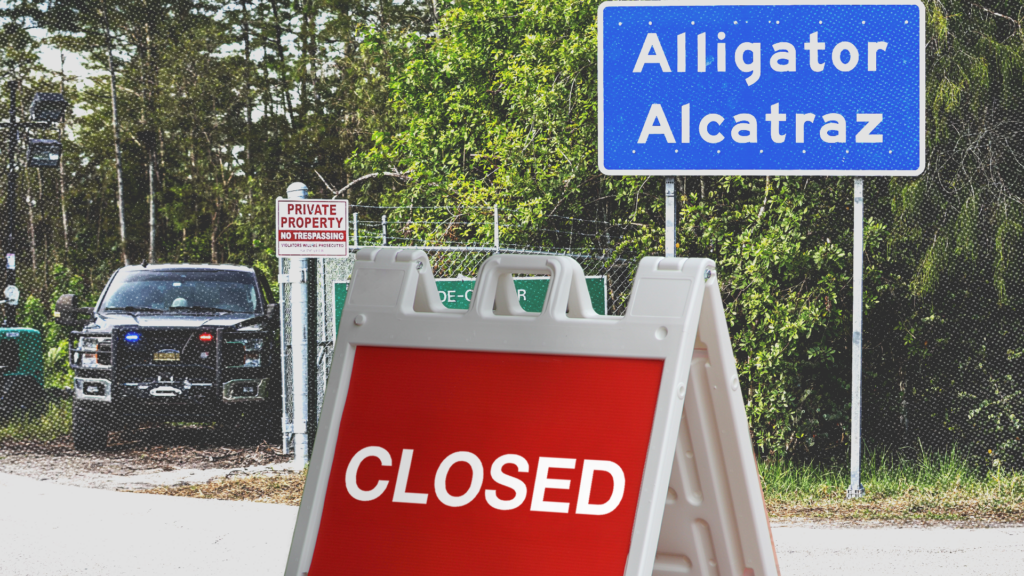
The first-of-its-kind, state-run immigration detention center in the Florida Everglades may soon be closed, a federal official told The New York Times on Thursday. Although the facility has been able to remain operational despite accusations of inhumane conditions, environmental law violations, and breaches of due process, the detention center may not be able to survive without federal funding that has yet to materialize.
Talks between Florida officials and the Trump administration are in the preliminary stages, but “officials at the Department of Homeland Security [DHS] have concluded that it is too expensive to keep operating…Alligator Alcatraz,” which has cost over $1 million a day to run, reports the Times.
Florida built and opened the immigration detention center on a 30-square-mile parcel of land outside of Miami last summer. Originally touted as an “efficient, low-cost opportunity to build a temporary detention facility” by Florida’s Attorney General James Uthmeier, the facility was expected to house up to 5,000 detainees and cost $450 million for a single year of operations.
Florida agreed to front the bill for building the novel hub capable of housing, processing, and deporting detainees directly from the facility’s air strip, with the plan to seek reimbursement from the DHS to cover costs. The ambitious project was initially praised by President Donald Trump, who toured the facility on opening day. And former Homeland Security Secretary Kristi Noem was amenable to funding the project, saying that Alligator Alcatraz would be funded “in large part” by $625 million set aside by the Federal Emergency Management Agency (FEMA) Shelter and Services Program.
But shortly after the detention center’s opening, leaked documents showed that the cost to run the facility had ballooned to $608.4 million in less than two weeks of operating. And now, according to the Times, Florida is struggling to front the costs of detaining the nearly 1,400 individuals currently housed there as the state waits for its requested reimbursement.
As the Times reports, it’s still unclear why the DHS reimbursement remains delayed. But it is no mystery why the federal government (and taxpayers) would be disinclined to fund an endless, swampy money pit that has only ever met a fraction of what it promised.
As I wrote shortly after Alligator Alcatraz’s grand opening last summer, Florida officials would have been wise to brush up on the history of the center’s namesake. Much like the original Alcatraz, what made the idea of Alligator Alcatraz appealing was, in part, the remote location. By utilizing the intimidating natural security perimeter of places like the Everglades or the San Francisco Bay, the security costs could be kept low. However, the isolated location of the original Alcatraz, although initially perceived as an asset, was ultimately its downfall. The prison was just too expensive to run and maintain because it required all supplies to be shipped in, including food and water.
Now, it seems, Alligator Alcatraz will meet a similar fate. And while this may be good news for taxpayers, it is unlikely to deter the Trump administration’s mass deportation campaign, which border czar Tom Homan promised to re-up earlier this week.
[ad_2]
Source link
