
[ad_1]

Democratic leaders worry about socialists because they fear reliving 1972 for the next two years. They have good reason to be concerned. As progressive nominees remove their less extreme members, Democrats’ congressional delegation will swing further leftward in the next term. Just as at their 1972 presidential convention, this will mean putting their progressive face unavoidably before the public. Only this time, it will last years, not days.
James Carville recently let fly at democratic socialists invading his party and targeting incumbents. On his “Politics War Room” podcast he stated: “These people are so f—ing stupid I don’t know what to say about it.” Yes, democratic socialists and other hard-left Democrats are targeting party incumbents – and winning – but if they are winning “safe” Democratic seats (and they are), then the seats will remain Democratic. So, what’s the problem?
The problem is that Carville is old and seasoned enough to remember what the problem was for Democrats 54 years ago.
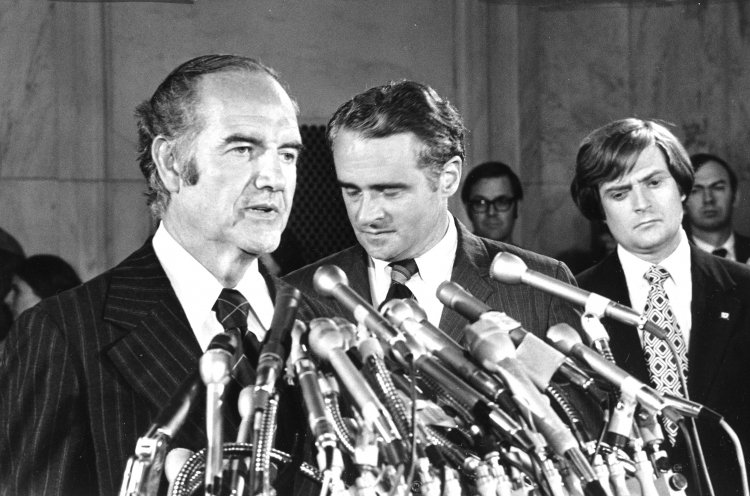
While most remember 1968 as Democrats’ presidential debacle because of the pitched battles outside their Chicago convention, 1972 was the real debacle. There George McGovern’s remaking of the Democratic Party nomination and convention rules – replacing labor and political stalwarts of FDR’s New Deal coalition with young activist upstarts – resulted in having a spectacle broadcast nightly into Middle America’s homes.
Following the convention and McGovern’s nomination (plus a hurried VP replacement of Missouri Sen. Thomas Eagleton with Sargent Shriver), Democrats would see their presidential vote drop in November from 30.9 million votes in 1968 (and 1964’s 42.8 million) to just 28.9 million in 1972, while Republicans’ total would skyrocket from 31.7 million votes in 1968 to 46.7 million votes in 1972. The electoral votes would be even worse: Democrats’ 191 in 1968 would fall to just 17 (winning only Massachusetts) in 1972, while Republicans’ electoral votes swelled from 301 to 520.
As Theodore H. White wrote of Miami’s Democratic convention in “The Making of the President 1972”: “The convention gave the sense of a movement rushing through and beyond the political and cultural limits all politicians had up to now accepted.”
In short, over the Miami convention’s four days, Democrats “couldn’t hide their crazy.” The networks had to broadcast it, and America got to see it.
The Democrats are about to do the same thing again; only this time instead of lasting for four days it will last for the next two years.
Democratic socialists have already won three House primaries (two in New York, beating incumbents Rep. Adriano Espaillat in NY-13 and Rep. Claire Valdez in NY-7, and incumbent Rep. Diana DeGette in CO-1). Other hard-left candidates could win upcoming primaries. In many of these districts, primary wins mean automatic general election victories. These hard-left newcomers would therefore join hard-left incumbents like “the Squad.”
The same dynamic is occurring with Democratic Senate nominations. Hard-left James Talarico in Texas, AOC-endorsed Abdul El-Sayed in Michigan, and a short, bruising internal fight in Maine to replace hard-left Graham Platner (who handily won the primary after driving Maine’s more moderate Democratic governor from the race): All would pull Democrats’ Senate Caucus much further left. There they would join Sen. Bernie Sanders of Vermont.
Neither is Democrats’ problem coming from democratic socialists alone. After all, liberal incumbent Rep. Dan Goldman (NY-10) was ousted by newcomer Brad Lander who ran to his left. Nor is this progressive left only an external threat arising during this campaign year: There are almost 100 House and Senate members in Congress’ Progressive Caucus already.
Democrats’ problem is that their progressives could hold the reins of congressional power if Democrats are fortunate enough to grab them. Yet, even if Democrats don’t win control, their progressives will have outsized influence over their Washington agenda – and an equally great determination to stick it to Trump: After all, that is what their far-left constituents have sent them to do.
At same time that Democratic leaders will want the party to appear moderate (as they did successfully in 2025’s gubernatorial elections in Virginia with Abigail Spanberger and New Jersey with Mikie Sherrill), Democratic congressional members will be pushed toward progressive priorities.
Again, White’s observations of 1972’s Democratic convention and the policies it pledged to pursue is apropos: “These programs had themselves become values. However much the real world might fear the liberal programs, it must submit because programs were morality, even after programs had gone wrong in visible practice.”
For progressives, policies have become elevated above politics to holy writ and beyond debate or dissent. What occurred during 1972’s convention for days could play out for two years in Washington on the congressional stage and in front of the whole country.
And the liberal programs of the late 1960s do not hold a candle to the Democratic Party’s progressive agenda of today.
[ad_2]
Source link
