
[ad_1]

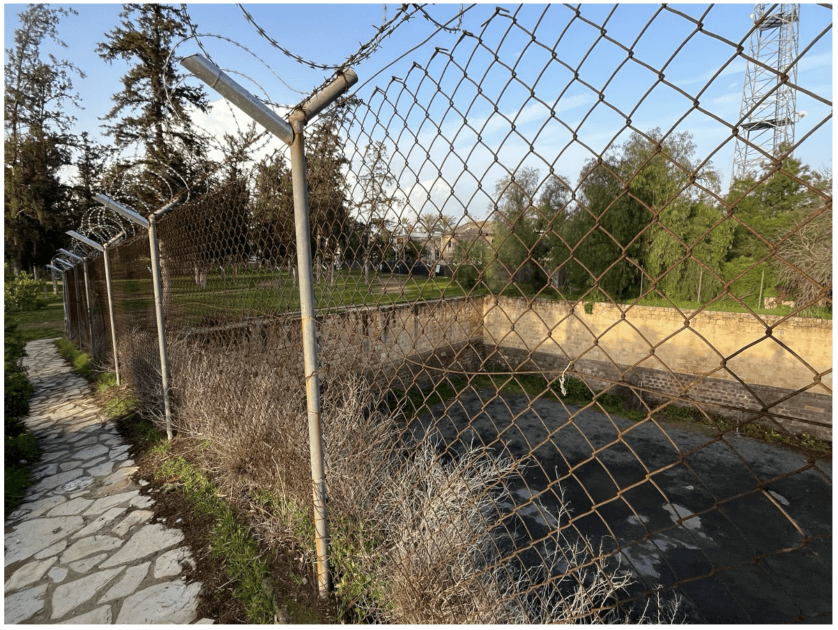
Up against the Green Line on Cyprus. Photo by Matthew Stevenson.
I realize that the time to visit Cyprus is high summer, when the coastline is transformed into a nonstop beach party, but I was there in February hoping both to find a touch of winter sun and to ride a bicycle on both sides of the Green Line—yet another European dividing line (this one between Greek and Turkish Cypriots) that was drawn up in 1963 but only became a hard border in summer 1974.
My flight from Skopje landed in Larnaca on the southern coast around 11 p.m. In weighing options for my flights, I had thought of flying directly to Nicosia, but Ercan International Airport is located in the Turkish sector and with it as my entry point I didn’t think I would be granted access into the Greek sector, otherwise the Republic of Cyprus.
Only Turkey recognizes the Turkish Republic of Northern Cyprus, although as Brendan O’Malley and Ian Craig argue in The Cyprus Conspiracy: “The Cyprus crisis was no failure of American diplomacy, but a deliberate Cold War plot to divide the island and save the top secret spying and defence facilities from the twin threats of a communist takeover or British withdrawal.”
For my first two nights on the island, I had reserved a small Larnaca hotel that was several blocks from the main beach. I didn’t quite think that I would be swimming there in February, but I still warmed to the idea of seaside meals, as when I had left my home in Switzerland it was encased in its trademark winter fog.
At the luggage carousels I asked several taxi drivers about the cost of a ride into Larnaca, about four miles from the airport. I got two quotes: one of €30 and the other of €40, which got me thinking that maybe the island was divided to bail out the taxi industry. I might have paid €30 just to be headed to bed, except that both offers came with contemptuous taxi-driver snarls, which sent me in the direction of a €1.25 city bus.
I cannot say that the bus driver was more cheerful than the hacks; at one point he tried to persuade me to leap off the bus several miles from my hotel. But in the end I alighted (Cyprus was, after all, British as a result of the 1878 Treaty of Berlin) several blocks from the beach, and I had no trouble finding a hotel key with my name on it and a comfortable room that had shuttered windows overlooking one of the main squares in tourist Larnaca (defined by €5 coffee).
+++
I usually travel with my own bicycle but on this occasion, just to get to Larnaca, I had to fly to Pristina (in Kosovo) and take a taxi to Skopje, North Macedonia, and then my return flight involved an overnight change in Serbia—so humping a folding bicycle hardly seemed worth it.
Besides, in Larnaca I had located Pro-Cycle Hire, which boasted late model rentals. What I didn’t know was whether I would be able to cross the Green Line on a hired rig. Some cycling posts indicated that theft insurance stopped at the makeshift border.
I showed up at the bike shop shortly after it opened at 10 a.m. I walked along the waterfront (beachfront Larnaca is an endless strip of latte emporiums), and then cut through the drab central business district, which had the look of back offices for Russian offshore companies. More than Switzerland, Cyprus is Russia’s bank teller window to the West.
Pro-Cycle had my reservation, which entitled me to roam around the shop and pick out a bicycle that might suit my journey. I explained that I wanted to ride along both sides of the Green Line, but as the shop staff was from Africa that disclosure meant nothing in terms of me choosing a road or mountain bike.
I went with a new Trek FX hybrid, and added in a helmet and two panniers. I figured its wide tires would get me up hills and across potholes; besides, I wasn’t racing anyone except maybe history.
My route was east to Famagusta, north to the Greek ruins at Salamis, west to Nicosia (perhaps with a side trip to Girne on the north coast), and back to Larnaca along the Green Line that near the divided capital meanders like a small intestine.
Cyprus became an independent country in 1960, and throughout the 1960s local Greeks agitated for union (enosis) with Greece while Turkish Cypriots petitioned Ankara, if not NATO, for minority protections.
Until I read O’Malley and Craig, I was under the impression that resurgent Turkish nationalism in the 1970s was the reason for the island’s partition. In the mid-1970s, I made my first visit to Greece, and there all anyone would talk about was the Ottoman resurgimiento that had “taken” much of Cyprus and had its eyes on Macedonia and Thrace, if not Athens.
O’Malley and Craig make the point, however, that Cyprus was less a dream of the sultan and more a pawn in the Cold War in which British and American general staffs (not to mention the machinations of Richard Nixon and Henry Kissinger) cared more about pending conflict with the Soviet bloc than the ethnic composition of old neighborhoods in Nicosia or Famagusta. They write:
The defence chiefs said the role of British forces in Cyprus was: to defend the Arab states, Turkey and Israel from a Russian invasion of the Middle East; to protect Britain’s commercial interests and British nationals; and to collaborate with members of the Baghdad Pact. In a local war, they might be needed to defend Jordan, prevent or end an Arab/Israeli conflict, and ensure the free use of the Suez Canal to British shipping. In a global war, they would be used to hold the Russian advance beyond the Zagros mountains in Iran.
In other words Cyprus was an unsinkable aircraft carrier on the front lines of the Cold War, and to the British and Americans, what mattered was continued access to the British military and naval stations on the island—not the patriotic sentiments of Greek orthodox ministers giving communion in monasteries around Troodos.
In my planning, I thought I would have a second night in Larnaca and use the rental bike to explore the city, which was just a nondescript port until partition closed the old Nicosia airport and shifted European airlines to Larnaca.
But when I tried to stow my rented bicycle in the hotel garden (empty in February), one of the hotel owners (it seemed to double as a real estate and insurance agency) berated me for cluttering up the grounds. He wanted me to park it on the street, but my cheap bike store lock resembled a seashell necklace, and I hated the idea of having the new bike stolen.
I thought about my options, packed up my gear in the panniers, left the hotel, and rode off in the direction of Famagusta, a Turkish Cypriot city that is the eastern extremity of the Green Line. Along the way I would pass near several of the British bases and some of the ghost towns from the 1974 war (when everyone except the Greeks had a geo-political reason for dividing the island).
In explaining the partition, O’Malley and Craig write:
With Soviet missiles threatening Turkey from the north, and political upheaval on its border, the Turks could not afford any uncertainty over Britain’s commitment to stay on Cyprus. If the island fell into the hands of Turkey’s enemies, whether Greeks or communists, it would leave her totally surrounded and vulnerable from the south.
Larnaca to Famagusta is only thirty miles, and I hoped that I would get there before dark; at least in leaving Larnaca, I would be spared more lectures from the anti-cycling lobby.
This is the fifth in an occasional series about travels through the Balkans to and from the Green Line in Cyprus.
[ad_2]
Source link
