
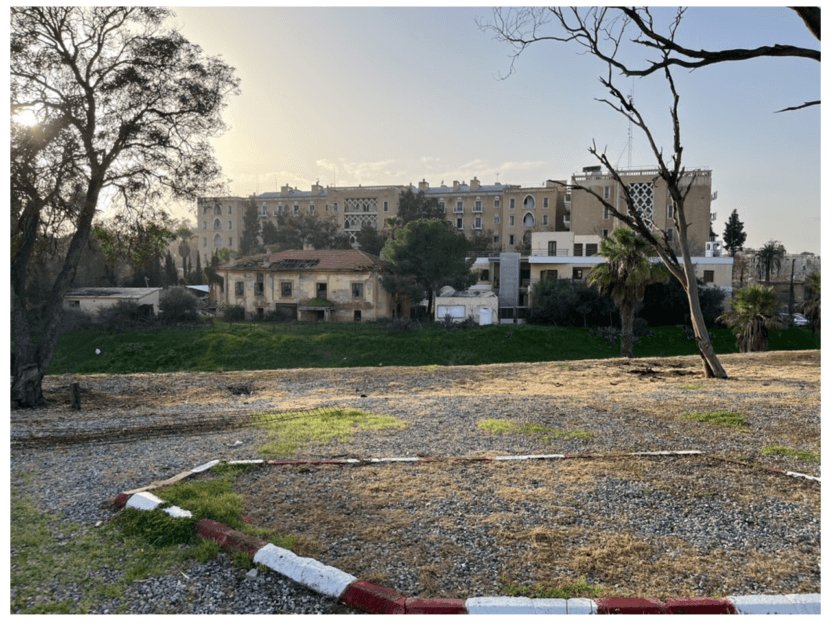
The Ledra Palace Hotel in Nicosia seen from the Turkish quarter across the Green Line. Photo by Matthew Stevenson.Ma
Maybe if I had been in Famagusta in summer, I would have gone in search of a nearby beach, but as it was late February I set out on the road to Salamis—Greek ruins to the north along the coast.
I don’t think it was a ten-mile ride, and mostly I clung to the shoulder of a busy road, although implausibly here and there I came upon the ruins of earlier bicycle lanes (yet another lost civilization).
I had expected Cyprus to look, well, Greek (white houses with blue shutters), but on the ground the landscape is that of the Middle East—maybe that of Syria or northern Israel.
There is a range of mountains that cuts across the island in the north and west, but around Salamis there are mostly broad stretches of farmland and scrub vegetation.
All my paper map showed about Salamis was the location of an historic site near the sea, but GPS steered me more precisely (or so it confidently believed) toward a ticket office and parking lot—none of which I found.
As I approached on my bicycle, I could see the bare columns of the Salamis gymnasium towering above the weeds, but no sign toward “Parking”. Instead, when I asked a family heading in the same direction about the entrance, they kept pointing toward a hole in the chain-link fence, which eventually I took to mean: “Enter here.”
Maybe somewhere on the bleak coast there is a visitors’ center and ticket office, but all I found was a paved sidewalk that looped around the contours of Salamis. It saw life as a Greek city-state (around the time of Pericles, if not in the centuries preceding), then as an imperial Roman garrison, and finally as an outpost of Christianity that drew visits from saints Paul and Barnabas, among others.
My bicycle made exploring Salamis easy, as it is spread over a wide area, and to my delight, I had the ruins to myself, which reminded me why I take such great pleasure in visiting Greek and Roman ruins across Europe and the Mediterranean. (For Christmas one year my children even gave me “ruin shoes.”)
Some of the best ruins are found far from Europe, in the Near East and North Africa. Among my favorite sites are Jerash in Jordan and Baalbek in Lebanon (although it’s under the influence of Hezbollah these days).
I knew that the bike ride from Salamis to Nicosia would be a problem. On my paper map, the capital appeared to be about fifty miles to the west, but the issue was that only one road—and it looked to be a highway—connected the Greeks to the modern (now divided) capital.
To ride on a less busy streets, I could have gone north or south, but I worried that the northern roads might not have a wide shoulder, and the problem with the southerly route was that it cut directly through the Green Line.
In the end I decided to give the motorway (as it was labeled on one of my maps) a try. Better to ride on a wide shoulder than to have careening trucks force me off some narrow secondary road.
I picked up the autoroute about six miles west of Salamis in open farmland, feeling a bit like Roger Thornhill in North by Northwest when the crop-dusting plane hunts him down in an Indiana cornfield. (As a farmer says in the film to no one in particular: “That’s funny, that plane’s dustin’ crops where there ain’t no crops.”)
I rode about thirty miles toward Nicosia on the busy throughway. It was not a divided highway with toll boots and rest areas, but an amped up two-lane road, mercifully with wide shoulders. I kitted out my bicycle with flashing lights and wore a yellow vest.
At least I had a prevailing breeze, allowing me to cover the distance in a nerve-racking two hours. But it was hardly what I had in mind when, back home, I contemplated an early-spring bike ride along the Cyprus Green Line.
As soon as I came upon a secondary road into Nicosia—it was just past Ercan International Airport—I bailed from the highway and started threading my way through the outskirts of the capital, although here both my paper maps and GPS apps failed me.
I had entered as a destination my Nicosia hotel, and in theory all I needed to do was follow the digital yellow brick road. But GPS led me directly into yet another ghost town on the Green Line between the Greek and Turkish zones.
This no-man’s land was littered with sand-bagged bunkers, observation posts, empty houses, and strands of barbed wire. What would the guards make of a cyclist picking his way through this Neverland?
In her celebrated novel The Island of the Missing Trees (not my favorite book about Cyprus but many love it, I know; I could not deal with the talking trees), Elif Shafak writes:
The partition that tore through Cyprus from one end to the other, a buffer zone patrolled by United Nations troops, was about one hundred and ten miles long, and as wide as four miles in places while merely a few yards in others. It traversed all kinds of landscapes – abandoned villages, coastal hinterlands, wetlands, fallow lands, pine forests, fertile plains, copper mines and archaeological sites – meandering in its course like the ghost of some ancient river. But it was here, across and around the capital, that it became more visible, tangible, and thus haunting.
I guess I could have turned around, but instead I rode on slowly, as I imagined local farmers would ride. When the roads turned into potholed tracks, I dismounted and walked, pushing the bike, always in the direction of Nicosia, which was visible as high-rise buildings on the horizon.
In this no-man’s land, I passed no one—neither local farmers nor UN troops—and eventually spilled onto a suburban street that led into the Turkish quarter of Nicosia, whose Crusader stone walls reminded me of Jerusalem.
I checked into my hotel by accessing a lock box, and as there was neither staff on duty nor other guests, I dragged my loaded bicycle through the lobby and parked it in my room.
I unpacked my panniers and washed my cloths in the sink, figuring the warm Nicosia air would dry them overnight. Then I set out to explore Nicosia, beginning around the old city walls, some of which were incorporated into the Green Line in summer 1974.
Nicosia has everything I look for in a city: few cars, narrow winding brick lanes, quirky shops, friendly street cats, elegant outdoor restaurants, a depressed local currency, cafés that play classical music, and a complicated political history.
Nor was it difficult, in such a small quarter, to pick up the traces of the Green Line, which runs through the city roughly east to west, although it can jump like a forest fire from one block to another, without warning.
There are gates in the Green Line through which cars and pedestrians can pass, and some blocks end with a Berlin-like wall and circles of barbed wire. But my sense is that, in general sense, the two communities want little to do with each other.
Perhaps the most haunting image of the divided city is that of Ledra Palace Hotel, once an elegant hotel in Nicosia, and now a hostage inside the Green Line. It used to house UN peacekeepers and still holds mediation talks between Greeks and Turkish Cypriots.
Depending on the angle from which you look at the hotel façade, the Ledra Palace appears either as a monument to post-war British colonial architecture or as a rundown housing project, awaiting demolition.
+ In The Cyprus Conspiracy, O’Malley and Craig write of the speed with which in summer 1974 Turkish forces swept over the northern part of the island:
In Nicosia, the British secured a temporary ceasefire to evacuate 4000 foreigners. They left in a thousand trucks, buses and cars draped in Union Jacks and escorted by British armoured cars. But fighting left 380 civilians trapped for 30 hours inside the Ledra Palace Hotel, close to the Turkish Cypriot quarter of the capital, without food, power or water in the baking heat.
It didn’t hurt that the Turks advanced with silent American blessings, notably those of Secretary of State Henry Kissinger. O’Malley and Craig add in their book:
The Americans’ long-term interest was to keep Cyprus and its military facilities available for American use. But the immediate imperative was to prevent the junta rallying the Greeks behind them in a war against Turkey. That would have been disastrous for NATO’s southern wing. He [Kissinger] told Callaghan that if necessary he would use the nuclear stick to beat [Turkish Prime Minister Bülent] Ecevit into line. In his memoirs he said that during the night of 21-22 July he forced a ceasefire by threatening Turkey that the Americans would move nuclear weapons from forward positions – especially where they might be involved in a war with Greece.’” He claimed it stopped Turkish military operations while they occupied only a small part of the island. Yet the operations did not stop that night.
The Kissinger result was yet another divided European city—a Middle East Berlin or Belfast—on which he could rest on his laurels.
